News - English and American Literature
Career Workshops for International Students
We would like to draw your attention to the career-oriented workshop programme of the department Career Services at JLU. Whether you are looking for a part-time job, an internship, or preparing your career entry after graduation - here you will find guidance!
Here you can find the complete workshop programme for the summer semester 2022:
www.uni-giessen.de/cs-sose22
For students of the faculty 05, we especially recommend the following workshops:
- Career paths in Anglophone Studies www.uni-giessen.de/cs22-11
- Be an early bird and plan your career! www.uni-giessen.de/cs22-07
- How to find an internship www.uni-giessen.de/cs22-10
- How to apply - prepare your Application for the German Job market www.uni-giessen.de/cs22-14 OR www.uni-giessen.de/cs22-26
Also interesting are the following:
- Coping with stress and difficult emotions for job starters and job seekers www.uni-giessen.de/cs22-01
- Presentation Techniques www.uni-giessen.de/cs22-32
- Negotiating your salary in Germany www.uni-giessen.de/cs22-15
- Next Level LinkedIn www.uni-giessen.de/cs22-12
All workshops will be held online. You can register for the workshops via Stud.IP.
Please only register for workshops that you can definitely participate in! If you cannot participate after all, you have to unregister at least one week before the workshop takes place.
Should you have any questions, please contact Julia Kislat or her team at career-services
First Thesis Support Meeting SoSe 22 on 22nd March
Dear students,
Do you need help finding the topic of your thesis?
Please join us on Tuesday, March 22nd 2PM via Cisco Webex.
What is the thesis support programme?
This meeting is intended to help students formulate a concrete project for their upcoming final thesis. Together with Prof. Olson, we will discuss helpful tips about finding a central topic and a title for your BA/Lehramt/MA thesis. This program is not just for students of anglophone literary and cultural studies, but linguistic and didactics students, as well. The deadline for registering your BA/MA thesis (MFKW, NFF, Anglophone Studies) for SoSe 2022 is March 25th. Together, we will guide you and your thesis from its inception to its registration and afterwards offer to help you with the writing process.
We strongly recommend international students and those who have yet to write a full academic term paper in English to attend our meeting.
How will it work?
We will be using a digital conference room (Cisco Webex) for our meeting. This way, we can see and talk to each other, meaning webcams and/or microphones are highly encouraged, but using your phone will work as well.
You can join us on Tuesday, March 22nd 2PM through the following link:
Meeting link: https://uni-giessen.webex.com/uni-giessen-en/j.php?MTID=m383655ea78ab0cc5f1308d3c4aecdc02
Meeting number: 2731 366 3524
Password: WrW8trKhi22
- The meeting will be scheduled for two hours. Here, you may share your ideas and questions about your upcoming thesis and we will provide you with constructive feedback.
- Directly afterwards, you can have a more in-depth discussion with Prof. Olson in her office hours (for which you must register separately via Stud.IP).
What's next?
After our initial group meeting, we will have individual office hours scheduled to offer personal guidance and help you with any questions you might have. After you have finalized the title and outline of your thesis, you should contact us or Prof. Olson again so it can be registered with the Prüfungsamt. Over the course of the following months, we will also send you supplementary material with helpful tips and are always available via E-Mail.
Any Questions? Please contact us at: Basupport and Masupport
Digital Panel Discussion: En-Gendering Borders, 29.4.22
German version below
On Friday, 29 April 2022 from 4-6 PM, the ZMI Section "Media and Gender", the Giessen Graduate Center for Social Science, Business, Economics and Law (GGS) and the Chair of Gender Studies at the Institute of Political Science at JLU invite you to the digital panel discussion "En-Gendering Borders: Media and Migration Reframed". Guest Speakers will be Krista Lynes (Canada Research Chair in Feminist Media Studies and Associate Professor in Communication Studies at Concordia University, Montréal), Greta Olson (JLU Giessen) and Jennifer Kanau International Women* Space (Berlin). The discussion will be moderated by Verena Zablotsky (JLU Giessen).
The discussion will take place as part of the virtual event series on the realignment of the GGS section "Transnationale und Intersektionale Herrschaftskritik" (TIHK), previously called "Soziale Ungleichheit und Geschlecht".
The link will be sent after registration under: carina.mueller
Am Freitag, den 29. April 2022 (16-18 Uhr s.t.), laden die ZMI-Sektion „Medien und Gender", das Gießener Graduiertenzentrum für Sozial-, Wirtschafts- und Rechtswissenschaften (GGS) und Dr. Veronika Zablotsky (ehem. Vertreterin der Gender Studies Professur am Institut für Politikwissenschaft der JLU) zu der Online-Diskussionsveranstaltung „En-Gendering Borders: Media and Migration Reframed" (in English), welche einen feministischen Blick auf die mediale Reproduktion von Grenzregimen wirft und den unabhängigen Medienaktivismus von geflüchteten und migrantisierten Frauen* ins Zentrum rückt. Zu Gast sind hierbei Prof. Krista Lynes (Canada Research Chair in Feminist Media Studies und Associate Professor in Communication Studies an der Concordia University, Montréal), Prof. Greta Olson (JLU Gießen) und Jennifer Kamau von International Women* Space (Berlin), während Dr. Veronika Zablotsky (Freie Universität Berlin, Transforming Solidarities moderiert.
Die Diskussion findet im Rahmen der virtuellen Veranstaltungsreihe zur Neuausrichtung der GGS-Sektion „Transnationale und intersektionale Herrschaftskritik" (TIHK) statt, die bisher unter dem Namen „Soziale Ungleichheit und Geschlecht" geführt wurde.
Informationen zu International Women* Space finden Sie in den Dokumentationen "In Our Own Words" (2015) und "We Are Here, We Exist", sowie in einem Video von Denise Garcia Bergt zum Besuch von Angela Y. Davis am "Refugee Strike House" in Berlin in 2015.
Der Link wird nach Anmeldung unter carina.mueller verschickt. Bitte versenden Sie die Einladung und den Flyer gerne auch innerhalb Ihrer Netzwerke.
Two Externally Funded PhD Positions for a Project on Images of Migration and Human Rights Discourse, deadline for applications 15 July
Apply now and support us from 01.09.2022 in part-time (65%) as a Research Associate (m/f/d) in a Project on Images of Migration and Human Rights
The two positions are part of the externally funded project “Dehumanizing, Victimizing, or Universalizing? How Images of Migration Interact with Human Rights Discourse.” They will be filled on a fixed-term basis in accordance with § 2 WissZeitVG and § 72 HessHG with the opportunity for an academic qualification at the Chair of Prof. Dr. Greta Olson, Department of English. The salary is in accordance with the collective labour agreement of the State of Hesse (E 13 TV-H).
As long as the maximum permissible duration of a fixed-term contract is not exceeded, you will be employed for a period of 4 years.
Application deadline is 15 July 2022.
Click here for the complete job advertisement.
Die ausführliche Stellenanzeige auf Deutsch finden Sie hier.
BA ICB: Anmeldung für Praktikumsübung über Stud.IP
Liebe ICB-Studierende,
hiermit möchte ich Sie darüber in Kenntnis setzen, dass Sie sich für die in Ihrem Studiengang vorgesehene Praktikumsübung über Stud.IP anmelden können. Sie finden die Veranstaltung unter dem Namen "Praktikumsvorbereitung BA ICB". Die Veranstaltung wird von Mathilde Berhault geleitet. Bitte beachten Sie, dass eine Anmeldung über FlexNow derzeit nicht möglich ist und die Anmeldung über Stud.IP vorerst ausreichend ist.
Ich werde versuchen mich im Verlauf der kommenden Woche mit weiteren Informationen bzgl. der noch offenen Fragen an Sie zu wenden.
Viele Grüße,
Damaris Schäfer
Ausstellungseröffnung "Die Klassifizierung der Welt - universitäres Sammeln im kolonialen Kontext", 01.09.2022
Wir laden herzlich ein zur feierlichen Eröffnung der Sonderausstellung „Die Klassifizierung der Welt – universitäres Sammeln im kolonialen Kontext", die unter der Beteiligung der Abteilung Linguistik des Instituts für Anglistik entstanden ist. Die Eröffnung findet am 1. September 2022 um 17 Uhr im Hörsaal der Hermann-Hoffmann-Akademie der JLU Gießen statt.
Grußwort: Prof. Dr. Joybrato Mukherjee, Präsident der Justus-Liebig-Universität Gießen
Einführung: Prof. Dr. Bettina Brockmeyer (Historisches Institut), Prof. Dr. Magnus Huber (Institut für Anglistik)
anschließend Umtrunk und Besichtigung der Ausstellung mit den Kuratorinnen und Kuratoren
Zur Ausstellung:
Die Sonderausstellung, die vom 01.09. – 16.10.2022 im Palmenhaus des Botanischen Gartens zu sehen sein wird, beleuchtet Sammlungen an der Justus-Liebig-Universität Gießen, die im Zuge von universitären Aktivitäten in kolonialen Kontexten bzw. durch kolonial inspirierte Sammlungsaktivitäten ihren Weg an die Universität Gießen fanden. Im Fokus stehen dabei vier Themensektionen, die unterschiedliche Sammlungsbestände der Universität im 19. und frühen 20. Jahrhundert beleuchten:
Die Antikensammlung: Im frühen 20. Jahrhundert fanden Objekte von verschiedenen Grabungsexpeditionen ihren Weg in die Antikensammlung, die ihren Bestand vor allem unter Lehrsammlungsaspekten erheblich erweiterte. So gelangten auch Funde aus dem unter britischer Kontrolle stehenden Ägypten und aus dem vom deutschen Kaiserreich wirtschaftlich abhängigen osmanischen Reich nach Gießen, darunter auch die kaiserliche Schenkung von Funden aus Heinrich Schliemanns Troja-Grabungen.
Der Botanische Garten: Der Direktor des Botanischen Gartens, Adolf Hansen, und sein Gartenbauinspektor Friedrich Rehnelt reisten zu Beginn des 20. Jahrhunderts nach Sri Lanka, in die damalige britische Kolonie Ceylon, um Pflanzen und Samen in großen Mengen nach Gießen zu transferieren. Die „Ausbeute" lässt sich heute noch im Hansen-Rehnelt-Herbarium und in Bildaufnahmen rekonstruieren.
Die Sondersammlungen der Universitätsbibliothek: Die Provenienz der singhalesischen Palmblatthandschriften der Universitätsbibliothek aus Sri Lanka ist bis zu den Schenkern nachvollziehbar. Die Objekte verdeutlichen, wie diese kulturellen Zeugnisse von Privatpersonen im späten 19. Jahrhundert teils als Souvenirs erworben wurden, ohne sie inhaltlich einordnen zu können.
Sektion Linguistik: Im Rahmen der Kolonisierung trafen mit den Kulturen auch Sprachen aufeinander. Die Sektion beschäftigt sich mit dem Pidgin-English als Verkehrssprache in deutschen Kolonien und seinem Verhältnis zum Deutschen. Daneben wird auch die Instrumentalisierung von Sprache zur Konstruktion einer weißen Überlegenheit als Legitimation der Kolonisierung untersucht.
Die Ausstellung bildet zugleich den Auftakt zu einer Auseinandersetzung mit der kolonialen Vergangenheit an der Justus-Liebig-Universität, und knüpft an die derzeitige Debatte über den Umgang mit dem europäischen Kolonialismus an, die momentan in Deutschland und in den Nachbarländern in vollem Gange ist. Die Museen und auch die universitären Sammlungen enthalten Objekte, die aus der Zeit des Hochimperialismus und den zu der Zeit bestehenden Kolonien stammen. Zunehmend wird deshalb gefragt, woher die Sammlungsgegenstände kommen, und die Provenienz der Dinge erforscht, so derzeit auch im Oberhessischen Museum (aktuelle Ausstellung: „Zwischen Sammelwut und Forschungsdrang. Koloniale Kontexte in Gießen" vom 06.05.2022–15.01.2023 im Alten Schloss).
Die Ausstellungsidee entstand unter den Mitgliedern der Justus-Liebig-Universität in der vom Hessischen Ministerium für Wissenschaft und Kunst angestoßenen und geförderten und durch die Konferenz Hessischer Universitätspräsidien gebildeten Kommission „Koloniales Erbe in Hessen", welche die wissenschaftliche Expertise der hessischen Universitäten zur Thematik bündelt.
Das Ausstellungsteam besteht aus Prof. Dr. Bettina Brockmeyer (Historisches Institut), Dr. Joachim Hendel (Universitätsarchiv Gießen), Prof. Dr. Magnus Huber (Institut für Anglistik), Prof. Dr. Katharina Lorenz (Professur für Klassische Archäologie), Dr. Olaf Schneider (Sondersammlungen der Universitätsbibliothek Gießen), Dr. Michaela Stark (Kustodin der Antikensammlung der JLU), Dr. Alissa Theiß (JLU-Sammlungskoordination), Lutz Trautmann M. A. (Universitätsarchiv Gießen) und Prof. Dr. Volker Wissemann (Professur für Spezielle Botanik).
First Thesis Support Meeting WiSe 22/23 on 27th September
Dear students,
Do you need help finding the topic of your thesis?
Please join us on Tuesday, September 27th 2PM
What is the thesis support programme?
This meeting is intended to help students formulate a concrete project for their upcoming final thesis. Together with Prof. Olson, we will discuss helpful tips about finding a central topic and a title for your BA/Lehramt/MA thesis. This program is not just for students of anglophone literary and cultural studies, but linguistic and didactics students as well. The deadline for registering your BA/MA thesis (MFKW, NFF, Anglophone Studies, ICB) for WiSe 22/23 is September 30th. Together, we will guide you and your thesis from its inception to its registration and afterwards offer to help you with the writing process.
We strongly recommend international students and those who have yet to write a full academic term paper in English to attend our meeting.
How will it work?
The meeting will be held on Tuesday, September 27th 2PM in Room B340.
It is scheduled for two hours. Here, you may share your ideas and questions about your upcoming thesis and we will provide you with constructive feedback.
Directly afterwards, you can have a more in-depth discussion with Prof. Olson in her office hours (for which you must register separately via Stud.IP).
What's next?
After our initial group meeting, we will have individual office hours scheduled to offer personal guidance and help you with any questions you might have. After you have finalized the title and outline of your thesis, you should contact us or Prof. Olson again so it can be registered with the Prüfungsamt. Over the course of the following months, there will be additional support meetings (roughly every other week), where you will receive supplementary material with helpful tips as well as personal feedback on the progress you’ve made on your thesis. We are also always available via E-Mail.
Any Questions? Please contact us at: basupport and masupport
Book Launch From Law and Literature to Legality and Affect, 10.10.22
Please join us on Monday, 10 October, from 6 to 8 PM / 18:00 to 20:00 (UTC+02:00). Everyone is welcome, and there is no need to register beforehand.
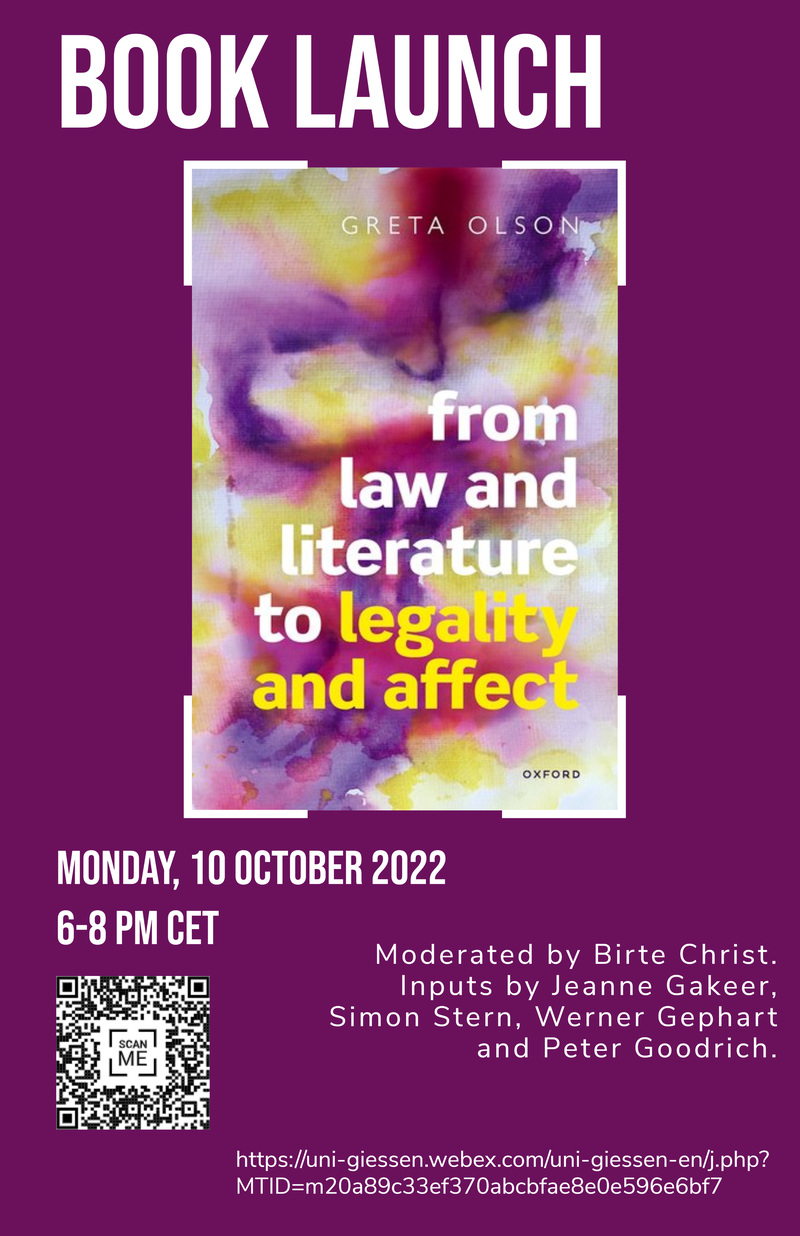
From Law and Literature to Legality and Affect argues for the continued vitality of Law and Literature. Traditional methods of Law and Literature are combined with work in critical media studies, affect, and cultural narratology to address topics such as ethnonationalism, anti-immigration sentiment, and systemic racism in Germany and the United States. Taking stock of the diversification of the field at fifty years, this book understands Law and Literature as a political project. It has a precedent in inaugural Law and Literature texts such as Jacob Grimm's "Von der Poesie im Recht" (On the Poetry in Law) from 1815/16, which imagined an alternative legal order that was grounded in the unity of law, poetic language, and feeling. The political thrust of Law and Literature continues up into the present in the arts of BlackLivesMatter, which document and resist police violence. Law and Literature offers keys for understanding how legal texts and identities are constructed, and for comprehending how cultural-legal issues are mediated affectively. Using cultural, medial, affect theoretical, and narrative analyses of law, a revitalized Law and Literature offers a set of methods and theories with which to address the most pressing issues of the present.
Join via the following link: https://uni-giessen.webex.com/uni-giessen-en/j.php?MTID=m20a89c33ef370abcbfae8e0e596e6bf7
or Webinar number 2734 594 3859 & password: ygNsY2uSP67
If you have any issues while logging in, please contact Melanie.Kreitler
The book launch will feature inputs by Jeanne Gaakeer, Professor of Jurisprudence at Erasmus School of Law (Rotterdam) and Senior Justice in the Court of Appeal, The Hague;
Simon Stern, Professor of Law and English, Chair in Innovation Law (Toronto) and Co-Editor of the Oxford University Press Law and Literature series;
Werner Gephart, Professor of Legal Sociology and Founding Director of the Käte Hamburger Center for Advanced Study "Law as Culture" (Bonn); and
Peter Goodrich, Professor of Law and Director of the Program in Law and Humanities, Cardoza Law School (New York) and Visiting Professor in the School of Social Science at New York University Abu Dhabi (United Arab Emirates).
The launch will be moderated by Birte Christ, Substitute Professor for English and American Literature (Giessen) and author of a book on representations of the American death penalty in film and television (under review) and co-editor, with Stefanie Mueller, of a special issue of Amerikatustudien on Poetry and Law.
Call for Papers for a Special Issue of the journal Zeitschrift für Anglistik und Amerikanistik (ZAA)
The Aesthetics and Politics of Psychotherapy:
Literary, Cultural, and Media Perspectives on ‘Healing the Soul’
Editor: Joanna Rostek (University of Giessen, Germany)
This special issue of the ZAA: A Quarterly of Language, Literature and Culture will explore the aesthetics and politics of psychotherapy from the point of view of Anglophone literary, cultural, and media studies. In particular, we seek contributions that fall into at least one of the following three strands:
- Investigating points of convergence between psychotherapy on the one hand and literary, cultural, and media studies on the other.
- Analyses of fictional representations of the psychotherapeutic process (in novels, films, series, plays, etc.).
- Analyses of non- and semi-fictional insights into the psychotherapeutic process created by (former) psychotherapists or patients (memoirs, podcasts etc.).
As Christine Lister-Ford states in her Short Introduction to Psychotherapy, “[s]ince the earliest recording of human culture there has been evidence of human mental and emotional distress and also ways to explain and alleviate it” (11). Literary and cultural texts, due to their capacity to verbalise and label complex interior states, provide a unique psychological archive. But they do not merely record: precisely because they translate emotions into words and images and arrange them into patterns, they arguably perform similar work to that involved in conversation-based psychotherapy. In the words of novelist and psychotherapist Lisa Williamson Rosenberg: “What ties my therapist-self to my writer-self is the ability to translate emotion into words.” One could also claim that literary and cultural scholars decoding meanings and structures and ‘containing’ them through academic language perform a type of work comparable to that of psychotherapists. Contemporary psychologists and psychotherapists are open to the idea that literary and cultural texts can play a role in the process of ‘healing the soul’. Bibliotherapy, as the website Psychology Today explains, “is a therapeutic approach employing books and other forms of literature, typically alongside more traditional therapy modalities, to support a patient’s mental health”. Watching films can apparently have similar effects: “cinema therapy”, as psychotherapist Bruce Kircaldy explains, “refers to using movies to help address issues of psychological and mental well-being” (5).
From Philip Roth’s Portnoy’s Complaint (1969) and David Lodge’s Therapy (1995) to The Sopranos (1999-2007) and In Treatment (2008-2021), psychotherapy has been represented in a considerable number of novels, poems, plays, films, and TV series (Anghelescu et al.; Furst; Hotz-Davies & Kirchhofer; Thurston; Wassmann). Some of this work has been produced by therapist-novelists, e.g. Irvin D. Yalom, Salley Vickers, and Bev Thomas. Depictions of psychotherapy have been used for various aesthetic and political purposes. Placing a character in the role of a patient in a psychotherapeutic setting can, for instance, legitimise the inclusion of potentially tabooed topics, harness readers’ voyeurism and attention, create sympathy for a flawed and/or vulnerable protagonist, question normative discourses, or establish narrative unreliability. The power dynamics between psychotherapist and patient are amenable to setting up suspense, while representing the intimacy of the consulting room enables the creation of discrepant awareness, which perhaps explains why psychotherapy seems to feature regularly in thriller and crime genres.
Finally, psychotherapists themselves have been producing popular non-fictional or semi-fictional texts that give insight into their profession and thought. A classic in this regard is Man’s Search for Meaning (1946) by Viktor Franckl. More recent best-sellers include Stephen Grosz’s An Examined Life (2014), Philippa Perry’s The Book You Wish Your Parents Had Read (2019), and Lori Gottlieb’s Maybe You Should Talk to Someone (2019). Therapeutic podcasts have likewise mushroomed over the past decade: Esther Perel’s Where Should We Begin, Lori Gottlieb and Guy Winch’s Dear Therapists, or Gill Straker, Rachael Burton, and Andrew Geeves’s Three Associating provide glimpses into psychotherapy ‘in action’, while at the same time raising interesting questions regarding privacy, exposure, and audience interaction in the context of digital media.
This special issue therefore puts its focus not on mental ill health per se, but on the aesthetics and politics of the psychotherapeutic process. Historical approaches, comparative UK-US perspectives as well as transdisciplinary collaborations between literary, cultural, and media scholars and psychologists or psychotherapists are welcome.
Papers may address, but are not limited to, the following topics within the three strands named above:
- theoretical approaches to overlaps between psychotherapy and literature, culture, and media
- shared patterns of communication in psychotherapy and literature
- reading and interpreting texts and/as and psychotherapy
- the cultural imaginary of psychotherapy in novels, films, series, plays, etc.
- psychotherapy and genre (e.g. autofiction, memoirs, thrillers, crime series)
- narratological affordances of psychotherapy
- psychotherapy and discourses of healing and/or self-care
- psychotherapy, voyeurism, and secrecy
- psychotherapy and/in digital culture
- psychotherapy and self-help culture
Please send an abstract of c. 300 words and a short bio profile to Joanna Rostek by 15 March 2023. Authors will be informed in the course of March whether their submission has been accepted. Articles (c. 5,000 words) will be due by 15 September 2023, to allow time for the peer-review process. The special issue is scheduled to appear in 2024.
Bibliography
Anghelescu, Ion-George, Franziska Liedtke, and Georgia Wendling-Platz. “Wie wird Psychotherapie in Filmen und Serien dargestellt?”. DNP – Der Neurologe & Psychiater 23 (2022): 36-41. “Bibliotherapy.” Psychology Today. 9 August 2022. Web. [29/11/22]
Furst, Lilian R. Just Talk: Narratives of Psychotherapy, Lexington: UP of Kentucky, 1999.
Hotz-Davies, Ingrid and Anton Kirchhofer, eds. Psychoanalytic-ism: Uses of Psychoanalysis in Novels, Poems, Plays, and Films. Trier: WVT, 2000.
Kircaldy, Bruce, ed. Psychotherapy, Literature and the Visual and Performing Arts. Cham: Springer, 2018.
Lister-Ford, Christine, ed. A Short Introduction to Psychotherapy. London: SAGE, 2007. Print.
McLeod, John. Narrative and Psychotherapy. London: SAGE, 1998.
Thurston, Michael. “Psychotherapy and Confessional Poetry.” The Cambridge Companion to Modern American Poetry, ed. Walter Kalaidjian, Cambridge: Cambridge UP, 2015, 143–154.
Wassmann, Claudia, ed. Therapy and Emotions in Film and Television. London: Palgrave Macmillan, 2015.
Williamson Rosenberg, Lisa. “To Write Fiction with a Psychotherapist’s Mind”. Literary Hub. 1 August 2022. Web. [29/11/22]