The Relationship Between Biophysical Skin Properties, Tactile Ability, and the Distance Adaptation-Aftereffecthttps://www.uni-giessen.de/de/fbz/fb06/psychologie/abt/allgemeine-psychologie/arbeitsgruppen/haptics/publications/2025/2025-9https://www.uni-giessen.de/@@site-logo/logo.png
Inhaltspezifische Aktionen
The Relationship Between Biophysical Skin Properties, Tactile Ability, and the Distance Adaptation-Aftereffect
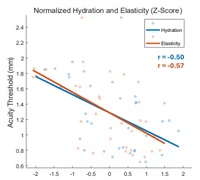
Interindividual differences in biophysical properties such as skin hydration and elasticity have been demonstrated to play a critical role in influencing various aspects of tactile perception. Here, we assess their role for interindividual variation of basic tactile abilities and the tactile distance adaptation aftereffect in a young adult sample. Tactile abilities were defined by tactile sensitivity in a monofilament detection task and spatial acuity in a grating orientation task. In the distance aftereffect, when a body area is repeatedly touched at two points separated by a given distance, subsequently presented smaller distances are perceived as smaller than on unadapted areas. Aftereffect magnitude describes the perceptual shift in a distance discrimination task following adaptation. We examine whether differences in skin hydration and elasticity at the finger pad are related to tactile abilities which in turn affect the magnitude of distance aftereffects. Results revealed that higher hydration and elasticity were related to increased tactile sensitivity and spatial acuity, but magnitude of distance aftereffects was independent from both skin properties and tactile abilities. While these results reemphasize the importance of healthy skin for tactile perception, they suggest individual differences in the magnitude of the distance aftereffect to be independent from peripheral skin properties. M. Jeschke, E. Azañón and K. Drewing, "The Relationship Between Biophysical Skin Properties, Tactile Ability, and the Distance Adaptation-Aftereffect," 2025 IEEE World Haptics Conference (WHC), Suwon, Korea, Republic of, 2025, pp. 115-122. https://doi.org/10.1109/WHC64065.2025.11123197