Aktuelles / Home
AG QuantenNanoPhotonik - virtual-reality- und künstliche-Intelligenz-verstärkt: Startseite

Mitteilungen / Posts:
(in Bearbeitung / to be updated)
August 2026:
AG QNPi Physiker untersuchen „selbstentwickelnde” Algorithmen für das Design komplexer optischer Nanostrukturen – Evolution ressourceneffizienter künstlicher Neuronennetze (https://www.uni-giessen.de/de/ueber-uns/pressestelle/pm/pm112-26kinachvorbilddernatur).

Wie wir von SML (Self-Mode-Locking Laser) zu sML (smart Machine Learning) kamen und QNP mit cAI (clever AI) sowie digitalem Bildungswesen verknüpften, verdeutlicht die rechte Seite dieser Momentaufnahme mit Postern zum Abschluss unseres „Straße der Experimente 2026” Beitrags. Die Linke Seite fasst unseren www.LaserLab-VR.de qnpi Gamification-Ansatz zusammen. Was wir von unserem Gamescom Congress 2026 Besuch für unsere Lehrforschung mitnehmen, auch Thema unserer Posts auf Social Media Kanälen (externe Links) @rahimiiman_lab mit KI bzw. VR & Physik Avatare a1_r1 und dr_vr.

Youtube und Social Media Channels @rahimiiman_lab explaining AI & Physics as well as VR & Physics with the help of digital twins. Our qnpi-group support avatars a1_r1 and dr_vr want present you short science and teaching videos about selected topics from our team´s actual and virtual reality world. With in-game VR footage from a solar eclipse on time for the real-life total eclipse August 12th seen in northern Spain, avatar dr_vr delivered the summaries in German and Spanish language this time - see for instance ext. link: https://www.youtube.com/@rahimiiman_lab/playlists
Nachtrag zu den Juli 2026 Posts: Zuvor lag unser Augenmerk darauf, wie andere Gruppen weltweit für die Licht-Materie-Forschung maßgeschneiderte optische Bauelemente mittels präziser Nanostrukturen zu entwickeln. Mit der Zeit wurde es stattdessen unser Ziel, mit Hilfe der Prinzipien maschinellen Lernens passende, ressourcenschonende und gleichzeitig akkurate KI-Methoden zu entwickeln, die für solche wissenschaftlichen und technologischen Aufgaben effektiv nutzbar sind. Nach dem Vorbild der Natur „züchtete“ das von uns erforschte KI-System mithilfe des sogenannten NEAT-Algorithmus (NeuroEvolution of Augmenting Topologies) eine besonders kompakte und gleichzeitig wirksame Neuronennetz-Architektur für unsere Aufgabe. Das Ergebnis der „NeuroEvolution“ kombiniert mit unserer feedbackorientierten Lernstrategie für das zu trainierende KI-Modell lässt sich sehen: https://doi.org/10.1002/aisy.70468

Amendment to the July 2026 posts: Our qnpi group with previously updated emblem celebrates two years of effective and immersive gamification in physics teaching. Our VR- and AI-enhanced activities are entering their third epoch, where we apply self-made VR learning environments and immersive minigames to support physics education, combining elements and themes from our physics, data science and machine learning studies. Because innovation pairs with curiosity, just as learning pairs with creating. That, too, is what our group name stands for. / Zweijähriges Jubiläum des aktuellen Team Logos zu AG QuantenNanoPhotonik, V.R. & K.I. Mit virtueller Realität vermittelten, verspielten Lernwelten und selbst erstellten immersiven Minigames stärken wir die Physiklehre für Jung und Alt, Klein und Groß. Dabei kombinieren wir Themen und Elemente unserer Physikforschung, Datenverarbeitung und KI-Anwendung miteinander. Denn Lernen und Kreieren gehen Hand in Hand, Wissenschaft und Lehre ebenso – auch dafür steht unser Gruppenname. Einen Blick in die LaserLabVR-Welt gibt es hier (Link).
Amendment to the July 2026 posts: Welcoming new team member dedicated to our VR-based immersive learning studies as part of an education project in our qnpi group. / Im Rahmen des Heisenberg-Projekts widmet sich die AG QuantenNanoPhotonik, Virtual Reality und Künstliche Intelligenz der Integration von VR und KI-Technologien in moderne Lehrformate. Wir arbeiten an der Weiterentwicklung unseres "Konzepte- & Kreativitätslabors" hin zu neuen Methoden und virtuellen Lernwelten für die Physikdidaktik und die Schullehre. Erfahrene Hilfskraft kurzfristig gesucht und gefunden – wir freuen uns auf den Teamzuwachs.

Amendment to the July 2026 posts: With the present half of our shining class displayed, our SPECTR026 thermal group photo can get quasi completed by data augmentation (a concept well known from machine learning, like adding artificial contents using symmetries – here applied to human artwork created without AI help). Our course again concluded with exciting seminar talks given by the students, and qnpi-based VR- and AI-enhanced content. Further impressions: https://lnkd.in/p/ebjain3q (ext. Link).
Juli 2026:
Achievement unlocked: "Work Life²: Balance".
(Busy month)
Juni 2026:
Invited talk at the META2026 conference: "Machine Learning Optimization of Chiral Photonic Metasurface with Neural Network Pipeline and Evolutionary Strategies". Head of the qnpi research group Dr. Rahimi-Iman looks forward to presenting at the special symposium on "SYM6: Advanced Techniques for Computational Electromagnetics" organized by French Colleague Dr. M. Ben Rhouma during this premier metamaterials meeting, this year taking place in Ireland: To improve the design and performance of photonic metasurfaces with chiral reflection, we demonstrate an optimization framework that integrates deep learning with genetic algorithms. Our refined pipelines employ neural networks and evolutionary strategies to better balance chiral dichroism and reflectivity toward fast design exploration and high-performance results with hybrid methods.
Visualizing the vacuum: fluctuations – or "half empty modes" – and their impact on noticeable physics; not an obvious case. Light–matter interactions (energy exchanges) become an immersive learning experience. Virtual particles visualized and vacuum fluctuations imagined in UnrealEngine5 qnpi group's LaserLabVR – exploring the virtually unimaginable in immersive mode. Before, shiny laser modes and emitter particles in a virtual frequency comb spectroscopy experiment imagined, too.
Not shown here: Level 1 – the awesome laser alignment training parcours in VR, virtually labeled "Laser hazard course" by our team. Next stop is the "Anomalous materials spectroscopy labs" of our digital learning facilities. Our team may be hiring soon: assistant VR coach. Team coach: Dr. Rahimi-Iman – assigned and preparing for unforeseen teaching challenges!
Impressions shared with a photo from a virtual-reality mode symposium talk in Frankfurt from 2025.

Lecturing achievement: "Invisible essential(ly) made tangible – with VR."
In press article: "A NEAT Approach to Evolving Neural-Network-Based Optimization of Chiral Photonic Metasurfaces: Application of a NeuroEvolution-of-Augmenting-Topologies Pipeline". The data generated through the use of the chiral metasurface machine-learning optimization framework for this scientific paper is shared via ext. link to our Zenodo 2026 dataset publication https://zenodo.org/records/19667817. Preprint of the article available on arXiv (ext. link https://doi.org/10.48550/arXiv.2512.13656).
Almost true to the claim "in virtual space, no one can see you try – unless screen-sharing on", jokingly speaking about the LaserLabVR minigame demonstration recently. "In contrast to deep space, your weight still makes a difference in low earth orbit – use it skillfully and master the qnpi group virtual-reality minigame challenge; and the laser beam colors matter, too". And, we said "be faster than 2 min!" to our participants – now, beat it: 00:58:21 seconds, a "world record" so to say, achieved on May 31st, 2026, by one of our three young champions in Giessen; congratulations! They basically qualified to become future masters of laser tech – and virtual reality, too (the parents were proudly watching, cheer-leading excitedly till the last millisecond).
The level? A playful blend of different physics themes ranging from the cosmos to the nano cosmos: 2 minutes not enough to explore deep space or the quantum photonics world mimicked in VR, the game's creator and group leader Dr. Arash Rahimi-Iman confidently affirms. But, good to level up in VR early on, get immersed into our virtual lab environment!
If you have the chance, and nobody else in the queue, maybe you can dive in, and tackle our team's light–matter puzzles.
LaserLabVR minigame a success story at Straße der Experimente 2026 event in Giessen (also see our post on https://www.instagram.com/rahimiiman_lab/). / LaserLabVR Minigame bei der Straße der Experimente 2026 in Giessen erfolgreich zum Einsatz gekommen, Siegerehrung junger Rekordhalter inklusive (ext. Link zu LinkedIn Post).

Welcoming new team member from the physics space application Master's program „Physik und Technologie für Raumfahrtanwendungen” on an education project in our qnpi group. / Das Projekt "AI in Teaching & Learning" am Fachbereich 07 widmet sich der Integration von KI-Technologien in moderne Lehrformate. Wir arbeiten in der AG QuantenNanoPhotonik, Virtual Reality und Künstliche Intelligenz an der Weiterentwicklung unseres "KI-Konzepte & Kreativitätslabors" hin zu neuen Lehrmitteln für Photonik-KI-Labs in Studiengängen des Fachbereichs. Hierzu haben wir auch Teamzuwachs, worüber wir uns freuen.
Mai 2026:
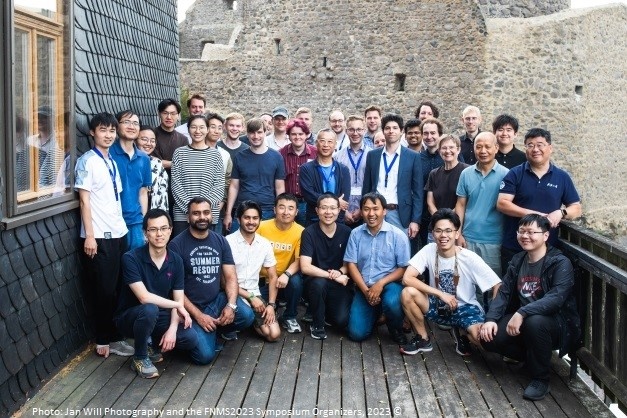
Celebrating past and future collaborative research and teaching enhanced by our Sino-German Cooperation Group on Functional Nano-Materials Science (FNMS-COOP): What was seeded a decade ago at the Philipps-Universität Marburg and Zhejiang University in Hangzhou, based on experience, trust and mutual interests, was successfully concluded at the Justus-Liebig-Universität Giessen this year.
An exciting, memorable and rewarding academic cooperation project, including partners from Goethe-Universität Frankfurt, Hefei, Beijing and Baoding, was carried out since 2020 with the generous support from the Sino-German Center for Research Promotion (CDZ, Chinesisch-Deutsches Zentrum für Wissenschaftsförderung, involving Deutsche Forschungsgemeinschaft (DFG) - German Research Foundation).
Its foundation: A first binational Symposium in 2018 (ext. link), university courses jointly taught (ext. link), academic exchange with students and group leaders involved.
5 years ago, co-chairs Prof. Wu and Groupleader Rahimi-Iman looked forward to their next jointly organized symposium, the 2nd Sino-German FNMS Symposium in 2023 at JLU Gießen (ext. link).
Extended post on LinkedIn or Instagram (ext. Links).
AG QuantenNanoPhotonik, Virtual Reality und Künstliche Intelligenz mit dabei bei der Straße der Experimente 2026 (ext. Link zum Flyer), dem 20-jährigen Jubiläum der vom Mathematikum und der Gießen Marketing GmbH (ext. Links) etablierten öffentlichen Stadtveranstaltung zu Wissenschaftsthemen für Jung und Alt, Groß und Klein – mit virtuellem qnpi-Spielball die Laserlab VR Challenge meistern macht die Teilnahme unserer Arbeitsgruppe an dem Jubiläumsevent sprichwörtlich zu einer runden Sache! / Exploring VR gamification with our laserlab VR with levels inspired by lectures and research. A VR experience for young and old is provided during this years Strasse der Experimente 2026 in Giessen (ext. Link). Visit us on May 31st at qnpi group’s tent at the public event organized by Giessen’s Mathematikum and City Marketing as annual science outreach. Play our lab’s exciting and amazing virtual challenge with quantum and classical physics at the core of interactions in spacy and space-like worlds.

Achievement unlocked: “qnpi gaming – learn, like a |BOT>!”
13 years ago, 2013, the first demonstration of an electrically-driven polariton laser got published. This year, our latest polariton project was concluded. Good things come in threes: in this gamification era of our group’s science activities, we go beyond mere discovery mode via classic spectroscopy in our two-year old concepts and creativity space in room 313 d, but explore machine-learning techniques for future polaritonics-enabling research and delve into virtual worlds with laser beams, (quasi-)particles and data-science inspired landscapes. After so many years, it became time to create a polariton-inspired VR world for immersive teaching and training purposes.

Achievement unlocked: “VR labs – it’s in the game!"
Leiter der AG QNPi eine weitere Amtszeit des DPG AKPIK Vorstands weiter als Vorsitzender ehrenamtlich tätig. Eine besondere Ehre erneut zuteil geworden. Ein kompakter Einblick in die Welt der KI und Physik wurde während einer der kürzlichen DPG Events von Sprecher des AKPIK, Arash Rahimi-Iman, hier geteilt: https://www.youtube.com/shorts/7Nv-iBdBTTo (ext. Social Media Link).
April 2026:
In press with Advanced Physics Research: “Advancing Machine Learning Optimization of Chiral Photonic Metasurface: Comparative Study of Neural Network and Genetic Algorithm Approaches” (DOI/ext. Link to openAccess paper: https://doi.org/10.1002/apxr.202500223). The dataset generated through the use of the chiral metasurface machine-learning optimization framework for this scientific paper is shared via ext. link to our Zenodo 2026 publication https://zenodo.org/records/19667817. Preprint of the article available on arXiv (ext. link https://doi.org/10.48550/arXiv.2512.13656).
2 Jahre Concepts & Creativity Room der AG Rahimi-Iman – eine erfolgreiche Transformation zu mehr IT-gestützter Erforschung von innovativen Methoden für die eigene Forschung und Lehre. / 2 years anniversary of the qnpi-group’s Concepts & Creativity Room: Machine learning and virtual reality topics explored with students of our team, and new datacentric research and digital teaching activities triggered for the own transformation to an AI and VR group.

Achievement unlocked: “VR an´ AI team”
Vor 5 Jahren an der Uni Marburg sich habilitiert (Semiconductor Photonics of Nanomaterials and Quantum Structures, Springer Nature, 2021, ext. Link), vor 17 Jahren an der Uni Würzburg Spektroskopie an Einzelphotonenemittern gemeistert, letztes Jahr eine Machine-Learning and Virtual Reality-enhanced Vorlesung angeboten – Gruppenleiter Rahimi-Iman aktuell mit V.R. Gamificationzielen der AG zu QuantenNanoPhotonik für die Lehre befasst.
JLU HackyHour 2026 (ext. Link) im MaGie – MakerSpace Gießen beginnt dieses Sommersemester mit einem Vortrag zu VR Gamification: "Virtual Reality Gamification for Photonics, AI and More - Powered by Unreal Engine".
Weiterer DPG AKPIK Netzwerkabend (ext. Link) zum Thema Quantencomputing gemeinsam mit vortragenden Onlinegästen Regina Finsterhölzl von Quantinuum und Nikola Strah von Classiq veranstaltet. AG QNPi Gruppenleiter freut sich über die positive Resonanz zum Veranstaltungsformat und plant im AKPIK Vorstandsteam weitere Events dieser Art.
Study physics or related subjects and apply methods of AI, such as machine learning, to your future science projects. Enrolled in a Masters program at JLU? Summer term started, SPECTRO26 course, too! / Das Sommersemester beginnt und mit dabei ist dieses Jahr eine besondere Variante der Spektroskopievorlesung, die die theoretische und experimentelle Sichtweisen auf die Materie stark miteinander koppelt und auch Aspekte des Maschinellen Lernens und Virtual Reality Elemente mit Inhalten zu lichtgestützten Experimenten vereint (Links: Course and Seminar „Spektroskopie - Von der Theorie bis zur Anwendung und Virtual Reality Gamification“).
März 2026:
DPG Arbeitskreis AKPIK (ext. Link) erneut auf zwei DPG Frühjahrstagungen vertreten, diesmal in Dresden und Erlangen (SKM bzw. SMuK). Mit dabei die AG QNPi aus Gießen mit Vortrag (VR-Gamification) und Poster (Actual-Reality-Interaktion) zu Virtual Reality Gamification for Photonics, AI and More bzw. Advancing Machine Learning Optimization of Chiral Photonic Metasurface: Comparative Study of Neural Network and Genetic Algorithm Approaches (externe Links zu https://www.dpg-verhandlungen.de Veranstaltungsprogrammseiten der SKM Frühjahrstagung Dresden).
Februar 2026:
Data science and analytics studying projects concluded successfully by qnpi team members - on ai-assisted sensor analysis and data visualization.
DPG AKPIK Netzwerkabend (ext. Link) zum Thema Quantencomputing-Software gemeinsam mit vortragendem Onlinegast Michael Fellner von partity QC veranstaltet. AG QNPi Gruppenleiter freut sich über die rege Teilnahme und plant im AKPIK Vorstandsteam bereits nachfolgende Abendvorträge im kommenden Sommersemester.
Januar 2026:
Rahimi-Iman group setting up exploration spaces “AI Concepts & Creativity Labs – Photonics AI Laboratories”, aiming to deliver hands-on lab experiments and machine learning with photonics hardware at JLU Giessen. With its own subproject as a member of a 2026 launched Hessenhub project “Teaching AI@FB07 - CampusLab for innovative Teaching” at Fachbereich 07 of our university, the qnpi group expands the idea of its 2024 established “Concepts and Creativity Room” towards JLU education spaces and training environments with AI focus for BSc and MSc students at the department of physics. Additionally, its group leader is exploring a flipped classroom approach, virtual-reality gamification and the extension of the own group´s playground for innovation.
Achievement unlocked: “Path to AI-driven qnpi labs”.
One year anniversary of our qnpi eSports team |BOT>. Last year, we launched our VR edition of our team eSports activity as well, enhancing and inspiring qnpi-group´s VR gamification in research and teaching.
Sharing the beauty of (intended and unintended) 3d printing results. More than five years ago, we started designing and devoping photonic mirrors made of plastics. Sometimes, the most impressive designs are the unplanned ones, and the best ones usually hidden from us. In the era of machine learning optimization, automation will bring labs closer to practical structures with high performance. Until then, continuing to show human-made fabrication, because it is not only science, but also art.

Dezember 2025:
Vor zwölf Jahren die eigene Promotion abgeschlossen und veröffentlicht (ext. Link zur Cuvillier-Verlag Seite), gratuliert Gruppenleiter der AG Rahimi-Iman mit großer Freude einem ehemaligem Teammitglied diesen Monat zur preisgekrönten kollaborativen Forschung (ext. Link zur pgzb.de Seite) über nanometer-dünne 2D-Materialstapel und "gechirpte" optische Mikrokavitäten an der TU Berlin; ebenso auch allen anderen Teammitgliedern, die über die letzten zwölf Jahre so zahlreich und erfolgreich ihre Abschlussarbeiten verfassten.
Erneut bringt ein DFG-Heisenberg Vernetzungstreffen (ext. Link zur dfg.de Seite) zahlreiche Heisenberg Gruppenleiterinnen und -Leiter in Bonn zusammen.
DPG AKPIK Netzwerkabend zu Quantencomputer-Software (ext. Link zur dpg-physik.de Seite) geplant für den 11. Dezember.
Auszeichnung für innovative und verantwortungsbewusste Nutzung künstlicher Intelligenz in der Hochschullehre - HessenHub-Netzwerk würdigt Modul SPECTRO25 mit JLU Förderpreis
Gruppenleiter der AG QNPi mit Förderpreis gewürdigt: nicht für den preisverdächtigen Nachweis zum ersten Polariton-Laser von damals, sondern für Lehrkonzepte für die Zukunft – die digitale Transformation in der Hochschullehre unterstützend. Erstmals an der JLU ausgezeichnet wurden die Durchführung von Lehr-/Lernszenarien, die KI innovativ, verantwortungsbewusst und lernwirksam in die eigene Vorlesung integriert haben. Auch lobend hervorgehoben zu Modul „SPECTRO25 – Machine-Learning and Virtual-Reality Enhanced Spectroscopy“ durch die Jury: „Die innovative Kombination mit Virtual-Reality-Elementen stärkt zusätzlich das immersive, interaktive Lernen.“
Experiencing quantum nano-photonics better over time: Glowing “particles” in the dark recorded with infrared cam, a.k.a. thermal viewer, during 2025`s end-of-the-year team activity with highly quantum theme. Our laser taggers got excited when beaming coherent light deterministically across the room. They emitted streams of photons into their surroundings invisible to their eyes. A collection of those was detected by the thermal viewer’s semiconductor chip – yet no ghost imaging applied so far. The dedicated qnpi|BOT> event picture: a false-color heat map of the team like in 2024.

Infrared measurement 2025 team achievement unlocked: "|BOT>² – ‘Team (Infra)Red’, too."
Gastbeitrag im JLU Seminar „Führungsimpuls III: Altes Wir mit neuen Tools - Wie Zusammenarbeit 2.0 gelingt“ aus der AG Rahimi-Iman.
Amendment to the Nov. 2025 posts: KI in der Lehre und VR Gamification der AG QNPi beim Event „Neue Wege mit KI“ der Uni Gießen als eine von sieben Perspektiven auf KI an der JLU kurz präsentiert.
...Countdown läuft zu weiteren neuen Wegen mit KI und VR.
Amendment to the Nov. 2025 posts: Welcoming new team members from the Master's programs Data Science and Data Analytics.
Amendment to the November 2025 posts: qnpi group’s work “Machine Learning Optimization of Chiral Photonic Metasurface: Evolution-based Algorithm and Deep Learning Approach” highlighted at PIERS Chiba 2025 in FocusSession.SC1 on Specific Approaches in Computational Electromagnetics as Applied to Modern Nanphotonics. Additionally, our group presented “Neural-network-based Optical Temperature Sensing of Semiconductor Membrane External Cavity Laser” in our co-organized session on Machine Learning for Photonics Applications – a successful meeting space in Japan, which also hosted a talk by our FNMS-COOP partners of the Wei-Fang group at the ZJU, China, on “Deep Learning-based Noninvasive Characterization of Optical Micro/Nanofibers”.
November 2025:
Achievement unlocked: "Updates pending".
(Busy month)
Oktober 2025:
Die AG Rahimi-Iman gratuliert ihrem Teammitglied zum erfolgreichen Abschluss seiner Machine-Learning in Nanophotonics Forschungsarbeit, hier im Bild mit VR Headset beim Team-eSports Match gezeigt. / We say Herzlichen Glückwunsch to our successful qnpi-group student – and eSports |BOT> team member – shown in this picture here with glasses on in a VR match with his project supervisor! Time to celebrate joint achievements and his completed thesis in the Rahimi-Iman group! By the way, did he choose that chiral pattern on his T-shirt deliberately? Else, what a funny coincidence!

Team achievements: “VR sports unlocked”, “BOT trainer”, “Master defended”.
Interesse an Quantennanophotonik gepaart mit KI-Tools und VR-Gamification? Eine prima Zeit, ein Studium mit Physik- oder IT-Bezug an der JLU Gießen anzugehen und den Weg in die Quantenwelt bzw. zu modernen Informationstechnologien zu ebnen (https://www.uni-giessen.de/de/fbz/fb07).
Septemer 2025:
Vor 25 Jahren erste eigene IT Kurse mit Spaß am Thema und Freude an der Wissensvermittlung an der Volkshochschule Gießen doziert: Animierte, künstlerische und programmierte Inhalte von heute und damals vor Augen, schließt sich mit der Verknüpfung von Physik, IT und VR-Gamification ein großer Kreis für AG QNPi Gruppenleiter Rahimi-Iman.

Spectaris GmbH, fachlich durch das Fraunhofer ILT und des Bundesverbands BITMi unterstützt, lädt ein zur Tagung „Künstliche Intelligenz in der Photonik – Mehr Wertschöpfung in Laserfertigungstechnik und Optikdesign“. Mit dabei die AG QNPi mit dem Vortrag „Evolution- und neuronennetz-gestützte Optimierung: Einblicke und Perspektiven zum Metaoberfl ächendesign“ in Berlin (ext. Link zum Programm: https://www.spectaris.de/fileadmin/user_upload/Agenda_KI-in-der-Photonik_20250923.pdf ).
Many renowned scholars and science enthusiasts from all over Germany, and beyond, who had the time, interest and privilege, gathered together in Göttingen to talk "Quantum - 100 Years" in a memorable setting. Dwelling in the footsteps of Heisenberg, his European colleagues and worldwide peers and touching upon quantum physics history and frontiers, many could refresh their fascination for physics topics and perhaps feel humbled by remaining mysteries of our physical realm unfolding dynamically in front of us, for instance during such great DPG Herbsttagung. (ext. Link: https://quantum25.dpg-tagungen.de/)

Für die, die mehr über Quantencomputing erfahren wollen: DPG Event “Fit4QuantumComputing” in Bad Honnef bringt interessierte Teilnehmerinnen und Teilnehmern aus ganz Deutschland zusammen; eine Freude, das DPG Akademie Seminar mitgestalten zu können und dabei gewesen zu sein. / An amazing DPG Akademie seminar "Fit4QuantumComputing" bringing together students, scholars, teachers and industry to familiarize themselves with the latest achievements and the overall developments, this September. Perfect mix of mainly non-academic pool of participants and topics - and well timed seminar! Our qnpi-group enjoys being part of it, both, in the role of the co-organizer via DPG AKPIK and as attendees! (ext. Link: https://www.quantum2025.de/veranstaltungen/fit4quantumcomputing-von-den-grundlagen-bis-zur-anwendung-in-der-berufswelt)
August 2025:
Über ein Jahr Gamification in der AG Rahimi-Iman im Bereich QuantenNanoPhotonik mit Virtual Reality und UnrealEngine5 Inhalten. Eines der Highlights: Teilnehmende der Spektroskopievorlesung für VR Training und Lehre begeistert, wie an diesem Studentenbeitrag zu „Holografie in VR“ besonders gut ersichtlich. / More than a year of gamification in the Rahimi-Iman group with VR and UE5 contents in the field of photonics. In this context, VR-enhanced spectroscopy course accomplished this summer term, with one of the highlights shown here: participants inspired by VR training and learning materials, as evidenced for instance when student presented his own VR creation on “virtual holography”.

Juli 2025:
Hier ist unser neues Logo der Arbeitsgruppe QuantenNanoPhotonik, V.R. & K.I. (qnpi-group). / Please find our updated group logo on the qnpi-group’s webpages. 
Team achievement unlocked: “Yes V.R.! Class-Room Selfie” staged during our Spectroscopy lecture. Special thanks to NIDIT @ JLU Giessen for the supply of additional glasses to the qnpi-group.

Eine kurze Themenvorstellung: Virtual Reality (VR) Gamification – ein spannender Bestandteil moderner Lehre. Für Jung und Alt eine neue Möglichkeit, in virtuellen spieleartigen Umgebungen sich für wissenschaftliche Themen zu begeistern und diese auch neugierig sowie aktiv zu erforschen. Das immersive Lernen eröffnet einen anderen Zugang zu im gewöhnlichen Klassenraum diskutierten Fragestellungen. Diesen Ansatz erproben wir in eigenen VR-unterstützten Vorlesungen. Die universitäre Lehre ist hier durch selbstgestaltete VR Welten bereichert. Diese sind ähnlich wie Level in Computerspielen mit Rätseln oder Visualisierungsmaterial bestückt, zeigen Teilchen, Strahlen und vieles mehr, erschaffen auf Basis starker Programme wie der Unreal Engine und per VR Brille sichtbar gemacht.
A qnpi-group topic at a glance: Virtual Reality Gamification can excite learners of different ages to look at or to deal with science topics in virtual game-like exploration spaces. The „immersive“ experience promises a different approach to ordinary class-room teaching, which we explore in own VR-enhanced lectures in Giessen. Here, university-level education is supported by self-designed VR environments. These are like “game levels”, likewise equipped with riddles or visualizing materials, show particles, beams and more, created on the basis of powerful software tools like the Unreal Engine and displayed to the user via VR glasses.
Amendment to the May 2025 posts: Successful PhD thesis talk of an FNMS-COOP group’s student at the Zhejiang University experienced pleasantly, which highlighted her significant works on THz photonics involving machine learning techniques. After this outstanding graduation colloquial, works from the qnpi-group were presented for discussion with ZJU colleagues on “Towards Chiral Light-Matter Interaction with Machine-Learning-Optimized Nano-Photonic Metasurface” during a School of Physics Seminar, Zhejiang University, China.
Juni 2025
Progress on collaboratively AI-enhanced optical nanostructure design shared via seminar talk on “Machine Learning Optimization of Chiral Photonic Metasurface: Evolution-based Algorithm and Deep Learning Approach” at the Mathematics Institute of the University of Namur, Belgium.
Farewell visiting students of the FNMS-COOP group members.
Achievement unlocked: “VR shower” - frequent virtual environment presenter, both at conferences and in lectures.
Get-together of alumni and research partners of the Rahimi-Iman group.
“Functional Nanomaterials Science, AI and Photonics Education Supported by Virtual Reality Gamification” presented by qnpi group leader at FNMS-2025 in Frankfurt with the help of UE5 engine.

FNMS-2025 – Frankfurt, Mainz and Beyond – a major event for all FNMS-COOP members and friends. With invited presentations about quantum technologies, biophysics, nanophotonics, photovoltaics and machine learning, a wide scope of state-of-the-art research was discussed. Scholars from China, Germany and a few experts from other countries discussed, among others, topics such as agentic AI, deep learning and synthetic data in metamaterials or nanostructures studies, as well as in analysis methods. And, congratulations to two best student poster presenters at this Sino-German Symposium.
Guests of the 4th Sino-German Symposium on Functional Nano-Materials Sciences FNMS-2025 are welcomed in Giessen.

Machine-learning article “Towards Neural‐Network‐Based Optical Temperature Sensing of Semiconductor Membrane External Cavity Laser” appears in Advanced Sensor Research, e70009 (ext. Link to openAccess paper: https://advanced.onlinelibrary.wiley.com/doi/10.1002/adsr.70009 , initial preprint: arXiv:2410.22528). Also see “Dataset 'Towards Neural-Network-based Optical Temperature Sensing of Semiconductor Membrane External Cavity Laser'” on Zenodo regarding the spectra used for the supervised deep learning task (ext. Link: https://doi.org/10.5281/zenodo.15262006 or https://zenodo.org/records/15262006 ).
Mai 2025
Nach dem Seminarvortrag von Prof. Willie Padilla am I. Physikalischen Institut diesen März über Inverse Design mit Deep Learning und die Nutzung von kommerziell zugänglichen Sprachmodellen für Metamaterialforschung freut sich die Gastgeber-AG Rahimi-Iman auf seinen FNMS-2025 Vortrag zu Agentischer Künstlicher Intelligenz für die zukünftige Photonikforschung. / After having heard „Inverse Design in Electromagnetics with Artificial Intelligence” by the qnpi group’s visiting scholar Prof. Willie Padilla, Duke University, in Gießen in March time, we look forward to his next invited presentation at FNMS-2025 on “Autonomous Agentic Framework for the Future of Photonics” in Frankfurt.
Call for PIERS Chiba 2025 presentations to the session “Machine Learning for Photonics Applications” (external Link) open.
Nach einem Jahr spannender Vorstandsarbeit im Arbeitskreis Physik, moderne Informationstechnologie und Künstliche Intelligenz (AKPIK, externer Link) der Deutschen Physikalischen Gesellschaft (DPG) ist ab Mai 2025 der Gruppenleiter der AG iQNP nun auch als Sprecher des Arbeitskreises für die über 2000 Mitglieder aktiv. Eine besondere Ehre zuteilgeworden.

Eine besondere Wissenschaftskonferenz am Persischen Golf stattgefunden, und dank PIERS Abu Dhabi 2025 in einer modernen arabischen Stadt. Erkenntnisse zu Maschinelles Lernen im Bereich Photonik in der Session „Deep Learning in Electromagnetics Research“ (ext. Link) auch von der AG iQNP präsentiert. / A special conference at the Persian Gulf located, and thanks to PIERS Abu Dhabi 2025 in a modern Arabic city. The qnpi group invited to present „Towards Chiral Light-Matter Interaction with Machine-Learning-Optimized Nano-Photonic Metasurface“ (ext. Link) at this event’s Deep Learning session.
April 2025
Unser 2024 nach dem internen Umzug des Teams von Raum 310 zu 313 d entstandener “Concepts & Creativity Room“ der AG Rahimi-Iman erlebt einjähriges Jubiläum. Mehr als nur eine räumliche Weiterentwicklung, mit der das interdisziplinäre Team dieser AG seine Lern- und Lehrziele wie auch Forschungsinteressen zu Photonik und K.I. wahrnehmen kann. / 1 year anniversary of our “Concepts & Creativity Room” at Rahimi-Iman group. A well-timed evolution has happened through an internal move from room 310 to 313 d that supports our group’s machine-learning oriented aims, training environment and research versatility in the field of photonics. This has already facilitated fruitful activities of our recent visiting FNMS-COOP PhD student from the ZJU (Hangzhou) and interdisciplinary team members.
Erneut findet im Sommersemester die "Spektroskopie"-Vorlesung am FB07 statt (StudIP Links: Vorlesung bzw. Seminar), diesmal machine-learning and virtual-reality enhanced und in Raum 437: Essentielle Grundlagen kombiniert mit spannenden Anwendungen und eine begleitende Einführung zu Maschinelles Lernen im Bereich Photonik verfeinert mit Gamification Aspekten.

3 achievements unlocked: "Immersive conference talk – we are in VR" | "Virtual environments for education – not a light task" | "Photonics VR gamification – it’s in the frame"
(Next Sino-German Symposium on Functional Nano-Materials Sciecnes FNMS-2025 in preparation. Details following soon.)
With nature’s annual renewal in spring time and hopefully refreshed minds after Easter vacations starting right into a new summer term. With longer days, more chance for daily light–matter interactions off the lab space; light–matter interactions are also at the core of the "Polariton Physics" book (ext. Link: https://doi.org/10.1007/978-3-030-39333-5) released 5 years ago.
März 2025
DPG Frühjahrstagung SKM Regensburg 2025 ahead (Spring Meeting Condensed Matter Section): Meet members of the qnpi group in the AKPIK sessions. Feel free to attend our talk "Photonics and A.I. Education Supported by Virtual Reality and Unreal Engine Contents" ((ext. Link https://www.dpg-verhandlungen.de/year/2025/conference/regensburg/part/akpik/session/3/contribution/5) and poster "Machine Learning Optimization of Chiral Photonic Nanostructures" (https://www.dpg-verhandlungen.de/year/2025/conference/regensburg/part/akpik/session/5/contribution/2). (In the meanwhile - yet rather on the concept level, soon likely a common situation - quasi-virtual team AI-ssistant with strong human in the loop aspect tries to be available for sporadic replies via email, hopefully benefiting from the JLU interface to large-language models provided throught the local IT facilities... and if not during DPG week active, nevermind).
Februar 2025
Wer mit Interesse an modernen Technologien und realer oder virtueller Welten ins neue Jahr gestartet ist: Eine gute Zeit, Physik oder IT Themen als Studienfach auszuwählen – oder zu lehren – z.B. Sommersemester 2025 im ‚Quantenjahr der DPG‘ (ext. Link https://pro-physik.de/nachrichten/startschuss-zum-quantenjahr). Für die Pro’s: Bald wieder DPG Frühjahrstagung in Regensburg, auch mit dabei, AG Quantennanophotonik & K.I. aus Giessen, und der Arbeitskreis AKPIK der DPG (ext. Link https://www.dpg-verhandlungen.de/year/2025/conference/regensburg/part/akpik) mit spannenden Einblicken zu Physik- und K.I.-Themen. Spannend auch, verwandte Studiengebiete, die sich beispielsweise mit Methoden befassen, Sonnenstrom im Alltag praktischer zu machen, wie solche mit Bezug zur Batterieforschung oder Nutzungseffizienz: 'Wenn’s mal wieder länger dunkelt'.

A good time to choose 'physics' or IT subjects as studying program for those with interest in modern technologies, and real or virtual spaces - the summer term at our university nears. Also, nice topics on the horizon at DPG spring meeting soon (external link: https://www.dpg-verhandlungen.de/year/2025/conference/regensburg/part/akpik) or in the qnpi-group, such as blending research and ai/IT tools. And, with a bit of humor on 'photonics': 'If free-space solar cells´ use on cloudy days is impeded, take a break, take a battery; else try collect photons wired (e.g. fiber-coupled)'. Toy robot qnpi-group and FNMS mascot without battery could be still pretty mobile even with indirect light on sunny days thanks to modern photovoltaics, as last year`s travel photo below indicates, else without alternative energy input has to pause until it shines again.
2025 erneut dabei: "Mittags-Online-Meeting" als virtuelles 'Heisenberg-Vernetzungstreffen' DFG-geförderter Gruppenleiter im Februar mit Zugang wie zuvor per LINK (Meeting Passwort per Einladung verschickt). Letztes mal im November 2024 stattgefunden, nächster Termin für das Sommersemester wieder im Plan.
AKPIK´s #KlugWieKI posts der DPG auf Instagram gehen in die nächste Runde. Als AKPIK Vorstandsmitglied macht es Spaß zu erleben, wie das Engagement der AKPIK Mitglieder beispielsweise diese monatlichen KI-bezogenen posts ermöglichen (ext. Link: https://www.instagram.com/dpgphysik/p/DErfNgDCaSG/).
Januar 2025
Move sun-powered - like a bot: Harnessing energy from light facilitated by photovoltaics, one could say a prime example of quantum technologies of the first generation. The so-called “Photons”, ‘energy bits’ of light, have also been at the heart of the qnpi-group’s research. And because IT, robotics, applied sciences and fundamental physics have their share in modern technologies and science fascination, our team likes to keep their share in the qnpi-group's activities high as well. Photos: Our FNMS-symposium´s and qnpi-group’s mascot in China and in the Photonics & A.I. testlabs at home, respectively.


From our shared hobbies and the computer-oriented research spawned our new eSports team |BOT> with qnpi-group members, alumni and friends - bringing fun and team play to lab- and coding-intense lifestyles. Active on steamcommunity. Becoming better over time not just a phrase, it´s in the name.
Amendment to the November 2024 posts: AI-enhanced optical nanostructure design and prediction of light-beam properties discussed after talk on “Machine-Learning-Based Optimization of Chiral Photonic Metasurface: Evolution- and Neural-Network-Based Designs for Printing or Ablating” during Herman-Group Seminar, University of Toronto, Canada.
Dezember 2024
Arbeitsgruppen-Jahresrückblick zu Gamification in der Photonik: Mit verspielten Computerprogrammen, Games und VR für Licht- und KI-Themen begeistern. Nicht auszuschließen sind als Nebeneffekt des Gamedevs erhöhtes Spaßaufkommen beim Lehren und Lernen sowie vermehrtes Interesse für IT-nahe Physik. Übrigens, relevant für VR-Brillentechnologie: spezielle und kompakte Photonikbauteile, darunter Kameras, Lichtsensoren, Optiken wie beispielsweise Metamaterial-Linsen, und mehr. Grafik: Drei Beispiele unterschiedlicher Softwareplattformen in einer Screenshot-Collage visualisiert.

End-of-the-year special: „Actual reality”-team activity with highly photonic theme successfully accomplished. An unconventional view on our laser taggers posing temporarily as ‘Team (Infra)Red’. The dedicated team picture: a false-color heat map.

November 2024
New achievement: Triple birthday month. Recognizing within a short time span our team members advancing experience levels together as part of joint office life, age shift.

After more than two decades of university life centered around the nanocosmos, with light-matter couplings managed and uncounted photons freed from microcavity boundary conditions, loads of fascination- and curiosity-driven research experienced: From nanoanalytics, single photons, polariton lasing and dynamic quasi-particle Bose-Einstein-like condensation in solid state science via semiconductor disk lasers and 2D optical nanomaterials to 3D lithographic nanoprinting and machine learning in photonics. Is it again that time? With ai-assisted research, quantum machine learning and more interdisciplinary spaces on the rise, it’s time to choose, again, in which novel worlds the next exploration phase delves in as part of knowledge creation and sharing efforts of the qnpi-group Giessen.
Milestone and More: 10-year anniversary of research cooperation with Chinese colleagues at the Zhejiang University, Hangzhou. Particularly acknowledged: cordial collaborative work with the physics group of Prof. Huizhen Wu, seeding fruitful joint endeavours early on and the successful expansion of nanoscience cooperation beyond our own domains. We are proud to see our activities having led to our ongoing Sino-German Cooperation Group ‘FNMS-COOP’ with multiple groups involved and having enabled three jointly carried out FNMS Symposia so far. / 10 Jahre Forschungszusammenarbeit mit der AG Wu an der Zhejiang University in Hangzhou, die in spannende gemeinsame Studien und interessante Wissenschaftsprojekte gemündet sind, unter anderem auch mit anderen Teams in beiden Ländern und unterstützt durch gemeinsam veranstaltete Chinesisch-Deutsche FNMS Symposien.
Oktober 2024
International Conference META-OPTICS: FROM SCIENCE TO TECHNOLOGY https://most2024.com/ (external link), in Samarqand, Usbekistan, underscored how flat optics can shape the world of light-based technologies, such as for instance optical sensors, or augmented/virtual reality eyewear. The often-unintuitive patterns of so-called metamaterials can particularly benefit from AI works in photonics when it comes to their proper design. An example from Giessen presented abroad: “Machine-Learning-Based Optimization of Chiral Photonic Metasurface: Evolution- and Neural-Network-Based Designs for Printing or Ablating”. Other examples from the AI domain, such as discussed in talks at MOST2024, among others suggested how for instance even large language models could nowadays be utilized in this field.
20 Jahre Universitätsleben bewältigt und Doktorarbeit vor 11 Jahren abgeschlossen: Vom Nanokosmos zur Quantenphotonik. Ein heller Marsch durch die Hochschulwelt mit internationalen Stationen. / With no lack of exciting research opportunities and international activities during 20 years in academia, achievements have been plentiful on a bright march.
September 2024
“Machine-Learning-Based Optimization of Chiral Photonic Metasurface: Evolution- and Neural-Network-Based Designs for Printing or Ablating” summarized during 17th International Conference on Laser Ablation (COLA-2024) (external link) in Hersonissos, Crete, Greece. The outstanding event displayed advances beyong laser ablation, where presentations on nanoprinting and other optical structuring techniques revealed many benefits of the laser era.
Insights on AI-enhanced optical nanostructure design shared via talk on “Towards Chiral Light-Matter Interactions with Machine-Learning-Optimized Nano-Photonic Metasurface” during Farsari-Group Seminar at FORTH in Heraklion, Crete, Greece.
#KlugWieKI posts der DPG auf Instagram haben viele spannende Gebiete der KI-gestützten Forschung beleuchtet. Einem breiten Publikum wird auch ein Beispiel aus der AG Rahimi-Iman vorgestellt (ext. Link: https://www.instagram.com/dpgphysik/p/C_49vCRpvoy/)
August 2024:
In Split, Croatia, an interdisciplinary Summer School “Photonics Meets Biology” (external link) brought extraordinary people together to discuss how optical technologies shape biophotonics and were biomedical applications can benefit from light-based research. A special occasion to present “3D nanoprinted optical multi-mode microcavity structures towards light-matter interaction and light-based sensing” to a multifaceted audience with many thriving PhD students included.
Our qnpi-group’s contributions to the FNMS-2024 Symposium successfully delivered as talk and poster, respectively: “Towards Chiral Light-Matter Interactions with Machine-Learning-Optimized Nano-Photonic Metasurface” and “Towards Neural-Network-based Semiconductor Membrane External Cavity Laser Output Characterization”.
An extraordinary time during the 3rd Sino-German Symposium FNMS-2024 in China, on Zhoushan Island: Many outstanding presentations given during the qnpi-group co-chaired event let the participants wonder about the extraordinary advances on optoelectronic materials and devices. Among the presented highlights by invited speakers were novel metamaterials optimized by deep learning for optical coloration, fine 3D nanoprinted photonic building blocks for optical circuits, as well as machine learning for infrared spectroscopy. 
July 2024:
Get-together of alumni and students of the Rahimi-Iman group following an insightful alumni seminar presentation on nonlinear photonics with fiber laser technology.


Vorlesungsmodul „Spektroskopie“ spielerisch beendet und dabei auch Photonikwelt virtuell erlebt. VR Brille und Unreal Engine 5 machen es leicht, Gamification in der Lehre zu erproben. „Achievement unlocked“: „Path to Photonics“.
June 2024:
Innovative Lernmethoden und KI-Themen vielseitig auf dem diesjährigen "Tag der Lehre" in Mittelhessen (ext. Link) vertreten. Zu Veranstaltungsschwerpunkten "Kooperatives (digitales) Lernen weltweit" / "Präsenz, Hybrid & Co. - Lerndesign der Zukunft" diesmal auch ein Modul mit Bezug zum Joint-Lecturing des Sino-German FNMS-COOP Kooperationsprojekt dabei.
Weiteres "Mittags-Online-Meeting" als virtuelles 'Heisenberg-Vernetzungstreffen' DFG-geförderter Gruppenleiter im Juni mit Zugang wie zuvor per LINK (Meeting Passwort per Einladung verschickt).
Preparations ongoing for the next Sino-German Symposium on Functional Nano-Materials Sciences within the frame of the
Sino-German Cooperation Group FNMS-COOP.
Mai 2024:
(FNMS-2024 symposium in preparation. Details following soon.)
FNMS-2023-inspired Special Issue of the Journal ‚Nanomaterials‘ about “Photonics & Optoelectronics with Functional Nanomaterials” in the making, as follow-up to the guest-editor team’s previous call for contributions. The current research paper call reads “Whether the target being quantum or photonic computers, or optoelectronic devices, such as solar cells, light-emitting diodes, detectors and lasers in the infrared or visible spectral region, works reflecting recent advances in this overarching field may reach a wide audience of interested readers here”.
April 2024:
(FNMS-2024 symposium in preparation. Details following soon.)
In Würzburg an der Technischen Physik MSc-Forschung im Bereich Quantenoptik vor 15 Jahren abgeschlossen – kleiner Meilenstein auf einer wissenschaftlichen Reise. / “Achievement unlocked” on a scientific journey: Quantum optics ‘mastered’ in Wuerzburg, Applied Physics, III/V Spectroscopy – 15 years ago MSc research concluded on electrically- and optically-driven quantum emitters in micropillar single-photon cavities with nonclassical light output. 
Our approaches “Towards Polymer/Air-Bragg Micromirrors and Multimode Chirped Resonators for Photonic Applications” (https://doi.org/10.1063/5.0170963 and https://arxiv.org/abs/2403.06008, respectively) highlighted during Stevens Institute of Technology Seminar within IEEE Nanotechnology Council Chapter NJ.
Mit dem Sommersemester beginnt auch wieder die "Spektroskopie"-Vorlesung am FB07 (StudIP Links: Vorlesung bzw. Seminar): Physikalische Prinzipien aufzeigen und 'Brücken schlagen' zwischen Themenfeldern bzw. Forschungsdisziplinen; insbesondere, Begeisterung für die Physik selbst steigern. Räume: Mo. 511, Mi. 516a, Fr. 516c. Interessierte siehe auch "theoretische Spektroskopie" (Link zum Modul).
Schnelle THz Polarimetrik mit optisch-einstellbaren Phasenwechselmaterial-Mikrostrukturen demonstriert (https://doi.org/10.1002/lpor.202301265) – optisches Schreibprinzip bekannt von CDs und ähnlichen Datenspeichermedien genutzt, welches auch für futuristische Hardware im Bereich photonischer KI-Bauteile mehr und mehr Beachtung findet. / “Optically Tunable Ultrafast Broadband Terahertz Polarimetric Device Using Nonvolatile Phase‐Change Material” reported within the “FNMS-COOP” group, using the attractive PCM concept, also known for their use in CDs etc and more recently in futuristic AI-related hardware such as in photonic/nanooptically-realized machine-learning devices.
Looking back a decade (extern. links): self-starting ultrashort pulses and ‘optical combs’ in the VIS-to-NIR range generated with mode-locked VECSELs. 
March 2024:
Essentieller Austausch zu aktuellen Forschungsthemen durch die DPG Frühjahrstreffen ermöglicht, mit der Sektion Kondensierte Materie diesmal wieder in Berlin. Beispielsweise: Kooperative Forschung zu 2D Halbleitern vorgestellt (ext. Link). / The cornerstone-like spring meetings of the German physics society (DPG) brought scholars and students together to highlight their recent findings, such as collaborative research in the field of 2D semiconductors (ext. link).
Im neuen Jahr geht das "Mittags-Online-Meeting" als virtuelles 'Heisenberg-Vernetzungstreffen' DFG-geförderter Gruppenleiter erneut in die nächte Runde (Zugang wie zuvor per LINK; Meeting Passwort per Einladung verschickt).
Februar 2024:
Rückblick auf 10 Jahre eigenständige Hochschullehre: Was 2014 mit einer neu erschaffenen Vorlesung „Quantentechnologie“ begann, mündete in viele Jahre englischsprachig weitergelesene „QT“ Vorlesungen für Masterstudiengänge des Fachbereich Physiks in Marburg, und verwandte Kurse in englischer Sprache auch an der Zhejiang University, China. / A decade of passing knowledge and training talents through initiated and taught university courses: Excitingly, “Quantum Technology” first lectured to a German audience 2014 became shortly after an integrated module of the English-language Functional Materials studying program in Marburg, and was also foundational to the courses jointly taught in English with local partner groups at the ZJU in Hangzhou on related topics.
Shedding light on our research group’s two-photon-lithography nanoprinting advances “Towards High-Quality Polymer/Air-Bragg Micromirrors and Resonators for Photonic Applications” during Nano-Optics Seminar at Spilker Engineering & Applied Sci., Stanford, Ginzton Lab.
Januar 2024:
Sessions on semiconductor disk lasers (VECSELs XIII) at SPIE Photonics West: “From self-mode-locking studies to frequency-modulated comb VECSEL (Invited Paper)”, external link: SPIE PW2024 LASE/VECSELs 12868-19 (also see https://spie.org/PWL/conferencedetails/vecsels)
Dezember 2023:
Finales "Mittags-Online-Meeting" für das Jahr 2023 als virtuelles 'Heisenberg-Vernetzungstreffen' DFG-geförderter Gruppenleiter (Zugang wie zuvor per LINK; Meeting Passwort per Einladung verschickt).
November 2023:
Aktuelle Forschungsthemen mit Partnerteams der FNMS-COOP Kooperationsgruppe bei Seminarvorträgen zu nichtlinearen optischen Untersuchungen an VECSELn und 3D-Nanodruck von photonischen Mikrostrukturen diskutiert. / Ongoing research subjects discussed with Sino-German FNMS-COOP partner teams during seminars abroad: „Towards Kerr-lens mode-locking of VECSELs: Probing nonlinear optical properties of semiconductor structures with the Z-scan technique“ & „Towards High-Quality Polymer/Air-Bragg Micromirrors and Resonators for Photonic Applications”.
Oktober 2023:
Fortgeschrittene optische Untersuchungen zu 2D Materialien der AG iQNP bei Schwerpunktprogrammveranstaltung in Bad Honnef zusammengefasst / Extended optical studies of our research group highlighted at meeting for priority program on „2D materials – Physics of van-der-Waals [hetero]structure“ (SPP2244 page: https://2dmp.tu-dresden.de/).
Farewell visiting scholar from Beijing on collaborative ultrafast VECSELs research.
September 2023:
Polymer-Luft-Mikrostrukturen aus 1D photonischen Kristallen – sogenannten distributed Bragg reflectors (DBRs) – können Licht bestimmter Wellenlängen nahezu perfekt reflektieren: 3D-nanogedruckte Polymerspiegel für quantenphotonische Anwendungsszenarien mit beispielsweise Molekülen, Quantenpunkten oder 2D-Nanomaterialien im Blick (https://doi.org/10.1063/5.0170963 und https://arxiv.org/abs/2302.04315). / 3D nanoprinted polymer/air Bragg microstructures with close to 99% reflectivity at their design wavelengths for possible use in, e.g., near-infrared quantum optics or telecom-wavelength nanophotonics designed and demonstrated. 
August 2023:
Farewell guest professors of the Sino-German FNMS-COOP group: Joint optoelectronics research ideas advanced and upcoming academic team member exchanges promoted.
Juli 2023:
Weiteres "Mittags-Online-Meeting" in 2023 als virtuelles 'Heisenberg-Vernetzungstreffen' DFG-geförderter Gruppenleiter angesetzt (Zugang wie zuvor per LINK; Meeting Passwort per Einladung verschickt).
Farewell visiting students of the FNMS-COOP group members
A month rich in unique presentations: among others, an invited talk given during qnpi-group’s event by Polariton project’s partner-group member from Lecce, Italy, on exotic microcavity physics, involving so-called Dirac points and other extraordinary features, and insights shared by 2D-materials cooperation partners such as from the Stevens Institute of Technology, on e.g. magnetic TMD monolayers growth and physics for possible spintronic application scenarios. 
Get-together of alumni and research partners of the Rahimi-Iman group.
Guests of the 2nd Sino-German Symposium on Functional Nano-Materials Sciences FNMS-2023 are welcomed in Giessen.
Juni 2023:
Preparations ongoing for the next Sino-German Symposium on Functional Nano-Materials Sciences within the frame of the
Sino-German Cooperation Group FNMS-COOP.
Mai 2023:
Looking back a decade: exciting research (ext. link) on semiconductor-based polariton lasers (ext. link) 
Unter dem Namen "Mittags-Online-Meeting" findet wiederholt das virtuelle Format 'Heisenberg-Vernetzungstreffen' DFG-geförderter Gruppenleiter statt (Zugang zum virtuellen Meetingraum an der JLU über diesen LINK; Meeting Passwort wird/wurde per Einladung verschickt).
April 2023:
Das Sommersemester und die "Spektroskopie"-Vorlesung am FB07 beginnen: Mehr dazu im StudIP (Links: Vorlesung bzw. Seminar) und den Veranstaltungsterminen. Interessierte siehe auch "theoretische Spektroskopie" (Link zum Modul).
März 2023:
2D-Materialforschung im DFG Schwerpunktprogramm: Forschungsergebnisse beteiligter Projektgruppen in Bad Honnef beim SPP 2244 Frühlingstreffen zusammengeführt und vorgestellt – besondere Aspekte eigener Untersuchungen der AG iQNP in Fachbeiträgen hervorgehoben / Principal investigators and their project members summarized accomplishments and promoted further interactions at the Spring Meeting 2023 of the SPP 2244 priority program on „2D materials – Physics of van-der-Waals [hetero]structure“. Some key aspects of own research presented at the event: „Optical properties of 2D-material heterostructures“ & „Angle-resolved optical spectroscopy of monolayer and heterostructure transition-metal dichalcogenides”.
Eine kurze Themenvorstellung: Nanodruck für die Quantenphotonik – Mikroskopisch kleine optische Strukturen per 3D Lithographie nanodrucken, wie beispielsweise einstellbare Polymermikroresonatoren für die Licht-Materie-Kopplung mit Quantenpunkten, Molekülen oder 2D Quantenmaterialien. / Topic at a glance: 3D nanowriting of optical microstructures promises the development of spectrally adjustable, environmentally sensitive, customized printed photonic devices that can benefit many light-matter interaction experiments, such as with quantum dots, molecules or 2D quantum materials as active medium.
Februar 2023:
Auch dieses Jahr findet unter dem Namen "Mittags-Online-Meeting" das virtuelle 'Heisenberg-Vernetzungstreffen' DFG-geförderter Gruppenleiter statt (Zugang wie zuvor per LINK; Meeting Passwort per Einladung verschickt).
Januar 2023:
Mit Prof. W. Fang gelang erneut der erfreuliche Abschluss einer gemeinsam gehaltenen Vorlesung zu Themen aus der Quantennanophotonik an der Zhejiang University, webunterstützt im Hybridformat. / Joint lecture about 'Semiconductor Quantum Structures for Photonic Devices' once again brought to a happy end together with Prof. W. Fang at the ZJU (Hangzhou), thanks to the internet-enabled hybrid approach.
Dezember 2022:
Virtual FNMS-COOP group meeting successfully carried out end of November: Our participating Sino-German FNMS-COOP groups highlighted their research advances online during the two-day event.
(Störung des Content Management System wurde zentral aufgehoben.)
November 2022:
Virtual FNMS-COOP group meeting 28-29th of November (Access to the virtual room: LINK)
Unter dem Namen "Mittags-Online-Meeting" findet bereits zum zweiten Mal das virtuelle Format 'Heisenberg-Vernetzungstreffen' DFG-geförderter Gruppenleiter statt (Zugang zum virtuellen Meetingraum an der JLU über diesen LINK; Meeting Passwort wird/wurde per Einladung verschickt).
Virtual FNMS-COOP group meeting: Our participating Sino-German FNMS-COOP group's PhD candidates are encouraged to present their research topic at the upcoming virtual group meeting end of November.
Oktober 2022:
In Kürze möge das nächste Sino-German FNMS-COOP Online Gruppentreffen stattfinden. / Next FNMS-COOP virtual group meeting to be likely arranged soon. Our group looks forward to supporting program preparation together with speakers from our Sino-German cooperation group.
Vorübergehende technische Störungen des Content Management System der Webseite festgestellt (noch nicht behoben) / Attention: Currently, our webpages do not display all online content properly due to a technical CMS glitch.
September 2022:
Nachwuchsförderung im SFB1083: Die Summer School 2022 mit starkem Bezug zu 2D-Heterostrukturen. Die AG iQNP ist mit zwei Übersichtsvorträgen vertreten / Two tutorial talks at the SFB1083 Summer School 2022 support the educative mission of the event. („Entering a Two-Dimensional Materials World“ & „Optical Properties of Transition-Metal Dichalcogenide Monolayers, Bilayers, and Heterostructures”) – Extern. Link: https://www.internal-interfaces.de/summer-school-2022/.
Besuchen Sie die Beiträge unserer Forschungsteams bei der jährlichen DPG-Tagung Kondensierte Materie, 2022 in Präsenz und in Regensburg. / Visit our research teams‘ contributions to the DPG condensed-matter anual meeting, 2022 in Regensburg.
Please find our updated group emblem on the group's webpages. 
Eine kurze Themenvorstellung: Forschungsaufenthalte in der AG Rahimi-Iman – weiterbildend, kooperativ und im Team, zielführende wie passende Förderungen und interdisziplinäre wie auch vertiefende Abschlussarbeiten gemeinsam in Betracht ziehen. / Topic at a glance: Wishing to become a Quantum and Nano-Science & Engineering (Postdoctoral) Fellow as part of a research stay in the Rahimi-Iman group? It is about jointly considering effective and suitable funding/scholarship opportunities, as well as interdisciplinary and in-depth thesis work.
August 2022:
Wir blicken auf ein weiteres Heisenberg-Vernetzungstreffen mit angenehmen Impressionen und interessanten Beiträgen zurück, diesmal wieder als interaktive DFG-Präsenzveranstaltung, in Bonn, mit persönlichem Austausch unter den Beteiligten. Das nächste Mittags-Online-Meeting ist in Planung.
Presseartikel zur Rudolf-Kaiser-Preisverleihung 2022 an der JLU Gießen veröffentlicht. / Press release on the Rudolf-Kaiser-Award Ceremony in July 2022.
Die AG iQNP unterstützt diverse Förderschienen und zweckmäßige Möglichkeiten für interessante und weiterbildende Forschungsaufenthalte, sei es mithilfe von DAAD Stipendien, DFG Postdocförderungmitteln oder EU-Horizon-MSCA (individual) fellowships. / The qnpi-group supports a variety of scholarship schemes and meaningful possibilities to accommodate scholars for interesting and educative research stays, e.g. with the help of DAAD or DFG scholarships as well as EU-Horizon-MSCA (individual) fellowships.
Juli 2022:
Impressionen zur Rudolf-Kaiser-Preisverleihung 2022 an der JLU Gießen mit besonderer Freude geteilt: Eine außergewöhnliche Feierstunde Revue passieren lassen / Rudolf-Kaiser-Award Ceremony in July 2022: Pleasant moments of a special celebration shared.
Eine kurze Themenvorstellung: Künstliche Intelligenz in der Photonik – Intelligent photonische Nanostrukturen, nichtlineare Optiken und lichtgestützte Bauteile durch maschinelles Lernen mithilfe neuronaler Netze und Optimierungsalgorithmen verbessern, verwirklichen und vermessen / Topic at a glance: Artificial Intelligence in Photonics boosts optimization, advances realization and automizes characterization of photonic nanostructures, nonlinear optics and light-based devices with the help of neural networks and optimization algorithms.
Das Journal Materials gibt eine Spezialausgabe zu optoelektronischen funktionalen Nanomaterialien heraus. Die Gasteditoren aus der Sino-German FNMS-COOP Group laden zu Beiträgen rund um diese Materialien und neuartigen Materialsysteme wie die 2D Halbleiter, niederdimensionalen Perovskite und den topologischen Isolatoren bis hin zu photonischen Metamaterialen ein.
With the launch of a Special Issue of the Journal ‚Materials‘ about “Recent advances in optoelectronic functional nano-materials”, the guest editors from our FNMS-COOP group call for contributions discussing such materials, among them novel platforms such as 2D semiconductors, low-dimensional perovskites and topological insulators, as well as photonic metamaterials. This special issue belongs to the Journal’s section “Advanced Nanomaterials and Nanotechnology”.

Mit herzlichen Grußworten aus dem Präsidium und Dekanat 07 der JLU und einem spannenden wie informativen Festvortrag von Prof. Dr. Reitzenstein der Technischen Universität Berlin mit anschließender Laudatio wurden die Gäste auf die Urkundenübergage seitens Kuratoriumsmitglied Herr Lüdtke eingestimmt, der über den Stifter und die Auszeichnung des Preisträgers kurz resümierte.
Die stilvolle musikalische Umrahmung durch das mittelhessische Saxophonquartett Saxism ließ diese unvergessliche Veranstaltung zur Würdigung wissenschaftlicher Leistungen des Gruppenleiters Dr. Rahimi-Iman in ganz besonderem Glanze erstrahlen. Den Ausklang fand der zeremonielle Teil mit einem festlichen Empfang bei Erfrischungen und musikalischer Untermalung im ehrwürdigen Hauptgebäude der JLU.
We had an exceptionally remarkable and prosperous Rudolf-Kaiser award celebration in the prestigious Aula of our university, the JLU, on the 6th of July (see external link, the announcement by the Deutsches Stiftungszentrum). With outstanding speakers, honorable guests and a unique award ceremony accompanied by the regional Saxophone Quartette Saxism, group leader Dr. Rahimi-Iman received the award of excellence during a luminous festivity.
Eine kurze Themenvorstellung: Halbleiterlaser, Quantenlichtquellen und mehr - Untersuchungen aus Forschungsarbeiten zu VECSELn, photonischen Nanostrukturen und neuartigen Lichtquellen zusammengefasst / Topic at a glance: Semiconductor Lasers, Quantum Light Sources and More promise the achievement of tailored devices for sophisticated applications ranging, e.g., from light-based microscopy, material to optical communications.
Juni 2022:
Arbeiten der AG Quantennanophotonik und Partnergruppen stärken die regionale Materialforschung zum Schwerpunkt "Material, Molekül und Energie" im Forschungscampus Mittelhessen (FCMH, ein Hochschulverbund aus UMR, JLU, THM). Dies berichtet u.a. die Uni Marburg: "Quasiteilchen überwinden Grenzen".
(Störung des Content Management System wurde zentral aufgehoben)
Das neue Format 'Heisenberg-Vernetzungstreffen' DFG-geförderter Gruppenleiter findet erstmals im Juni (am letzten Mittwoch) statt, unter dem Namen "Mittags-Online-Meeting Juni" (Zugang zum virtuellen Meetingraum an der JLU per Meeting-Kennnummer Webex 2731 688 3061, oder über diesen Link; Meeting Passwort wurde per Einladung verschickt).
Eine kurze Themenvorstellung: Winkelaufgelöste Spektroskopie und Experimente - Materialien und Bauelemente aus verschiedenen (Blick-)Winkeln betrachtet bieten neue Einblicke / Topic at a glance: Angle-resolved spectroscopy and experiments provide insights into materials and devices from different perspective(s).
Mai 2022:
Vorübergehende technische Störungen des Content Management System der Webseite festgestellt (noch nicht behoben) / Attention: Currently, our webpages do not display all online content properly due to a technical CMS glitch.
April 2022:
Licht im rechten Winkel abgestrahlt: Grenzflächige Materieanregung – Angeregte Quasiteilchen senden Licht mit Vorzugsrichtung aus gestapelten 2D Halbleiterkristallen (https://www.nature.com/articles/s41598-022-10851-3).
März 2022:

Mit Künstlicher Intelligenz Metaoberfläche verbessert! Maschinelles Lernen ermöglicht verbessertes Design für chirale Spiegel – Gemeinsame Publikation von Physikern aus Gießen und Dresden (https://www.uni-giessen.de/ueber-uns/pressestelle/pm/pm28-22ki_chirale_spiegel)
Februar 2022:
Das Coverbild zur Veröffentlichung vom Dezember ist nun erschienen. (https://onlinelibrary.wiley.com/toc/18626270/2022/16/2)
Die AG Quantennanophotonik unterstützt im ZfM die Materialforschung an der JLU (Heisenberg-Arbeitsgruppe als Mitglied des Gießener ZfM / english-language link: qnp-group at Center for Materials Research)
Dezember 2021:
Dies ist die online Repräsentation der AG Rahimi-Iman "Quantennanophotonik" am I. Physikalischen Institut Giessen und ist derzeit im Entstehen.
Ausgewählte Publikationen (siehe auch Selected Publications)
- D. Filippozzi, A. Mayer, N. Roy, W. Fang, and A. Rahimi-Iman (2026): "Advancing Machine Learning Optimization of Chiral Photonic Metasurface: Comparative Study of Neural Network and Genetic Algorithm Approaches," Advanced Physics Research 5, e00223 (https://doi.org/10.1002/apxr.202500223).
- C. C. Palekar, B. Rosa, N. Heermeier, C.-W. Shih, I. Limame, A. Koulas-Simos, A. Rahimi-Iman, S. Reitzenstein (2024): "Enhancement of Interlayer Exciton Emission in a TMDC Heterostructure via a Multi-Resonant Chirped Microresonator Upto Room Temperature," Advanced Materials 36, 2402624
(https://doi.org/10.1002/adma.202402624). - W. Lai, H. Gou, H. Wu, A. Rahimi-Iman (2024): "Optically Tunable Ultrafast Broadband Terahertz Polarimetric Device Using Nonvolatile Phase-Change Material," Laser and Photonics Reviews 2301265
(https://doi.org/10.1002/lpor.202301265). - O. Mey & A. Rahimi-Iman (2021): "Machine Learning-Based Optimization of Chiral Photonic Nanostructures: Evolution- and Neural Network-Based Design," Phys. Status Solidi RRL 202100571, arXiv:2111.06272v1
(https://doi.org/10.1002/pssr.202100571 OpenAccess). - A. Rahimi-Iman (2020): "Polariton Physics: From Dynamic Bose–Einstein Condensates in Strongly-Coupled Light–Matter Systems to Polariton Lasers," Springer Nature, Book in Springer Series in Optical Sciences (SSOS, volume 229, https://doi.org/10.1007/978-3-030-39333-5).
Kontakt
PD Dr. Arash Rahimi-Iman
Heisenberg-Gruppenleiter
Quantum Nanophotonics VR-and-AI-Enhanced Group
I. Physikalisches Institut
Tel.: +49 (0) 641 99 33124
Sekr.: +49 (0) 641 99 33101
Arash.Rahimi-Iman [ at ] exp1.physik.uni-giessen.de

https://www.linkedin.com/in/arash-rahimi-iman/
https://www.instagram.com/rahimiiman_lab/
https://www.youtube.com/@rahimiiman_lab/
&
Co-Chair of the
Sino-German Cooperation Group on Functional Nano-Materials Sciences
FNMS-COOP-Group.Rahimi-Iman.de
Änderungen und Irrtümer vorbehalten.
© A. Rahimi-Iman, 2021-2026