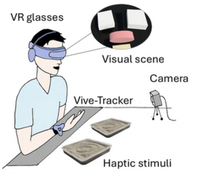
Humans use distinct exploratory procedures (EPs) in active touch, which are typically specialized for materials with particular properties: for example, pressing for deformable objects such as cushions, or stroking to test a fabric's smoothness. Further, humans can use abstract visual priors for fine-tuning of exploratory movement parameters such as exploration direction. We here test the usage of visual priors in the planning of material-specific EPs, using real-life materials and a naturalistic visual virtual reality environment. We show that humans are better at selecting specialized EPs at initial touch when they have access to valid prior visual information on the material: They used specialized EP earlier, with higher probability, and explored materials for a shorter time. We conclude that visual prior information increases the efficiency of haptic explorations by anticipatory planning of appropriate movement schemes. Michaela Jeschke & Knut Drewing (2025). Look first, feel faster: Prior visual information accelerates haptic material exploration. i-Perception, 16(5), 1–5. https://doi.org/10.1177/20416695251385816