
Research Area 3: Cultural Transformation and Performativity Studies
Research Area 3: Cultural Transformation and Performativity Studies

The Research Area 3 intends to examine cultural issues from a performative perspective, while also considering the transformative power of performance in society. The group meets at least once a month to discuss selected texts. Meetings are held in person at the GCSC and can also be organized in a hybrid format if needed.
The structure of each semester is shaped according to the expectations and interests of the group members. Each session is chaired by one member, leaving space for open discussion and collective reflection. Researchers and scholars from both within and outside the GCSC may also be invited to join the meetings. The ultimate aim of the group is to create opportunities for mutual learning and to share this knowledge with others through organizing academic and/or artistic events.
In previous semesters, we discussed both theoretical and experimental texts on phenomenology, embodiment, and affect. In the summer semester 2025, we began to explore a new yet related theme — “Other Ways of Knowing” — by examining diverse examples such as verbatim theatre and video essays as forms of knowledge production.
For the winter semester 2025/26, we intend to further expand this topic with the contributions and dynamism of new members. Discussions can take any form: reading a text, engaging with video or audio materials, experimenting with embodied practices, visiting an exhibition or a performance — or even taking a walk together.
The ways of doing are limitless — and so are the ways of knowing.
Possible Discussion Areas:
- Gender, Sexuality & Disability – Performative and social constructions of identity
- More-than-Human / Environment – Knowledge beyond human-centered perspectives
- Religion & Spirituality – Belief systems as ways of knowing
- Theatre & Performance – Verbatim/documentary theatre and creative enactments
- Indigenous Knowledge – Situated and traditional epistemologies
- Media & Technology – Digital storytelling, video, and sound as knowledge tools
- Embodiment & Affect – Experiential and sensory ways of knowing
- Art & Aesthetics – Creative practices producing knowledge
- Collective & Participatory Practices – Collaborative learning and knowledge-making
- Philosophy & Theory – Epistemology, situated knowledge, posthuman perspectives
If you are interested in the group or would like to receive more information, please reach out to the co-speakers, Ekin Durmaz and Luis Guillermo Zazueta Beltran:
📧 ekin.durmaz@hotmail.com
📧 luis.g.zazueta.beltran@stud.uni-giessen.de
Participants: Luis Guillermo Zazueta Beltran, Huan Bui, Ekin Durmaz, Fouzia Hayouh, Nubia Sanches Martins, Burcu Bacanak-Sahin, Wei Wei.
UPCOMING EVENTS
PAST EVENTS
January 21st 2025, 6 - 8pm - Keynote Lecture by Prof.*in Dr.*in Antke Antek Engel
"Queerversity as an Aesthetic Principle"
International Graduate Centre for the Study of Culture,
Justus-Liebig-Universität Gießen
Otto-Behaghel-Str. 12
Conference Room
Queerversity, a refined version of diversity, arouses interest in the complexity of difference – its intersectional interdependency and aesthetic or re/presentational modes. It strengthens modes of difference beyond classification: ambiguity, multiplicity, singularity, alterity. As an ethical or political principle, queerversity engages trans*versal justice in order to find nonviolent and respectful ways of dealing difference. Yet, what does it mean to propose queerversity also as an aesthetic principle? In this talk I will sketch queerversity as an aesthetic principle which can be detected in and fosters cultural or artistic practices that overcome addictions to binary oppositions and classificatory thinking. It aims at finding pleasure in complexity, confusion, and conflict in order to overcome the violence of normalcy.
Antke A. Engel (Dr. phil.) is a philosopher working in the fields of queer theory, poststructuralist philosophy, and visual cultural studies. In 2006 Engel has founded the Institute for Queer Theory (iQt) in Berlin (http://www.queer-institut.de) and since then functions as its director. They were Asa Briggs fellow at the University of Sussex and visiting fellow at the Gender Institute of the London School of Economics as well as the Institute of Cultural Inquiry Berlin, and since 2003 regularly holds guest professorships in Gender and Queer Studies. On a guest professorship at FernUni Hagen they released in 2021 open access introductory videos to queer theory (https://e.feu.de/queer-theory-videos). Engel co-edited Hegemony and Heteronormativity (2011) and Global Justice and Desire: Queering Economy (2015), and published numerous essays and the monographs Wider die Eindeutigkeit (2002), Bilder von Sexualität und Ökonomie (2009) and Queer Theorie – Queer_Pädagogik (2024).
January 21st 2025, 10am - 4pm - Workshop "Writing Queerly / Queer Schreiben"
International Graduate Centre for the Study of Culture,
Justus-Liebig-Universität Gießen
Otto-Behaghel-Str. 12
SR 308
Queering is a process that fosters a desire for complexity and confusion. What potential does writing hold to slow down and shift thinking rooted in oppositions, rigid constructions of belonging, attributions, exclusions, hierarchies, and oversimplified notions of antagonism? This writing workshop offers an introduction to the constitutive ideas of queer theory by engaging with topics or questions posed by participants, subjecting them to a queering process through writing.
The participants' topics/questions do not need to relate to queerness, gender, or sexual politics in the first place. Rather, the goal of this workshop is to explore and/or playfully experiment with your ideas and our material through the lens of queering.
In the workshop, we will approach queering by collectively discussing contemporary artistic works selected specifically for this masterclass. We will focus in particular on processes of transing regimes of normality, culminating in a spiral-like tension between queerness and queering. State and process interpenetrate one another. While queering introduces movement into one-dimensional desire or heteronormative pairings, transing traverses dualisms to subvert their hierarchical organization.
The workshop will be conducted in a mix of German and English, with participants free to write in whichever language they are comfortable. We aim to create a multilingual context spontaneously as needed. Your active participation will enrich the depth and queerversity of the discussions, fostering a supportive environment for emerging scholars to explore these critical questions.
+++
Queering ist ein Prozess, der Lust an Komplexität und Konfusion fördert. Welche Potenziale wohnen dem Schreiben inne, um ein Denken in Oppositionen, engen Zugehörigkeitskonstrukten, Zuschreibungen, Ausschlüssen, Hierarchien und simplifizierten Gegner*innenschaften auszubremsen und zu verschieben?
Diese Schreibwerkstatt bietet eine Einführung in Grundgedanken der Queer Theorie, indem Themen oder Fragestellungen der Teilnehmenden aufgegriffen und schreibend einem Queering unterzogen werden. Die Themen/Fragen der Teilnehmenden müssen nichts mit Queerness oder Geschlechter- bzw. Sexualpolitiken zu tun haben. Vielmehr ist es Anliegen dieses Workshops, die Diskussion unseres Materials anhand des Queerings forschend und/oder spielerisch zu erproben.
Im Workshop behandeln wir Queering durch die gemeinsame Diskussion zeitgenössischer künstlerischer Arbeiten, die wir für die Masterclass ausgewählt haben.
Genauer eingehen werden wir auf Prozesse des Durchquerens von Normalitätsregimen, die in einer spiralförmigen Spannung von Queerness_Queering münden. Zustand und Prozess durchdringen sich. Während Queering Bewegung in ein-dimensionales Begehren oder heteronormative Paarkonstellationen bringt, durchquert Transing Dualismen, um deren hierarchische Anordnung zu unterwandern.
Der Workshop wird in einer Mischung aus Deutsch und Englisch angeboten; die Teilnehmenden können in jeder Sprache schreiben, die ihnen vertraut ist. Wir werden versuchen, gemeinsam einen multilingualen Kontext für queerverse Diskussionen zu schaffen.
14.11.2023
Masterclass with Jennifer Doyle: "About Sex"
- How do we recognize sexuality within artworks? To what extent is our ‘radar’ influenced by highly subjective, subconscious, as well as socially ingrained desires? Can we rely on our methodical lens, and what are its blind spots?
- How do affects like arousal, shame, or disgust come into play when interpreting such artworks? Should we incorporate them in our research - how (not)?
- What language should we employ to convey our findings? How does an objective jargon sterilize the message or perpetuate the hegemonic methods of Western "scientia sexualis"? Conversely, would a more colloquial or poetic "ars erotica" overstimulate and distract from academic findings?
This Masterclass will be of particular interest to researchers in the fields of art history, sexuality, gender and queer studies, but it also offers valuable insights for scholars working on different topics that similarly navigate delicate intersections of intimacy and the public sphere (e.g. mental health, emotions, death, …). Your active participation will enrich the depth and diversity of the discussions, fostering a supportive environment for emerging scholars to explore these critical questions.
Keynote Lecture: "Scientia Sexualis - A Curatorial Project"
In this lecture, Jennifer Doyle shares her collaboration with Jeanne Vaccaro on Scientia Sexualis, an exhibition of contemporary art which takes up the intersection of sex and science. She will share the exhibition's defining questions and challenges, reflect on the history of queer and feminist work in this space and situate this project in relation to the ongoing fight for bodily autonomy and sexual liberty. Scientia Sexualis will open in the fall of 2024 at the Institute for Contemporary Art, Los Angeles and is part of PST ART: Art & Science Collide, a regional festival sponsored by The Getty.
11.07.2023
Seminar mit Insa Härtel: "Ästhetik des Sexuellen - Formen des 'Übergriffs' in Tseng Yu-Chins 'Who's listening 5'
Keynote-Lecture: "Aesthetics of the Sexual - On Sheaths, Scenes, and Screens"
He brings a condom into play, she – mocking him – blows it up like a balloon. This sequence from "Looking for Mr. Goodbar" (USA 1977) is quoted in the film "Test" (USA 2013), set in the gay 1980s San Francisco modern dance milieu. Based on the composition of such scenes and going beyond the actual use of the condom, this lecture deals with interlayers and screens, the performance character of sexuality and the aesthetic constitution of the latter.
Prof. Dr. Insa Härtel is a Permanent Senior Research Fellow at the University of Art in Linz at the Department of Cultural Studies / Institute of Fine Arts and Cultural Studies and works as a psychotherapist for children, adolescents and young adults in Hamburg . From 2012-2022 she was a Professor of Cultural Studies with a focus on cultural theory and psychoanalysis at the International Psychoanalytic University Berlin (IPU). Currently she is working on a book entitled “Aesthetics of the Sexual” (Ästhetik des Sexuellen). Selected publications: „Reibung und Reizung. Psychoanalyse, Kultur und deren Wissenschaft“ (ed.), Hamburg: textem Verlag 2021; “Kinder der Erregung. »Übergriffe« und »Objekte« in kulturellen Konstellationen kindlich- jugendlicher Sexualität”, Bielefeld: transcript 2014. Insa Härtel is a participant of the editorial board at „RISS. Zeitschrift für Psychoanalyse“.
Lecture and Master Class by Claire Bishop, June 6, 2017
A day with Claire Bishop, organized by Research Area 3
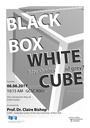
Claire Bishop joined us for a day of exchange and discussions on June 6, 2017. The event started with her morning lecture “Black Box, White Cube, Fifty Shades of Grey?” in which she presented material from her recent research. Starting out with framing the modernist paradigms of the Black Box (in theatre) and the White Cube (in the museum), she traced various temporalities and modes of attention connected to them, throughout the 19th and 20st centuries, up to our time. Focusing on what she called dance-performances in the museum (drawing especially on the examples of works by Maria Hassabi and Anne Imhof), she addressed how reception but also artistic production and spacial framing may have been influenced by recent developments such as smart phone photography and social media, suggesting that this digital realm forms a “Grey Zone” yet to be defined more closely.
In the afternoon, Claire Bishop held a Master Class with more than 20 enthusiastic participants from the GCSC as well as the Institute for Applied Theatre Studies. Apart from some topics that arose from the readings she had provided beforehand; the discussions took their departure also from the ideas Bishop had presented in the morning. She managed the heterogenous group with impressive teaching skills and created an inspiring atmosphere. The participants agreed that the day had been a great success.

RA 3-subgroup Performativity and Receptivity
This subgroup of RA3 we analysed the relation between theories of performativity and theories of receptivity that concern the audience in a broader sense (such as the reader or spectator). Up until summer 2015, the group was mostly dealing with different theoretical approaches that connect performative acts and reception processes, and we discussed texts by Derrida, Butler, Culler, Fischer-Lichte, and Rancière. The group then aimed at bringing these different theoretical approaches together and combining them with the members’ individual research foci in order to develop a broader and interdisciplinary view of the links between performativity and receptivity.
Former Research Focus and Past Activities
Research Focus and Events up to September 2018:
During the second funding period, RA3 continued its focus on performativity as a concept to describe the ritual, theatrical and interactive dimensions of culture and for understanding cultural change. Often conducting several projects simultaneously, several subgroups emerged, all addressing the overarching topic of the group—performativity—from diverse specific angles. The subgroups work on organizing reading sessions, reading retreats, guest lectures, workshops, and conferences. Thematically, they have been engaged in approaching performativity from the standpoint of German idealist philosophy, phenomenology, and theories of receptivity. Also, the subgroups have been examining the role of performativity in the evolving economies of the subject and modes of creating space. The projects within RA3 are realized in collaboration with other research areas and working groups within the GCSC, as well as other departments at JLU, various academic institutions, but also in close cooperation with artists. In the summer semester 2016, RA3 organised the reading retreat “The Intellectual: Economies of the Subject”, examining persuasive performances and failed performances in both the arts and real life, codified performances, the relation between discourse and performance, and the idea of participation of the audience in performances.
In June 2017, Claire Bishop joined us for a day of exchange and discussions on June 6, 2017. The event started with her morning lecture “Black Box, White Cube, Fifty Shades of Grey?” in which she presented material from her recent research. Starting out with framing the modernist paradigms of the Black Box (in theatre) and the White Cube (in the museum), she traced various temporalities and modes of attention connected to them, throughout the 19th and 20st centuries, up to our time. Focusing on what she called dance-performances in the museum (drawing especially on the examples of works by Maria Hassabi and Anne Imhof), she addressed how reception but also artistic production and spacial framing may have been influenced by recent developments such as smart phone photography and social media, suggesting that this digital realm forms a “Grey Zone” yet to be defined more closely.
In the afternoon, Claire Bishop held a Master Class with more than 20 enthusiastic participants from the GCSC as well as the Institute for Applied Theatre Studies. Apart from some topics that arose from the readings she had provided beforehand; the discussions took their departure also from the ideas Bishop had presented in the morning. She managed the heterogenous group with impressive teaching skills and created an inspiring atmosphere. The participants agreed that the day had been a great success.
In 2018, RA 3 focused on the interplay between agency, theatricality and rituality regarded from both social and artistic angles. We organised a Keynote Lecture and a Master Class with Frans-Willem Korsten from the University of Leiden and discussed modes of the theatrical and the dramatic in political and legal contexts. Furthermore, two events with philosopher Harry Lehmann in the last winter semester shed light on the recent emergence and development of contact zones and breaking points between academic research, cultural institutions and various forms of conceptual art and music. RA3 and its temporary subgroup “Evil” is also involved in the conference “Villains! Constructing Narratives of Evil”, which took place in February 2019.
Research Focus and Events up to September 2016:
During the first funding period, RA 3 focused on performativity as a concept to describe the ritual, theatrical and interactive dimensions of culture. The concept has proved to be productive also for the understanding of cultural change and will continue to be of central interest to RA 3 during the second funding period. Approaching cultural change from the perspective of performativity studies implies observing the gradual alterations of cultural processes and analysing their adaptations to equally changing cultural contexts. Such an approach highlights the interference of continuities and discontinuities, and the simultaneity of the dissimilar as fundamental features of cultural transformations. The notion of ‘ruptures’ and ‘caesurae’ are regarded as discursive and medial constructions answering to the need of reducing the complexity behind cultural change. This proposed extension of ‘performativity’ as a concept for the study of culture approximates concepts of evolution or emergence and materiality, while at the same time specifying and applying them.
Against the backdrop of current cultural, political, economic, and societal developments the possibility of cultural change and the societal efficacy of resistance, counteraction, and withdrawal is ever anew up for discussion. By engaging with diverse modes of performative practices and encounters – be it strategic, playful, carnivalesque, or refusing ones – in connection to the notions of cultural transformation and the event we are aiming at rethinking the cultural and political potency of the performativity of the body, of language, and of thought. We are doing so by looking at incitive or irritating practices within different societal arenas. In particular we are interested in understanding performativity as a political strategy by putting emphasis on the topics ‘performing politics’, ‘performing art’, and ‘performing knowledge’.
Research Focus and Events up to September 2014:
The rituals, theatricality and interactive dynamics of cultures are the key issues investigated in the research area on culture and performativity. In cultural performances such as festivities, plays, media or technology, cultures can be studied ‘in action’, as they shape, explain and unfold meaning. Since the late 1980s, performativity has become a key concept for the interdisciplinary study of cultures: performativity describes the theatricalised (re-)actualisation of socio-symbolic systems which render cultures visible to themselves and to others. Different academic disciplines cooperate in an attempt to describe the interrelationship of performativity and culture.
Originating in language philosophy (Austin’s speech act theory), the concept of performativity ‘travelled’ through cultural anthropology and history in the 1960s and theatre studies and social sciences in the 1980s and has been a part of gender studies since the 1990s. Cultural anthropology and history have studied rituals as performances providing an arena for cultural self-definition; sociology has analysed the performance of social interactions, stressing their importance for the maintenance and adaptivity of cultural patterns (de Certeau); theatre and literary studies have explored the interactive dynamics of plays and texts. Finally, gender studies (Butler) have examined the every-day role of gender in terms of a re-actualisation of socio-symbolic systems.
During the past two years, the area reflected intensely on a concept and terminology of performativity due to the current state of the theoretical debate. Therefore, the area focused on issues such as violence, the transformation of culture and media and the linkage between politics, resistance and art.
To the extent that this area focuses on the dynamic processes, which generate cultural meaning on the levels of body, narrative and image, it is linked to the research areas ‘Cultures of Knowledge, Research and Education’, ‘Culture and Narration’ and ‘Visual Cultures’.
Events up to September 2014:
2010-11-11/12/13/14 - Giessen
- Widerständiges Denken/ Thinking Resistance
2010-01-13 - Giessen
- Workshop with Thomas Weber
2010-02-17/18/19 - Giessen
- Medien.Kultur.Wandel
2010-06-21 - Giessen
- Deep Impact. Warum forschen wir?
2014-02-10 - Giessen
- Film screening: Tactical frivolity & Rhythms of resistance (Nuria Vila & Marcelo Expósito, 2007)
For further events up to September 2014 please follow this Link

images
https://i.pinimg.com/736x/79/02/14/7902141a1d9d85ea3981a02192651cd9--pop-art-contemporary-art.jpg
Oliver Gargan, „O'Connell Monument top closeup 1” (https://commons.wikimedia.org/wiki/File:O%27Connell_Monument_top_closeup_1.jpg). Edited by BR, CC BY-SA 4.0 (https://creativecommons.org/licenses/by-sa/4.0/deed.de).




presentations(1).png)

presentations(2).png)


