
Content
Conference Abstract
Conference “Nothing to Remember? Politics, Practices, and Agents of Commemorating Peace.”
January 22-23, 2026
In memory studies, scholarly attention has long been drawn to the remembrance of crises, wars, and periods of violence. These critical junctures have been explored as sites of trauma, reconciliation, and the foundation for constructing collective identities. For instance, commemorating decolonization struggles has foregrounded the legacies of imperial violence, and narratives surrounding the World Wars have often been used to shape national identities and international relations.
What is often overlooked is the memory of what happens in between the crises – the memories of peace. In academic, political, and everyday discussions, peace is either situated in the past or a distant future, never truly present today. In the first case, it is remembered as a ‘lost paradise’, a haunting reminder of a world that no longer exists. In the second, it is presented either as a realistic aspiration or as a utopia that remains on the horizon.
Demands, expectations and commemorations of peace are articulated differently. For example, gendered demand for justice as a way of achieving peace is practiced by the Madres de la Plaza de Mayo in Argentina and the Madres de La Candelaria in Colombia. These collectives of mothers publicly protest in search of their missing relatives, challenging oppressive systems despite social stigma and political repression. However, peace could also be instrumentalized to justify continuous militant efforts as in the case of the current war in Ukraine, where peace is depicted as an undefined in time and conditions end-goal, for the achievement of which the war must go on. On the other hand, the European tradition often marks peace as the end of war and commemorates it through memorials, remembrance days, and educational events.
Thus, the memories of violence still dominate our discussions. But what happens when we shift the focus? Can memories of peace offer more than nostalgia, maybe even an emancipatory potential? Does the revival of memories of peace contribute to peacemaking practices or trigger conflict and social polarization? How are memories of peace used and instrumentalized in political struggle?
In times of crisis and war, memory becomes a stumbling block to overcome. But memory also plays an important role in times of "peace". Considering the multi-layered dimension of peace as a concept, it is possible to problematize its scope. Peace does not imply the absence of conflict; on the contrary, using different theoretical approaches, from realist and liberal to structuralist, Marxist, and post-structural analysis, peace can be seen as a wide range of social, economic, and political conditions in a permanent state of contestation. Thus, the memory processes, initiatives, and debates occurring during these periods are indispensable to understanding how cultural and social group practices are performed in terms of narrative building and identity production.
Broadly, the politics of memory, defined as the use of the past by social and political actors for present purposes, influences how we perceive both peace and its opposites, always with a specific intention. Thus, it never reflects a ‘true’ image of reality but instead shapes and produces it. The (re)production of memory is a normative-colored and selective process embedded in the system of social relations, which allows groups (in power) to impose their memory as dominant. Because of this, memory is often used for political purposes—polarizing social groups, justifying violence, creating national myths, and prioritizing specific issues.
During the conference, we would like to discuss how the memory of peaceful times unfolds in political debates and struggles. We welcome papers that elaborate on the memory of peace as a social, political, and cultural tool and explore its transformative potential. In addition, we are interested in the limits, effects, and selection processes in the field of the remembrance of peaceful times, as well as how and why peace is commemorated. The interdisciplinary scope of the conference allows contributions ranging from cultural, social, political, and historical studies to other similar disciplines.
Possible papers could include (but are not limited to) topics and questions such as:
- How are peace times remembered and commemorated? Which memory agents preserve and transmit the memories of peace? What reasons, motives, and goals do they have?
- Do memories of peace have a reconciling and unifying function? Can they become a common ground for social cohesion and inclusion?
- Can we comprehend peace only in opposition to war and violence? Does remembering and commemorating peace imply that it is over?
- How does commemorating peaceful times shape identities, social groups, and political movements? What are the reasons for politicizing memories of peace?
- What are the historical and cultural implications of remembering peace?
- What role does the memory of peace play in articulating future(s)?
- To what extent can (grassroots) memories of peace challenge militarist stands/practices of the more powerful social groups/actors?
- What role do memories of peace play in conflict development as well as in peace-building? Can the memory of peace serve as an argument for violence? And what does it look like?
- How do memories of peace relate/refer to memories of violence?
- How could or are peace memories used to manipulate specific members or groups in different societies?
- What role does the memory of peaceful times play in (minority) activism?
The two-day conference will include panel discussions and a keynote lecture, offering participants the ground for an open and productive discussion, as well as the opportunity to engage with the latest research on this pressing but evergreen topic.
We welcome abstract submissions in English from scholars at all career stages and practitioners from various disciplines engaging with the themes outlined above. Abstracts (max. 250 words), accompanied by a short bio (max. 100 words), should be submitted by July 14, 2025 to ra1.conference@uni-giessen.de. Applicants will be notified of acceptance by mid-August, 2025.
The conference is organized by the Research Area Cultural Memory, part of the International Graduate Centre for the Study of Culture at Justus Liebig University Giessen. The Organizing Committee will cover daily lunches, coffee breaks, and a dinner. Travel and accommodation costs are covered by the participants.
Please send any inquiries to ra1.conference@uni-giessen.de
We are looking forward to your submissions!
Keynote Lecture I
Prof. Johanna Mannergren (Södertörn University) Wild Peace, Unruly Memories
My talk will centre on a (re)conceptualisation of peace and of memories of peace that I hope will inspire us to challenge more rigid and binary understandings of war and peace. I will suggest that we think of peace as a ‘spirit’ that is felt and expressed through a range of experiences, acts and events. In this conceptualisation, peace is embodied, corporeal and haptic. It is emplaced, and plays out in and through a number of informal and formal relations, charged with meaning and direction through narration and imagination. Peace emerges in low flickers or in sudden bursts. The ‘spirit’ of peace pulsates through societies and times – in peaceful times for sure, but also at times of war. Experiences, practices and acts of wild peace are conflictual, messy, difficult, sometimes overtly political, sometimes more subtle. Wild peace is agential and desired, and driven by the unexpected and the imagined.
Memories of wild peace are unruly. They can be uncomfortable or even dangerous for political power-holders. Memories of wild peace are often tamed and forgotten through top-down collective memory-making such as formal peace commemorations that serve the purpose of shaping hegemonic identity constructions. The remembering of wild peace, on the other hand, can be an act of protest and resistance, a site for imagination, and can take place in both formal and informal settings. The recognition of these unruly memories is at the same time also an expression of the ‘spirit’ of wild peace.
I will build the talk around several intriguing examples from my own empirical research in Bosnia and Herzegovina, Israel/Palestine, Belgium, and South Africa, mostly focusing on unruly memories of wild peace in these societies and the political implications of denying, erasing and activating these memories.
Johanna Mannergren Selimovic is associate professor of Peace and Development Research. Her research concerns peacebuilding with a special interest in transitional justice, reconciliation processes, politics of memory, and gender politics.
She is currently engaged in several research projects that investigate memory politics in transitions from war to peace; the cultural heritage of war; and divided cities, urban violence and peacebuilding. For these projects she conducts fieldwork in Bosnia-Herzegovina and Jerusalem.
Keynote Lecture II
Dr. Craig Larkin (King's College London) Remembering Peace: Heritage, Nostalgia and forgetfulness in Lebanon and Iraq
Programme Flyer
|
|
Nothing to Remember? January 22-23, 2026 Download the detailed programme here |


Schedule
-
January 22
10:00 Coffee & Conference Registration 10:45 Welcome & Opening Remarks (Katharina Hacker & Henning Tauche) 11:00-12:30 Panel 1: Re-shaping Peace Discourse
Chair: Mortada Haidar
Archana Ravi (GCSC) – The Rhetorics of Pre-emptive ‘War’
Dr. Vedran Obucína (Centre for Inter-religious Dialogue) – Rethinking Golden Ages (online)
Dr. Asis Mistry (University of Calcutta) – Commemorating Quietude: Minoritarian Memories of Peace in South Asia
12:30-14:00 Lunch (Otto-Behagel Mensa) 14:00-15:30 Panel 2: Memory, Citizenship, & Peace
Chair: Katharina Hacker
Kathi Ammann (University of Melbourne) – On the Future of the Past - Colonial Echoes and Premature Back Death in the Wake of German Memory Culture
Valentina Otmačić (University of Rijeka) – “I wish to remind our citizens”: The Interplay Between Memory and Local Peace in the Multiethnic City of Tuzla, Bosnia-Herzegovina
Ivana Dinić (GCSC), Fatos Hoxha (University of Regensburg) & Vasja Groselj (University of Ljubljana)– Remembering Peace: Yugoslav Miners´ Accounts of the Golden 1960s´ and the 1970s´
15:30-16:00 Coffee Break 16:00-17:00 Panel 3: Intersectionality & Peace
Chair: Henning Tauche
Prof. Dr. Zuhal Yeşilyurt Gündüz (TED University) – Rethinking Memories of Peace: Integrating Gender and Environmental Theories in International Relations
Vicky Panossian (University of Warwick)– Peace by Piece: The Function of Post-War Objects for Arabic Speakers in the UK
17:00-18:00 Coffee Break
18:00-20:00 Keynote Lecture
Chair: Miguel Angel Caballero
Prof. Johanna Mannergren (Södertörn University)
Wild Peace, Unruly Memories
20:00-21:30 Catered Dinner (GCSC 2nd Floor) January 23
9:00-10:30 Panel 4: Spaciality & Peace
Chair: Anna Ivanova
KVJ Koshalee (University of Ruhuna) – The Colossal Stupa of the 21st Century: Sandahiru Seya and the Memory Politics of Post-War Sri Lanka (Online)
David Cabrera Rueda (Leuphana Universität Lüneburg) –An Anticipated Ruin? The Public Life of the Unfinished Memory Museum of Colombia Building
Meral Gezici-Yalçın, Kai-Sören Falkenhain, & Esther Ruessler (Bielefeld University) –
Remembering Peace Along a Contested Border: Ethnographic Insights from the German -Polish Twin City Frankfurt (Oder) –Słubice10:30-11:00 Coffee Break 11:00-12:30 Keynote Lecture
Chair: Mortada Haidar
Dr. Craig Larkin (King’s College London)
Heritage, Nostalgia, and Forgetfulness in Lebanon and Iraq
12:30-13:30 Lunch Break (Otto-Behagel Mensa) 13:30-15:00 Panel 5: Literary Narratives & Peace
Chair: Mortada Haidar
Anna Dziuban (Ludwig Maximilian University of Munich) – Archive of Erasure: Silence and the Ghosts of Subjugation
Azzeddine Tajjiou (Mohammed First University) – Fugitive Moments of Peace: Remembering the Unyielding in Alex La Guma’s A Walk in the Night and Helon Habila’s Waiting for an Angel (online)
Soukaina Aouaki (Hassan II University )& Lahcen Ait Idir (Faculty of Arts and Humanities, Mohammedia) – Narrating Peace through Trauma: Diasporic Memory in Abbas El-Zein’s Leave to Remain
15:00-15:30 Coffee Break
15:30-16:30 Panel 6: Films & Peace
Chair: Reqqa Salem
Salma Yassine (University of Exeter) – In Search of a Cat: The Memory of Peace is not yet (t)here
Ahmed Berka (Doha Institute for Graduate Studies) – Peace as Absence: Remembering the Unseen in Post-9/11 Hollywood Films: The |Reluctant Fundamentalist and The Mauritanian
16:30-17:00 Closing Remarks Roundtable
Contact
For questions, please contact
the Research Area 1: Cultural Memory Studies
at ra1.conference
The Organising Committee:
The conference is organised by the speakers and members of Research Area 1: Cultural Memory Studies at the International Graduate Centre for the Study of Culture.
Mortada Haidar, Katharina Hacker, Tatiana Quintero, Anjuli Trautmann, Anna Ivanova, Henning Tauche, Navid Nail, Emilio Aguas Rodriguez.
Where to Find Us
| Address |
|---|
|
Justus-Liebig-Universität Gießen Otto-Behaghel-Str. 12 |
Coming by airplane (Frankfurt Airport)
You can take the train from the Frankfurt airport train station (Frankfurt(M)Flughafen) to the main train station (Frankfurt(Main)Hbf) in Frankfurt. From there take a regional train to Giessen (see the Deutsche Bahn website) and then a bus or a nextbike to the GGK/GCSC.
Find us by bus
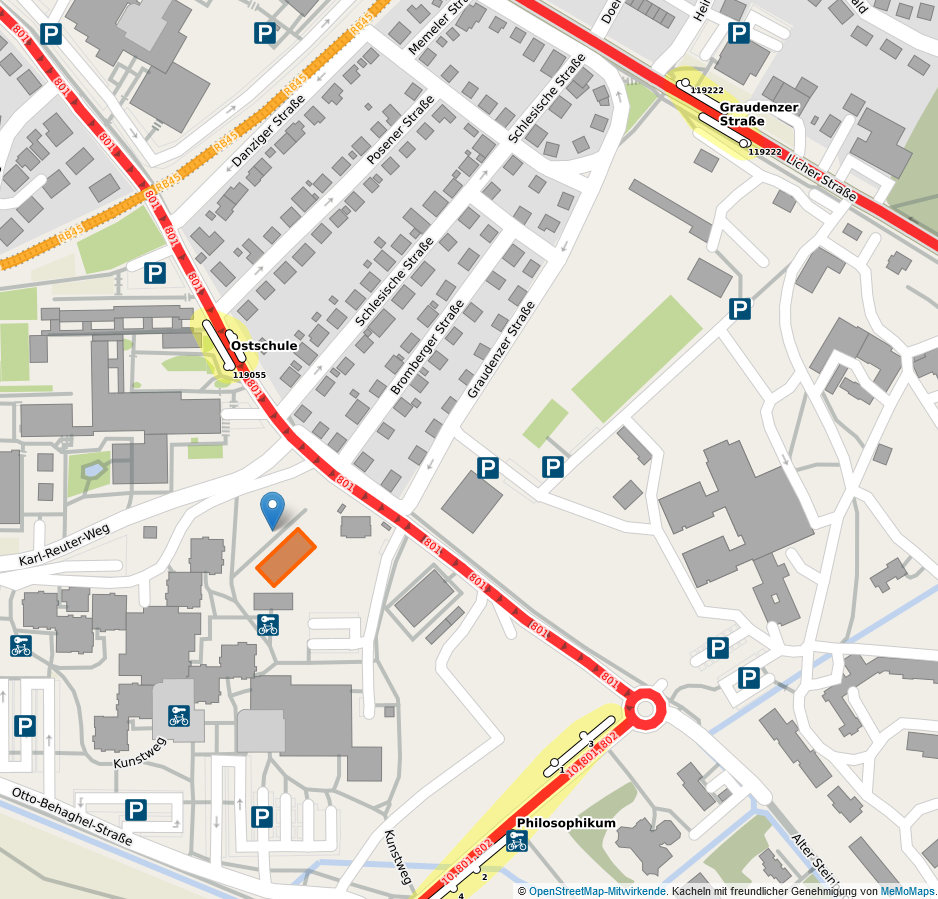
From the train station Gießen Oswaldsgarten and the bus stop Gießen Marktplatz, the bus line 801 goes to the bus stop Ostschule. When you arrive at Gießen Ostschule, you will see the four-storey GGK/GCSC building. From the train station Gießen Bahnhof, you reach the stop Gießen Marktplatz with the bus lines 2, 5, 15, 24.
Alternative: Line 10 und 18 (from the main Gießen train station) and line 802 (Gießen Oswaldsgarten and Marktplatz) to the stop Giessen Philosophikum. The walk from there is about 10 minutes.
You will find the current route planner on the Stadtwerke Gießen website.
Find us by car (directions from the A5)
The GGK/GCSC is located on the corner of Alter Steinbacher Weg and Karl-Reuter-Weg.
From the South:
Follow the A5 toward Kassel. Turn off the A5 at the junction Gambacher Kreuz toward Giessen and get on the A45. Turn onto the A485 toward Giessen. Get off the A485 at the junction Giessen-Schiffenberger Tal toward the university and get on Schiffenberger Weg. Stay on the Schiffenberger Weg and turn right at the Burger King onto Rathenaustraße. Follow until Alter Steinbacher Weg then turn left. Take the first left in front of the transformer house (direction: 'Anlieferung Uni-Bibliothek' and you will reach the parking lot behind the university library. The four-storey GGK/GCSC building is now directly in front of you.
From the North:
Take the A5 towards Frankfurt, Giessen. Change at the junction Reiskirchener Dreieck from the A5 to the A480 towards Dortmund, Giessen. At the Giessener Nordkreuz change to the A485 towards Giessen, Stadtmitte. Get off the A485 at the junction Giessen-Schiffenberger Tal and get onto Schiffenberger Weg. Stay on Schiffenberger Weg and turn right at the Burger King onto Rathenaustraße. Follow until Alter Steinbacher Weg then turn left. Take the first left in front of the transformer house (direction: 'Anlieferung Uni-Bibliothek') and you will reach the parking lot behind the university library. The four-storey GGK/GCSC building is now directly in front of you.



.png)

 new.png)