
Democracy and Governance (M.A.)
Taught in German
Overview
-
Accrediation
since 18 August 2009
- Overview
-
Overview
The Master's course "Democracy and Governance" is a consecutive study programme, which is based on a completed Bachelor's degree in Social Science. Further information about the admission can be found under "Application".
Democracy and democratic governance are the leitmotiv of political science. Yet how can democratic principles be pursued in practice in the light of growing global problems and new, much less formal governance structures? This is the central question addressed in this course, which is currently the only Masters programme in Germany to focus on the relationship between democracy and governance.
The starting point for study is an ambiguous situation. At the beginning of the 21st century, an unprecedented number of states embraced the principle of democratic legitimacy. Both the “Arab Spring” and the process of transformation in eastern European states are examples of cross-border waves of democratisation. Yet at the same time, we are also seeing processes of erosion in established democracies in Europe and North America, and the failure of attempts at sustainable democratisation in new democracies. The term “post-democratic era” has already been coined.
New protest movements, demonstrations during G8/G7 summits and the effects of globalisation, not all of which are positive, are a clear indication that new problems have emerged at the interface of (national or transnational) democracy and (national and global) cooperation between political, social and economic players. Addressing these problems on a democratic basis requires the involvement of different types of players: only then can the principle of democracy, the principle of justice and the need for effective problem-solving be pursued and fulfilled as the central components of a modern political order.
New forms of formal and informal cooperation, within and beyond the state, have been developed over recent years in efforts to enable a more effective approach to the ever more global problems in this era of globalisation. Often not only states but also transnational NGOs and companies are involved in this process. International political science has its focus on these different, non-hierarchical forms of governance as well as on the scope and the basis of their legitimacy under the paradigm of governance.
The combination of the study of governance and democracy focuses on one of the vital political challenges of our times. Without social acceptance transnational problems like climate change, poverty, terrorism or cyber-crime cannot be effectively dealt with.
- Duration of studies 4 Semester 120 Credit Points (CP)
-
Duration of Studies
4 Semesters - 120 Credit Points (CP)
Composition of the Study Programme
- Duration of studies 4 Semester 120 Credit Points (CP)
-
Duration of Studies
4 Semesters - 120 Credit Points (CP)
- Composition1
-
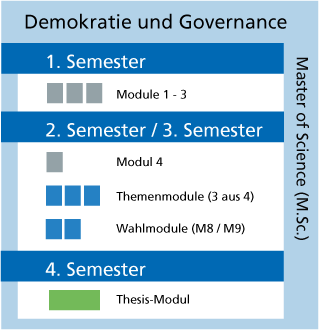 Composition of the Study Programme
The Master's course of study "Democracy and Governance" comprises 4 semesters and 120 credit points.
Core elements of the first semesters are basic modules in the areas of
- Democracy (M1),
- Democratisation processes (M2) and
- Methodology (M3).
The main part of the course is comprised of the special studies in political science in semesters 2-3 (M4-M9). Students ususally write the MA thesis and take the MA examination in the fourth semester.
Two replacement modules offer the opportunity to take classes in related disciplines such as economics, history, and philosophy.
- Modules 6,7, and 8 from the Master's Programme in Modern Societies and Cultures (Sociology)
- All genuine Master classes in History can be taken
- Modules in Economics offered by JLU's Faculty of Economics and Business Administration can be chosen according to prior agreement with the lecturer. Depending on the individual knowledge in economics students can either chose modules on Bachelor or Master level. Students with limited knowledge of economics are advised to chose Bachelor's modules.
- Modules 1,2,4,6,7,8 from the Master's Programme in Geography are on offer. We strongly recommend to take modules 2,4, and 7.
- Economics modules of the faculty of Economic and Business Studies can be taken in consultation with the lecturers. Depending on previous knowledge, Bachelor's or Master's modules can be attended. Students with little previous knowledge are recommended to attend Bachelor's modules.
Further modules are available upon request.
The modules are also intended as mobility windows especially in the framework of the ERASMUS programme. There are many exchange agreements with other European universities for a period of studies abroad.
- Composition2
-
1st semester M1: Democracy (10 cp) M2: Democratisation in International Comparison (10 cp) M3: Empirical Methods of Research on Democracy and Governance (10 cp) 2nd / 3rd semester 4th semester M4: Global Governance and international integration (10 cp) M10: Thesis module (30 cp) Subject module (Choose 3 out of 4):
- M5: Government and Governance (10 cp),
- M6: Norms and Institutions (10 cp),
- M7: Policy-Analysis (10 cp),
- M11: Media and Governance (10 cp).
M8: Elective module 1 (10 cp) M9: Elective module 2 (10 cp) Further Information
A description of the core- and specialisation modules can be found in the special regulations with module descriptions and module plans (in German)
More on this... ("Special Regulation")
Courses offered in the course catalogue
- Electronical course catalogue (in German)
Application
- Commencement of Studies in the Winter and Summer Semester
-
Commencement of studies
Summer semester and winter semester
- Application: Entrance Requirements
-
Entrance requirements
- The requirement for acceptance into the Master's course is to have completed a Bachelor's degree.
The Bachelor's course of study must show adequate qualifications with regard to contents and methods. Usually such courses are social sciences (political sciences, sociology, economics) or combined courses of study with a focus on social sciences (e.g. regional science). The required knowledge can also be demonstrated in the framework of a propaedeutic studies course during the first semester. - Students are chosen on the basis of the grade of their previous degree. Usually there is no separate entrance examination.
Applicants without a BA major in Political Science need to submit the module descriptions of their degree programme in addition to the transcript of records.
- The requirement for acceptance into the Master's course is to have completed a Bachelor's degree.
- Application not limited
-
Application for admission and registration
- The intake capacity of this degree programme is not limited internally by the university.
- Applications must be received by the JLU Student Secretariat by 15th January for the summer semester and 15th July for the winter semester. More on this...
- Special regulations apply to foreign applicants or those who gained their university-entrance qualifications abroad. Read more...
Career Options
- Career options
-
Career options
A Master's degree in Democracy and Governance qualifies you for a whole range of activities:
- as a researcher at universities in connection with doctoral studies,
- in opinon research,
- as a political consultant
- as a consultant for non-governmental organisations (NGOs),
- in administrations or
- in political education.
Doctoral Studies at JLU
Doctorate possible with a Master's degree
Graduate Centres
Further Information
- Further Information: Documents
-
PDF documents for the courses of study
- Study guide (in German)
Examination- and study regulations
- Special regulations
(with module descriptions and module plans) (in English)
(Please note that only the German version of the modules is offical and legally binding. The english Version is for informative purposes only.) - General study regulations for modular and multi-stage study programmes
Courses offered in the course catalogue
- Electronical course catalogue (in German)
- Study guide (in German)
- Links
- Master's Degree Programmes of Faculty 03
- Any Questions
-

Any Questions?
Information- and advisory services of JLU can be found under the category “contact” on this page!

Contact
-
Subject Advisor
- Subject Advisor D&G
-
Prof. Dr. Andrea Gawrich
Department of Political Science
Philosophikum II, House E, Room 201a
35394 Giessen
Phone: 0641 - 99 23136Office hours: by appointment via email
-
Links
-
Central Study Advisor
- Central Student Services
-
- Students office →
(for formal matters like matriculation) - Central student advisory office
(advice for students & prospective students) - Hotline Call Justus
(first contact for all matters pertaining to studies) - International office →
(for international students)
- Students office →