Media library
-
The media library is a collection of materials compiled by the entire NIDIT team during the project period. The materials are available to all teachers and interested parties even after the project has ended and bring together the key results of the project work within the network.
In addition to the NIDIT media library, you will find selected materials in the JLU ILIAS E-Learning Guide under the following categories:- Virtual Reality: including the self-study module on the topic of "Virtual Reality in Higher Education",
- Internationalisation: including explainer videos and the scripts „VITALS: Virtual International Teaching and Learning Skills“ and "VITALS in PRACTICE",
- Gamification: content that is well suited for gamification,
- Digital event design: explainer videos on (Synchronous) Hybrid Teaching.
At twillo, a portal for open educational resources in higher education, you will find the following materials:- OER self-study module "Virtual Reality in Higher Education",
- "Guide to planning an implementing a course with virtual reality components".
The self-study courses currently available in the HDM education programme have also been developed by the NIDIT team (as of 2025/9).
- Self-study course: Qualitätssicherung am Beispiel der weiterbildenden Masterstudiengänge an der Philipps-Universität Marburg,
- Self-study course: Vielfalt in der Hochschullehre - die eigene Lehre diversitätssensibel gestalten,
- Self-study course: Virtual Reality in der Hochschullehre.
- Self-study course: Visualisierungstechniken für die Hochschullehre..
The materials are grouped by topic below. You can access the respective pages via the individual tabs.
|
Script "VITALS - A didactical and methodological introduction to virtual international university teaching"This script is a written documentation of the workshop series “VITALS – Virtual International Teaching and Learning Skills” , which was conducted in spring 2023. It covers key methods, strategies, and concepts for designing international virtual teaching and learning environments. Click here to view the full script. The document is in German. |
Script "VITALS in PRACTICE – A Practical Implementation of Annika Brück-Hübner’s Virtual International Teaching and Learning Skills (VITALS)"This script by Anna Sophie Jäger builds upon the foundations introduced in Annika Brück-Hübner’s VITALS concept and expands them with practical implementations, discussion contributions, and innovative teaching methods for virtual international higher education. Click here to view the full script. The document is in English. |


|
Explainer video "Virtual international courses"This video provides a comprehensive explanation of virtual international courses. The video was created as part of the VITALS workshop series from 13 January to 3 February 2023 by Dr Annika Brück-Hübner. |
Poster "International Teaching Training"The poster offers a reflection on international university teaching. It highlights challenges, opportunities and concrete approaches for designing intercultural teaching and learning situations in an international context. Click here to see the full poster. The document is in English. |

|
Worksheet "Conflict Management in the International Classroom"This worksheet provides an overview of conflict management in international teaching contexts. It defines different types of conflicts, such as emotional, task-related, and administrative conflicts, and presents methods for addressing them constructively. Through interactive exercises, reflection tasks, and practical examples, the worksheet supports educators and tutors in better understanding conflict situations and developing effective strategies for resolution. Click here to view the full worksheet. The document is in English. |
Worksheet "Intercultural Competence"This worksheet presents methods and concepts for fostering intercultural competence in international teaching and learning contexts. It explains key skills such as cognitive, affective, and pragmatic-communicative competences and demonstrates how they can be applied to analyze and resolve intercultural misunderstandings. Through practical scenarios and reflection tasks, the worksheet supports educators and students in further developing their intercultural abilities. Click here to view the full worksheet. The document is in English. |


|
Paper "Desigualdades en América Latina: ¿una historia sin fin?"This report documents observations from the VIP seminar “Desigualdades en América Latina: ¿una historia sin fin?” . The purpose of the observation was to analyze teaching and learning practices in international, virtual, and intercultural contexts—focusing particularly on didactic methods, interaction, communication styles, and the role of online materials. The report also highlights challenges and opportunities in designing digital seminars across cultural boundaries. Click here to see the full document. The report is in English. |
Worksheet "Best practices - 10 Tips for Teaching Practices in COIL Seminars"The worksheet is designed as self-study material for moderators or trainers in virtual COIL (Collaborative Online International Learning) environments. The tips are organized into three main areas: student-centeredness, international teaching, and digital teaching formats. They support educators in creating learning environments where students take responsibility for their own learning, are actively engaged, and gain intercultural experiences. Special emphasis is placed on fostering autonomy, collaborative work, and international perspectives. Click here to see the full document. The text is in English. |


|
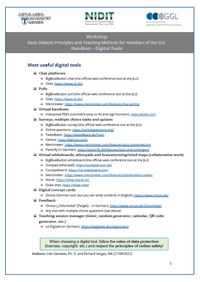
Handout "Most useful digital tools"This handout provides a concise overview of various digital tools for use in (online) teaching and tutorials — such as surveys, virtual whiteboards, feedback formats, and session managers. |

Paper: Enhancing Experiences in International Courses through Qualitative AssessmentThis contribution presents results from a recent publication within the NIDIT project. The study explores how qualitative assessment methods can enrich international teaching and learning contexts. The focus is on dialogic and formative approaches that take cultural diversity into account and actively involve students in the further development of courses. Based on case studies from JLU, including international workshops and the TAP method, the report illustrates how feedback and reflection can strengthen the quality of teaching and learning. The report is in English. |
|
|
|
|
|
|
|
Course Design CanvasThe course planning canvas helps teachers to structure and reflect on their courses in a clear manner. It helps to coordinate learning objectives, methods, media and examination formats. The visual representation makes didactic decisions comprehensible, facilitates coordination within the team and promotes coherent teaching concepts – even in digital or hybrid formats. |