
Composition of the Study Programme
Composition and structure of the degree programme
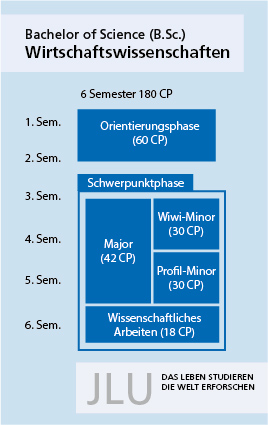
The course structure consists of an orientation phase (60 CP) and a core study area (120CP)
In the orientation phase, the students acquire a basic knowledge of business administration, economics and methods. All modules in the orientation phase are compulsory modules:
- Management I+II
- Accounting
- Finance
- Microeconomics
- Economic Policy and Public Finance
- Macroeconomics I+II
- Mathematics for economists
- Formal foundations of statistics
The core study area consists of four "building blocks": major (42 CP), WiWi-Minor (30CP), Profil-Minor (30CP) and academic work (18CP).
Major (42 CP)
Possible major:
- Business Administration
- Management
- Finance and Accounting (F&A)
- Economics
- General Business and Economics (GBE)
WiWi Minor (30CP)
Within the framework of the WiWi minor, you will contribute further modules of the faculty of Economics and Business Studies.
| Another building block is a Profil-Minor, which you can use for individual profile formation in one of four possible variants (a, b, c or d): | |
|---|---|
|
Variant a:
|
structured minor subject complete with modules from another subject area of JLU possible minor:
|
|
Variant b:
|
as a structured programm Managerial English of the faculty of Economics and Business Studies of JLU |
| Variant c: |
completed semester abroad |
| Variant d: |
flexible variant You can earn the required 30 CP in different ways:
|
Academic work (18CP)
Finally, you must complete the Proseminar module and the Thesis module as part of the building block academic work
Bachelor's Thesis
The thesis module is a major subject (possible majors: see above), i.e. you usually work on your thesis at one of the professorships involved. With this thesis you prove that you possess the ability to investigate a specific, delimited topic, within a limited time period, independently and scientifically, and can convey their results to the professional world.