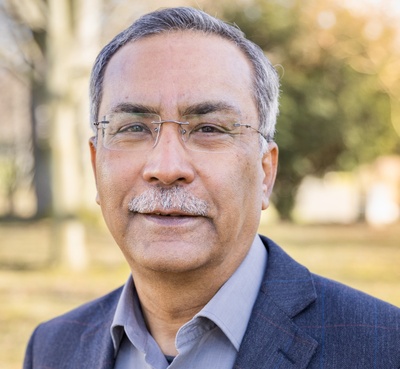
Ravi Raghavendra Prasad

- Kontakt
-
Doktorand
- E-Mail: ravi.prasad@stud.uni-giessen.de
- Akademischer und beruflicher Werdegang
-
Academics
2024 – Doctoral student at Justus Liebig University Giessen, Department of Social and Cultural Sciences
2017 – Master of Arts in Reconciliation and Peacebuilding, University of Winchester, UK
1985 – Bachelor of Science, University of Allahabad, India
Professional career
01/2024 to Present – Executive Director, IFOAM - Organics International, Germany
11/2021 to 10/ 2023 – Head of Global Policy and Advocacy, Transparency International, Germany
04/2018 to 10/2021 – Director of Advocacy, International Press Institute, Austria
07/ 2016 to 03/ 2018 – EU Advocacy and Campaigning Coordinator, Oxfam, Netherlands
08/2016 to 07/2018 – Consultant, UNICEF, Malawi
06/2011 to 05/2014 – Director and Head of Policy and Research, Child Helpline International, Netherlands
01/2009 to 05/2011 – Head of Communications, FLOCERT GmbH, Germany
06/2007 to 10/2008 – Communications/Media Specialist, International Center for Agricultural Research in the Dry Areas (ICARDA), Syria
02/2007 to 05/2007 – Team Leader, Policy, Communications & Donor Partnership, ActionAid International, Sri Lanka
06/2005 to 01/2007 – Media and Communications Coordinator, Oxfam GB, Sri Lanka
08/2004 to 06/2005 – Fellowship, Campaign to End Violence Against Women, Oxfam GB, Sri Lanka
04/1999 to 06/2005 – Foreign Correspondent, BBC World Service, Kosovo, Sri Lanka, South Asia
02/1996 to 04/1999 – Foreign Correspondent, The Statesman (India), Sri Lanka
06/1992 to 02/1999 – Special Correspondent, The Statesman, India
09/1989 to 06/1992 – Staff Correspondent, The Times of India
09/1985 to 08/1989 – Staff Reporter, The Pioneer, India
Publications
- Media Freedom and COVID-19, Ministry of Foreign Affairs, Canada, 2020
https://www.international.gc.ca/campaign-campagne/assets/pdfs/media_freedom-liberte_presse-2020/policy_paper-documents_orientation-covid-19-en.pdf - The State of Press Freedom and Safety of Journalists in South Asia
https://www.freepressunlimited.org/sites/default/files/documents/IPI_Report_South%20Asia.pdf - Press Freedom & Safety of Journalists in Africa: CHALLENGES & RECOMMENDATIONS
http://ipi.media/wp-content/uploads/2021/12/KAS-IPI-Report-on-Safety-of-Journalist-in-Africa-final-29.11.2021.pdf - COVID-19 pandemic severely undermined press freedom in South Asia
https://ipi.media/covid-19-pandemic-severely-undermined-press-freedom-in-south-asia/ - Child Helplines - A Crucial Tool for Protecting Children from Abuse and Violence
UNICEF Innocenti Research Centre, Research Watch, 2014
https://www.unicef-irc.org/article/986-child-helplines-a-crucial-tool-for-protecting-children-from-abuse-and-violence.html
Short courses
- Certificate in International Standards on Freedom of Expression, Oxford University
United States Institute of Peace
- Certificate - Negotiation and Conflict Management
- Certificate - Interfaith Conflict Resolution
- Certificate - Conflict Analysis
- Certificate - Gender Inclusivity in Peace Building
Humanitarian Leadership Academy
- Certificate in Project Management
- Certificate in International Humanitarian Law (ICRC)
- Certificate in introduction to Core Humanitarian Principles
UNICEF
- Evaluation in Humanitarian Settings
- Introduction to Advocacy
- Research and Evidence at UNICEF
- Psychosocial Support Programming
- Introduction to Water, Sanitation and Hygiene
Johns Hopkins University
- Certificate in Global Health – Introduction to Nutrition
USAID
- Certificate in M&E Fundamentals
Research interests
Conflict analysis
Conflict resolution
Peace processes
Third-party mediation and spoilers
Importance of symbols and memories in conflict resolution
Strategic communications in peace processes
Thesis abstract
Conflict resolution efforts and peace processes are often long drawn, frequently involve third-party mediators, depend on the political and social environment, and require the support of the populace. Historical memories, symbols and strategic communication play a significant role in shaping public opinion in favour or against the peace process. Mainstream media influences the public narrative(s) around peace processes providing negative and positive framing in coverage. Considerable scholarly exploration has been undertaken on the role of the media in peace processes, particularly focussing on peacebuilding. However, in many conflicts, mainstream media has influenced public opinion against the peace process by discrediting the interlocutors or criticizing the process itself.
Norway, as part of its foreign policy, has acted as third-party mediator in multiple conflicts, from Oslo Peace Accord to the peace agreement in Colombia. While it was successful in mediating peace in Colombia, its efforts in Sri Lanka failed, as public opinion turned against Norway amidst negative news coverage framing it as a biased mediator.
My research investigates the drivers and factors for mainstream media´s role in creating consent or dissent during peace processes, through a comparative study of peace processes in Sri Lank and Colombia, both protracted intra-state conflicts where Norway mediated the peace efforts.
- Media Freedom and COVID-19, Ministry of Foreign Affairs, Canada, 2020