
Research on hyphenated HPTLC
Sustainability, 2LabsToGo-Eco, Tox screening, Bioprofiling, Non-target safety analysis, Planar bioassays, Health food, Functional food, High-performance thin-layer chromatography (HPTLC), Planar chromatography, Effect-directed analysis (EDA), High-resolution mass spectrometry (HRMS)
Research field examples
- Trace analysis of functional food or health food, botanicals, environmental samples, pharmaceuticals etc.
- Pattern recognition
- Fingerprints
- Analysis of bioactive compounds (healthy compounds, but also toxins, active contaminants or residues etc.)
- Efficient effect-directed analysis combined with chromatography (HPTLC-EDA)
- Developement of straightforward validated methods for planar chromatography
- Miniaturization of analytical workflows (nanoGIT+active)
- Open source-based, all-in-one planar chromatographic system development (Office Chromatography)
- 2LabsToGo system
- Hyphenated techniques like HPTLC-UV/Vis/FLD-EDA-HRMS
- Open source-based automatization of interfaces for mass spectrometry
- Quantitative surface scanning by desorption-based mass spectrometry (DART-MS)
More than ever, consumers are getting concerned about the food or food supplements they consume. Botanical extracts play an important role in commercial food products, although fraud is increasingly common. Food control, specifications, and regulations need to be re-evaluated, as food contains thousands of different, mostly unknown compounds. Product changes are not only caused by natural variances or processing but also by residues and contaminations along the global product chain by addition of illicit compounds or adulterations.
Except for a minor portion of known bioactive compounds in a food sample, it is hardly known which of the other thousands of compounds are bioactive. Also we know that trace amounts do matter and show effects, as it is for hormones to mention one. Small changes do matter, if active components at the trace level have impact on the consumer`s health, especially when consumed regularly. Which analytical effort is rational? Which non-target method can point to relevant effects? Are all the thousands of compounds in a botanical extract under control? Which instrumentation is affordable?
An analytical technique that could cope with this complex task should be matrix-tolerant and thus avoid a discrimination of incredients by extended sample preparation steps. As we only see what is detectable with the given detection system, different detection principles are a must. So far, chemical marker compounds have been used to evaluate the product quality. How can these few marker compounds represent the whole sample complexity, including its activity?
Open-source means usable by every researcher
- 2LabsToGo-Eco
consolidation of the planar chromatography lab and bioassay lab in a sustainable miniaturized system
in Python) - autoTLC-LC-MS
fully automated elution of zones from the TLC/HPTLC plate via an orthogonal column separation (LC) into the mass spectrometer (MS)
software in R)
video of on-surface autosampler for liquid chromatography−mass spectrometry: www.youtube.com/watch?v=nVx9VL45JSY
- quanTLC
software for open-source videodensitometry
free download
https://sv09010.ernaehrung.uni-giessen.de/quanTLC -
software for chemovariate data analysis
https://sv09010.ernaehrung.uni-giessen.de/rTLC -
unsupervised clusterization algorithm for HPTLC-HRMS extracted ion chromatogram (EIC) signals
Open-source videos
- Estrogen-effective compounds in beer (pYES bioassay)
www.youtube.com/watch?v=Q7AGuljcFvQ&feature=youtu.be - Antibiotics in botanical (B. subtilis bioassay)
www.youtube.com/watch?v=_htlxuKajH0 - Antimicrobials in natural extracts (A. fischeri bioassay)
www.youtube.com/watch?v=STg6WiTYhM4 - Steviol glycosides in foods (planar chromatography coupled to mass spectrmetry)
www.youtube.com/watch?v=gTN6fcTrHGM
How to analyze unknown unknowns?
“…we know there are known knowns.
These are things we know that we know.
We also know that there are known unknowns.
That is to say, there are things that we know we do not know.
But there are also unknown unknowns –
the ones we do not know we do not know…”
D. Rumsfeld, 2002
How to contribute to this daunting challenge? Let us do the impossible! Let us develop straightforward, image-based bioanalytical hyphenated techniques and methods that can address the unknown unknowns.
Why not include bioprofiling or effect-directed fingerprints in routine quality control to ensure more comprehensive product quality and food safety? This would make it easier to detect food fraud and adulteration. Such bioanalytical techniques for bioprofiling detect the bioactives of health food, functional food, traditional medicines, plant extracts, etc.

Besides, we focus on miniaturization and think differently! By using totally new technologies in the field of chromatography, we try to set new perspectives and impulses: all-in-one 2LabsToGo system, Office Chromatography, open source technologies, pattern recognition algorithms, image evaluation by artificial neural networks, quantitative surface scanning using direct analysis in real time mass spectrometry (DART-MS), etc.
Konfuzius wisely said "Reaching the water source, you have to swim against mainstream". This is particularly true for planar chromatography. Still a decade ago, a handful of colleagues recommended me to change my subject - a well-meant advice for my academic career. But I believed in the power of this underestimated technique.
For teaching and in many presentations given at the hightime of ultrarapid separations, I developed the metaphor for UPLC versus HPTLC in 2005. Note that office chromatography (OC) was added as a metaphor in 2007, which developed further to the latest 2LabsToGo-Eco:
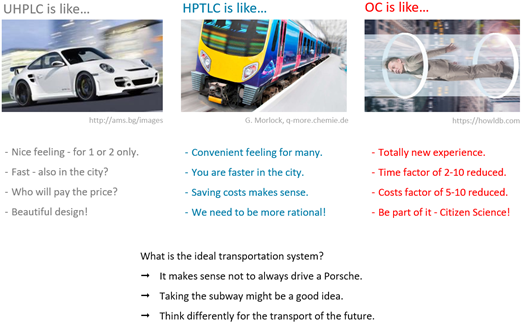
No styling is needed if you take the metro, so raw extracts are transported in HPTLC!
Imagine any metropolis like New York, Beijing, Tokyo, Paris, or Moscow without the metro?
What about separation science? No metro/subway needed... really? Not needed, although the eco-friendliness of HPTLC is as good as taking the metro.
The following figure also helps illustrate that HPTLC is a niche in research and is not seen as an option. This is because HPTLC is not trained in Analytical Chemistry or Food Chemistry (only in simple TLC, as proof that it makes no sense). The real potential of HPTLC is rarely known to experts. As a result, it often ends in analytical inefficiency - not taking the best technique to solve the challenge.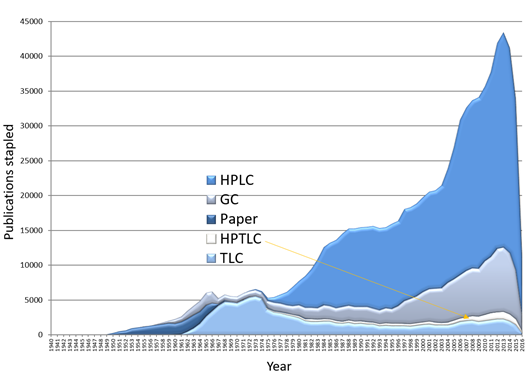
We curiously focused our research on aspects of HPTLC that are unique...
- Spotlight on the zone! Targeted high-resolution mass spectrometry avoids the recording of unnecessary data and contamination of the HRMS system. Since 2004, we have investigated the elution head-based coupling of planar chromatography with mass spectrometry. Since 2005, we have investigated desorption-based couplings. To date, we have published over 100 peer-reviewed research papers demonstrating the advances and benefits of HPTLC-MS coupling, which is essential to advancing HPTLC. Thanks are owed to the Landesstiftung Baden-Württemberg for funding a PhD position 2006-2009 and DFG/JLU for funding the high-resolution mass spectrometry system.
- Microorganisms and adherent cells on the plate! The open format is best suited among all chromatographic techniques for hyphenation with biological tools! Although our first papers were published in 2008, we primarily began developing quantitative bioautography in 2013. In 2014, sharply bounded active zones were reported for the first time in 70 years (in 1946, a Nature paper reported the first direct bioautography). New knowledge is obtained using this quantitative bioanalytical tool: We can deal with the unknown unknowns! We discover traces that matter. Our food is our medicine (attributed to Hippocrates) - so true! In over 50 peer-reviewed research papers, we brought forward this idea. Thank you to Merck, which recognized the potential immediately. Thanks are also owed to DFG, which granted a postdoc position, though it was not filled because the postdoc unfortunately chose another option (such underhanded tactics were not welcome).
- Print on the plate like on paper! It means being disruptive and thinking differently. Miniaturization to a still manageable size is the key to progress. We first showed printing on the plate in 2007. We further developed it and printed sample solutions, the mobile phase, the cell suspension, and the HPTLC layer itself. The exploited open-source technologies also offered potential for our own tailor-made automation of HPTLC-HRMS.
Since I went back to academia in 2004, I noticed the beauty in the valleys passed - success is a journey. Crises are opportunities and chances to grow. Meanwhile, we made many scientific contributions, including more than 70 practical workshops, to give HPTLC an independent voice; trained and inspired more than 100 guest researchers from over 25 countries about the potential of HPTLC; and solved severe challenges in industrial processes and other academic groups.
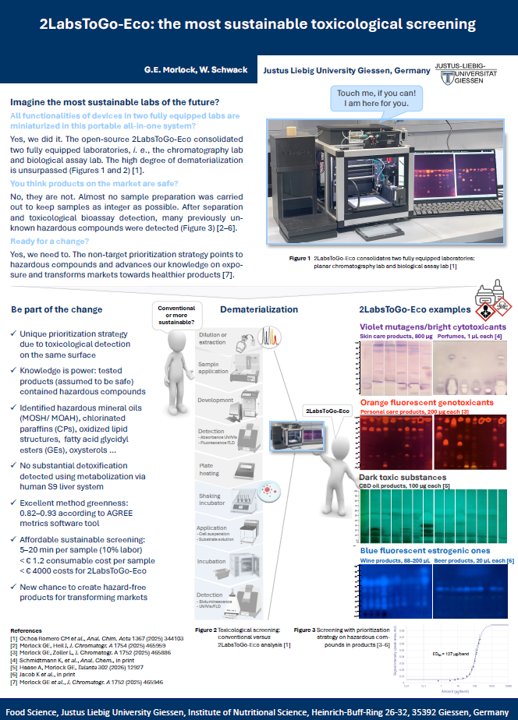
2LabsToGo-Eco: miniaturized, all-in-one, open-source, sets new sustainability standards
In 2010, we founded a new discipline combining planar chromatography with office peripherals, called Office Chromatography. Focusing on the open planar concept and participating in the worldwide advancement of print & media technology, office chromatography will provide an ideal platform for miniaturized planar chromatography on credit-card-sized ultrathin layers. Chromatographic runs are performed within a minute for many samples in parallel, meaning runs/sample below a second in a user-friendly and eco-friendly environment. This new discipline is highly disruptive. The sustainable, portable, open-source 2LabsToGo-Eco system combines a chemical-analytical laboratory with a biological laboratory. It combines sample separation with biological effects detection and provides a solution for checking the quality of complex samples. Sustainability is guaranteed by low manufacturing and operating costs; analyses can be performed anywhere in a user- and environmentally-friendly environment, also supported by solar energy. The sustainable 2LabsToGo-Eco is especially useful for laboratories with limited space and budget that need to answer urgent analytical questions. Read more in the latest 2LabsToGo-Eco of 2025 with open-source file download on the GitHub platform.
If interested in the history: Review of the beginning until 2015, OCLab1, OCLab2/LabToGo, and OCLab3/2LabsToGo.
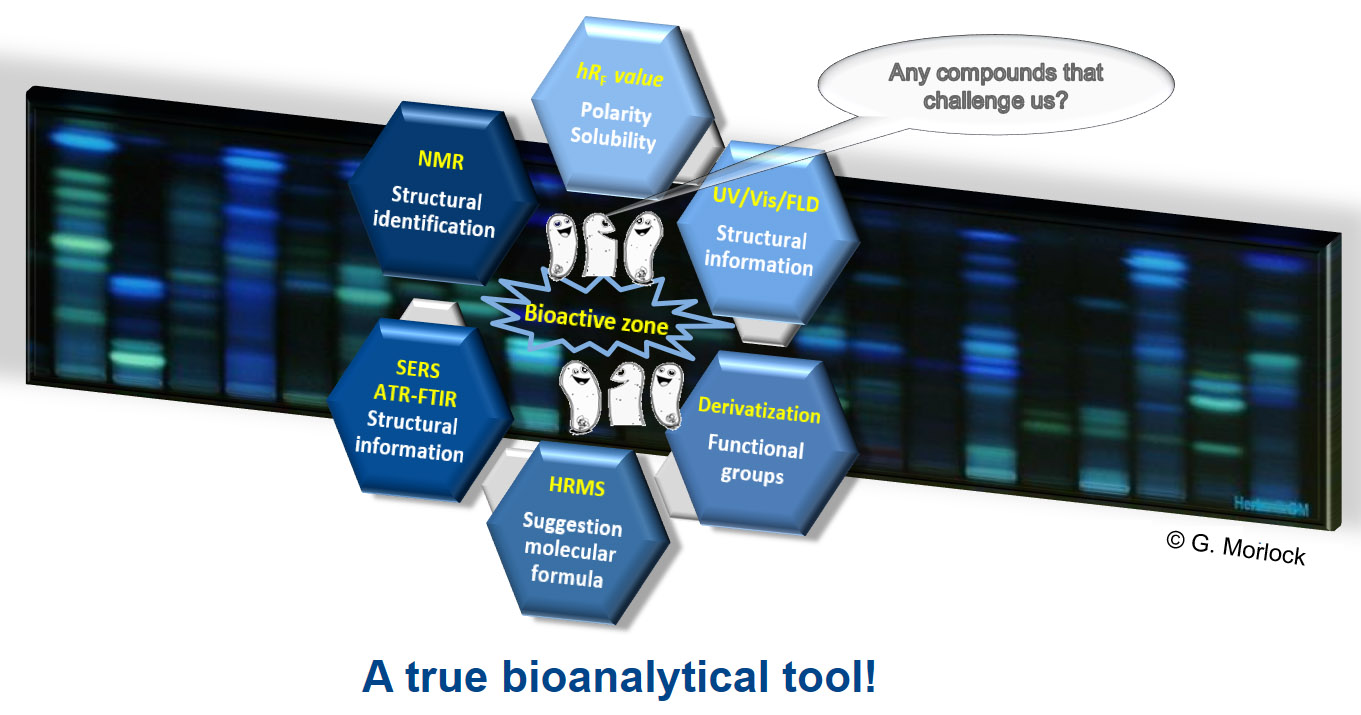
Effect-directed analysis: Better glasses needed? You want to see more? Use quantitative HPTLC-EDA-HRMS
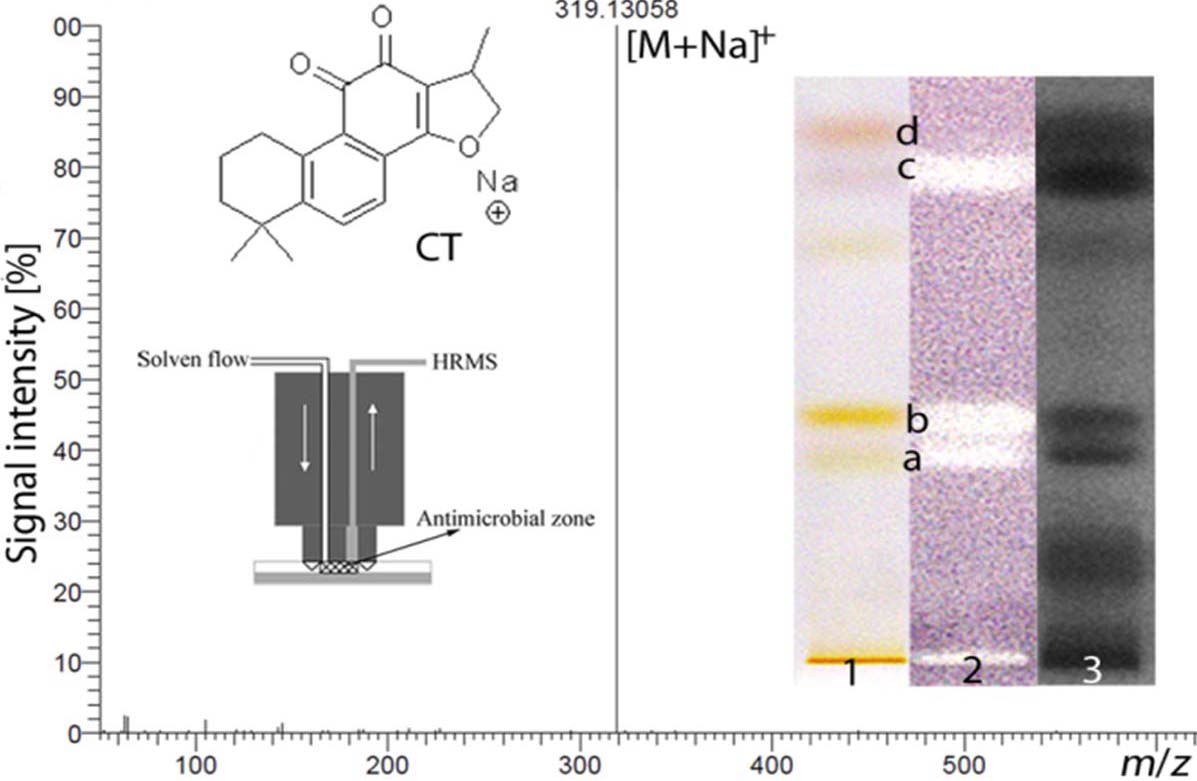
HPTLC coupled with bioactivity-based detection by Aliivibrio fischeri and Bacillus subtilis bacteria or genetically modified yeast strains (pYES/pYAS assays, including antagonistic effect detection pYEAS/pYAAS assays) or enzymatic detections is combined with high-resolution mass spectrometry (HRMS). For screening for bioactive natural products in marine sponges, this effective analytical approach was demonstrated via HPTLC-UV/Vis/FLD-bioactivity-HRMS (6, Chinese). All the following information was reached by a single HPTLC separation: (I) up to 30 sponges (just lyophilized, dissolved and centrifuged) were screened matrix-robust at one go for natural bioactive secondary products (UV/Vis/FLD/EDA images), (II) high producers of bioactive products were identified, (III) information on the range of bioactive products produced by the sponge was given and (IV) the sum formula was obtained from bioactive zones of interest. Read more in an original research paper or in the latest review.
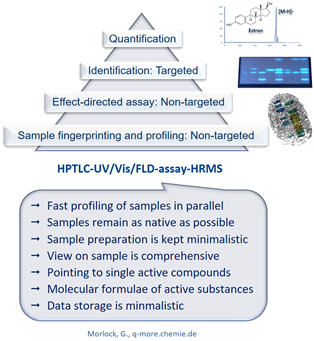
Hyphenation HPTLC-HRMS: Targeted and fast, it saves unnecessary recording of matrix and background
In my professorial thesis research, I successfully focused on hyphenations and particularly on coupling of HPTLC with mass spectrometry (HPTLC-MS) because there has not been available any rational and practical coupling technique. A key feature of HPTLC-MS is the cost-effective, targeted recording of mass spectra. Different approaches were investigated using open ionization sources operating at ambient pressure. Direct analysis in real time (DART) was first coupled to planar chromatography (5) and to atmospheric pressure glow discharge (APGD, later called FAPA). Meanwhile, optimized solutions exist. We substantially modified the DART SVPA interface and achieved mass signals that were 34 times more intense. Our modifications also enable quantitative surface scanning, not only on TLC/HPTLC plates. We also helped to adapt the protocol for TLC-matrix-assisted laser desorption and ionization (MALDI). Using this technique, HPTLC-MALDI-TOFMS achieved repeatability of about 10% directly from the plate via Imaging MS. In April 2004, Dr. Luftmann from the University of Münster published a paper on a TLC-MS interface. One month later, I was visiting him, as I was excited to get such an interface. He was very, very happy and surprised at the same time, as he had approached several leading companies in the field over the previous 3 years, but none had been interested! At that time, the interface worked only with flexible TLC foils/carriers, and we modified it for use on TLC/HPTLC glass plates first. Then, we showed that, using this modified interface, detectabilities were comparable to those of HPLC-MS and that reliable quantification was possible, too. Through our research reported in over 15 original papers, we found that the modified interface was the most reliable and universal plug-and-play tool for HPTLC-MS coupling worldwide. After four years (!), a company took over this successful approach in 2008 and started marketing the interface in spring 2009 (flyer TLC-MS Interface). Nowadays, several options are available for recording mass spectra of zones of interest from the HPTLC plate within seconds. Read more in the latest original research paper and review...
Streamlined analysis: One can do it the way around or straightforward - your decision. Who pays for inefficiency?
Planar chromatography comprises all chromatographic techniques that use an open-planar stationary phase, present as or on a plane. Therein, the simple thin-layer chromatography (TLC) is the most widely spread chromatographic technique; whereas high-performance TLC (HPTLC) is considered the most efficient and powerful planar chromatographic technique, standing for optimized coating material (lower particle size and narrower particle size distribution) in combination with the employment of advanced instrumentation for mostly all steps of the chromatographic process. HPTLC is highly relevant in the age of ultra-rapid separations because its planar format offers unrivaled features. A 1000 matrix-robust sample runs per 8h-day are readily achieved by HPTLC. This was shown for quantitative analysis of sucalose in milk confectionery and dietary food (1) or for water-soluble food dyes in various foods (2). Method development and sample throughput are very fast using HPTLC. This was shown for isopropylthioxanthone, a new contaminant found in milk, for which the newly developed HPTLC method was published first (3). Also, difficult analyses can be performed by HPTLC, as shown for heterocyclic aromatic amines and acrylamide in drinking water (4), potato chips, and coffee, yielding results comparable to those obtained by HPLC. Further rapid screening is shown for PAH analysis in water samples, additives in mineral oils with hyphenation of HPTLC with ATR-FTIR, or explosives. Read a recent paper on such a streamlined method...