
Hessian Higher Education Pact
Here you will find all the important information about the Higher Education Pact 2026–2031, its impact on JLU, and answers to frequently asked questions.
- Introduction
-
16 June 2026
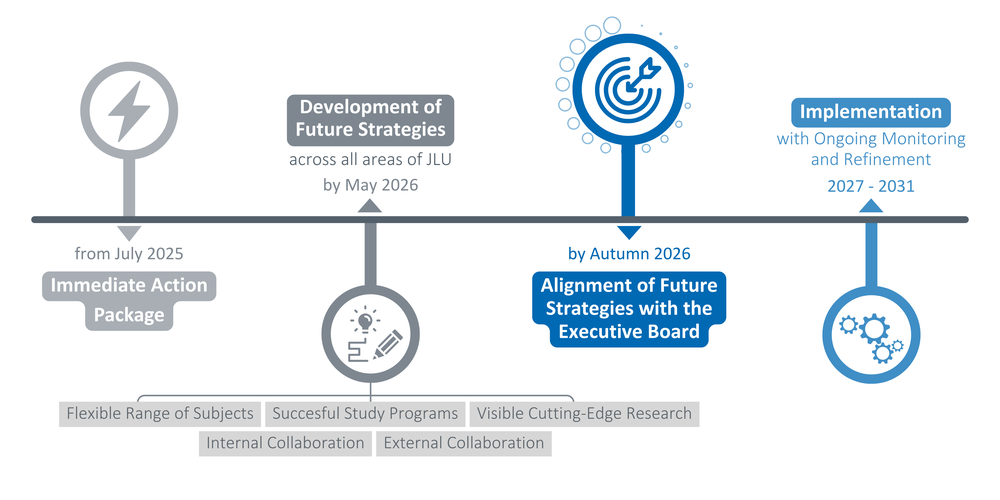
Just under a year after the signing of the Higher Education Pact 2026–2031, it can be stated: JLU is on schedule – and is actively shaping its future.
Shaping the future of JLU
In recent months, the Executive Board, together with all faculties and large parts of the presidential administration, has worked intensively on the future of JLU: analyzing challenges and developing initial future concepts. These concepts are guided by the university's strategic framework: a flexible range of subjects, successful study programs, visible cutting-edge research, and both internal and external cooperation.A significant milestone has thus been achieved. The phase of consolidation now begins: by autumn 2026, the concepts will be merged, aligned at a higher level, and integrated into medium-term planning. The goal is a JLU that remains scientifically strong, financially viable, and capable of long-term action.
Academic breadth to be maintained
Financially, JLU also remains within its planning parameters; recent collective bargaining agreements have remained within the expected range. The required annual savings of approximately 25 million euros remain achievable – based on the current state of affairs – without having to abandon entire faculties of the university. Thus, the breadth of subjects and interdisciplinarity, a particular strength of JLU, will be preserved.At the same time, the restructuring is palpable throughout the entire university. More than 100 full-time equivalents (FTEs) have already been reduced; tasks, processes, and structures are changing, and some things will no longer be possible in the future.
The fact that JLU has been able to pursue this path is due to the commitment of its members and staff: in faculties, administration, services, and infrastructure, employees and managers make a daily contribution to simultaneously consolidating and further developing the university. The Executive Board expresses its explicit gratitude for this.
Changes of this magnitude require time, careful coordination, and sustainable decisions. JLU aims to maintain academic visibility, strategic focus, and future resilience within an increasingly challenging environment.

-
Frequently asked questions about the Higher Education Pact 2026–2031 and its impact on JLU
The university is facing an annual deficit of approximately 25 million euros as a result of changes to the state budget in the new Hessian Higher Education Pact 2026-2031. In order to ensure financial stability and the ability to implement strategies and take action , short-term savings and sustainable structural adjustments are necessary. These include, among other things, a reduction of approximately ten percent of the staff, for wage increases and rising material costs in particular will not be fully compensated by the state during the term of the Hessian Higher Education Pact 2026-2031.
Detailed implications of the Higher Education Pact 2026-2031:
- Permanent reduction of the higher education budget for all universities by 30 million euros from 2026 onwards
- Wage increases will not be offset: No compensation for the after-effects of the 2025 wage increase in 2026 and no compensation for the costs of the wage increase in 2026. From 2028 onwards, wage increases from the previous year will be partially offset.
- Approximately 25% of the total budget at state level will in the future be distributed on the basis of performance indicators (external funding income, completed doctorates, graduates, appointments of women, doctorates of women in STEM subjects, degrees completed by international students). The aforementioned performance parameters, as well as the number of students, are becoming increasingly important because they are expected to be used as the basis for the Higher Education Pact that will come into force in 2032.
JLU's situation with significantly reduced financial leeway:
- High tariff increases in 2025 and repercussions of this increase in 2026
- Significant reduction of reserves at JLU
- Continued high demand for infrastructure renovations
In order to secure JLU's ability to act and strategize in the short and long term, strategic staff reductions and a reduction in infrastructure costs are necessary.
04.11.2025
To secure liquidity, the executive board has transferred reserves to the central administration and imposed a general hiring freeze , which will remain in place until the end of 2026 except for well-justified exemptions.
Of course, these short-term measures should be replaced as soon as possible with sustainable long-term planning . To this end, the executive board is in close dialogue with the faculties and centres.
04.11.2025
The savings affect all JLU facilities , including the administration. Although the hope for quick solutions and simple answers is understandable, JLU is a complex and highly diverse organization that deserves careful and thorough handling of its challenges.
JLU members can rest assured that the executive board and the faculties will closely examine everything and make nuanced decisions .
04.11.2025
The austerity measures are harsh, but they also provide an opportunity to make JLU resilient and secure for the future .
The executive board has developed five guiding principles to serve as a basis for future decisions, for example, when planning appointments in the faculties:
- Flexible and diverse studies with a special focus on the life sciences.
- Successful and highly sought-after degree programmes, particularly those leading to state examinations, fulfill a public service mandate in the region ; 40% of JLU students study education, law, medicine, or veterinary medicine.
- Visible cutting-edge research— including in the three Clusters of Excellence—is a guarantee that the University of Gießen will continue to play an appropriate role in the future.
- Interdisciplinary cooperation within JLU.
- Collaborations with external partners.
04.11.2025
A permanent reduction in staff of around ten percent of state-funded personnel is a political goal of the state government and also affects JLU. The university is therefore taking a series of short-term cost-cutting measures such as a hiring freeze. In the long term, a strategic concept for the future will be developed.
17.07.2025
No, there will be no layoffs.
17.07.2025
A temporary hiring freeze is now in effect for all JLU institutions, initially until the end of 2026. This means that all decisions are suspended by means of this hiring freeze. Future tasks and services, and thus plans for job structures and job approvals, will be fundamentally reconsidered.
New positions or positions that become vacant due to resignations cannot be approved or filled during the hiring freeze.
The following are exempt from this hiring freeze:
-
Contract extensions for current
fixed-term
positions for
academic qualifications
:
a) In the course of the extension options practiced at JLU in accordance with the Temporary Employment Act for Academics (WissZeitVG, German only ), for example as part of the so-called 3+2+1 or 3+3 regulations.
b) As part of the family policy component and additional extension options under the WissZeitVG (Temporary Employment Act for Academics).
c) Due to the coronavirus extension year .
-
Positions that were promised within the statutory binding period of five years as part of
appointment and retention negotiations
.
-
Positions financed via
external funds
.
-
Substitute positions
for maternity leave and parental leave, reduced working hours for family reasons, illness, special leave, etc. can be created for up to 50% of the vacant position.
-
Additional exceptions in well-justified individual cases shall be decided by those responsible for the personnel budgets (dean's offices for the faculties, executive board for the central administration), provided that these exceptions are indispensable for averting security-related, legal, or financial risks or for maintaining essential services (e.g. to ensure teaching) and no other organizational compensatory measures can be taken.
21.07.2025
The executive board works closely with the faculties and centres to make JLU fit for the future.
All other members of the university are also encouraged to contribute ideas and suggestions to this process—preferably directly to the president at praesidentin .
04.11.2025
Against the backdrop of the current financial framework, the Executive Board has decided not to refill the Chair in Turkology. Like all measures, this decision is oriented towards the strengths of the JLU that must be preserved: a flexible range of subjects, successful study programs, visible cutting-edge research, as well as internal and external collaborations. These guidelines were decisive for both the Executive Board and the department when deciding on the future of Turkology. The JLU will, of course – and is legally obligated to do so – ensure that currently enrolled students can continue and complete their studies properly in Giessen.
16.06.2026
-
More Information (German only)
Interview with University President Prof. Dr. Katharina Lorenz
Justus Liebig University confronted with "Funding cuts on an unprecedented scale".
Serious financial cutbacks for JLU
JLU signs Hessian Higher Education Pact: Security in planning under difficult conditions.
Joint statement by Hessian universities
University presidents sign new Higher Education Pact—with reservations.
“A brake on innovation rather than a booster for the future”
Joint statement by the senates of all Hessian universities on the Hessian Higher Education Pact