Global Nutrition and Trade - News
-
Welcome to the Professorship for Global Nutrition and Trade!

- Contact Content Panel
-
Professorship for Global Trade and Nutrition
Head:
Secretary:
Prof. Dr. Thomas Kopp
Harriet Lüdtke
Zeughaus
Senckenbergstr. 3
35390 Gießen+49 (0) 641 99 39313
+49 641 99-39320
thomas.kopp@uni-giessen.desekretariat.kopp.fb09@uni-giessen.de
-
News:
September 2026: Presentation at the Parliamentary Evening of GEFA e.V.
At the invitation of the German Export Association for Food and Agriproducts (GEFA e.V.), Prof. Thomas Kopp took part in a parliamentary evening-, "Free Trade in a Changing World", organized at the German Parliamentary Society in Berlin. He gave the keynote on "Open markets in an uncertain world - agricultural trade between export opportunities, resilience and geopolitical risks", followed by a discussion with the ohter guests, including Ms. PSt Silvia Breher, MdB, Parliamentary State Secretary to the Federal Minister for Agriculture, Food and Regional Affairs, Mr. Hermann Färber, MdB, Chair of the Committee on Agriculture, Food and Regional Affairs and Mr. Jan-Bernd Stärk, acting GEFA spokesperson.

September 2026: GreenPaths Horizon final meeting
Our final GreenPaths meeting at the Universidad de Cantabria in Santander brought colleagues together to share findings, reflect on three years of collaboration, and consider what comes next for just green transitions.
Daniel Chavez and Donna Andrews delivered thought-provoking keynotes, connecting European transitions with wider global questions on a socially just and ecologically sustainable transition and highlighting the importance of solidarity across borders.
A memorable contribution came from our colleague Aimen Abbas, who reflected on her experience as a junior scholar from Pakistan in GreenPaths. The talk highlighted how supportive collaboration, openness to different perspectives, and space to learn can help early-career researchers grow. Her reflections on finding a sense of community within the project gave our final meeting a particularly meaningful closing note.
Thank you to all our colleagues and partners for the knowledge, care, and commitment they brought to GreenPaths. A special thank you to Judith Clifton, Daniel Díaz-Fuentes, Ana Lara Gómez Peña, and Marcos Fernández Gutiérrez for hosting us in Santander.
As the project draws to a close, we take forward both what we have learned and the relationships built along the way.

September 2026: Braunschweig, GeWiSoLa Annual Conference
Prof. Kopp participated at the annual meeting of the German Association of Agricultural Economists (GeWiSoLa), focusing on the theme "Agriculture and rural areas: challenges in a local, regional and global context", at which there was also a reunion with colleagues from Göttingen.

September 2026: ELU - S Conference in Lisbon
Prof. Thomas Kopp participated in the panel discussion “Toward ‘Long-Term Competitiveness’ in the EU?” at the Annual ELU-S Conference in Lisbon on September 3, 2026. In his contribution, entitled “Beyond Competitiveness as Usual: Toward a Sustainable European Competitiveness Strategy,” he discussed the limitations of an efficiency-focused approach to European competitiveness and argued for a broader understanding of long-term competitiveness.


The contribution highlighted the interdependence of economic dynamism, political functioning, and environmental integrity, arguing that none of these dimensions can be traded off against the others without ultimately compromising Europe's long-term competitiveness. The panel brought together different perspectives on how environmental, social, political, technological, and economic factors should inform the EU's future competitiveness strategy.
July 2026: Participation of several group members at ESEE Conference in Ghent
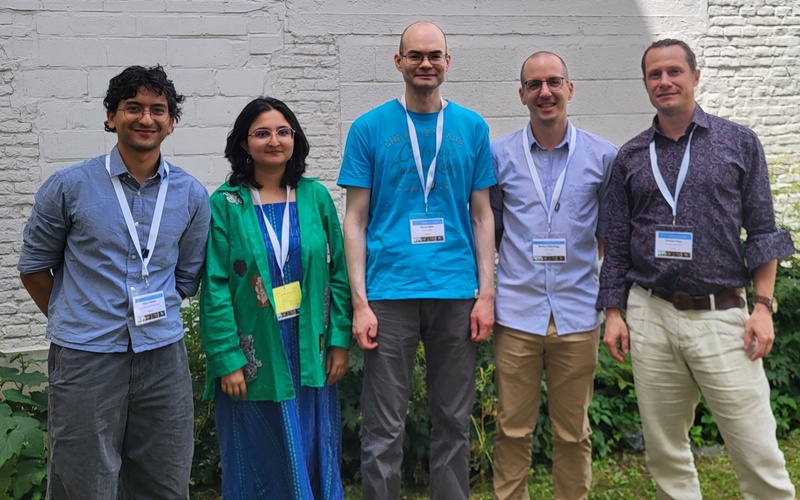
Several members of our group attended the 16th Conference of the European Society for Ecological Economics (ESEE) from June 30th until July 3rd in Ghent, Belgium. Four group members as well as Professor Kopp presented their current work and enjoyed the discussions with ecological economists from across Europe.


Syeda Aimen Abbas presented her paper titled “Greener at Home, Dirtier Abroad? Environmental Policy Stringency and Emissions Embodied in EU Imports.” This work explores how stricter EU environmental policies can be linked to increasing emissions embodied in imports.

Marcel Böhl, in a joint work with Steffen Lange titled "Rising Prices, Rising Populism: Inflation and Far-Right Populists' Electoral Gains in Western Europe,” analyses a monthly panel dataset of 19 countries over 25 years. This study concludes that inflation tends to increase far-right support in Western European countries.

Markus Nabernegg discussed a joint paper with Luca Salvatici titled "Where is the EKC turning point? A meta-study of in-sample vs. out-of-sample turning points for production- and consumption-based carbon indicators.” This paper reviews studies that utilise the Environmental Kuznets Curve (EKC) to classify them as no EKC, in-range EKC, or out-of-range EKC.

Vipul Chawla presented a paper titled "A Room of One’s Own? A Panel Data Analysis of Income Inequality and Living Space in Post-Communist and Non-Post-Communist Countries in Europe." This study explores the relationship between income inequality and living space in Europe, and whether this association differs between post-communist and non-post-communist countries.

Prof. Thomas Kopp discussed a collaborative research with Severin Caspari and Niklas Heiland titled "Reducing Emotional Distress in Academic Work Environments through Experimental Organizational Development.” This work reveals that a two-hour annual workshop appears to meaningfully strengthen leadership practices and improve the working conditions of junior researchers at universities.

July 2026: New publication in Higher Education Quarterly
Inga Stademann, Julia Wiethüchter, Pia Mamut, Hannes Wender and Thomas Kopp recently published the paper "Grasping Sustainability Culture in Higher Education Institutions: Conceptualizing and Understanding Key Elements" in Higher Education Quarterly.
This study assesses the need for a robust sustainability culture to support long-term structural reforms in higher education institutions. The analysis highlights participatory structures, respectful work environments, and transparent communication as critical cultural conditions that shape the effectiveness of sustainability efforts in institutions.
Inga Stademann, Julia Wiethüchter, Pia Mamut, Hannes Wender, Thomas Kopp. 2026. Grasping Sustainability Culture in Higher Education Institutions: Conceptualizing and Understanding Key Elements. Higher Education Quarterly. https://doi.org/10.1111/hequ.70129.

July 2026: Invited talk of Markus Nabernegg at the International Inequalities Institute, LSE
Chair member Markus Nabernegg presented his ongoing work, “Earnings volatility in Latin America: evidence from administrative data”, at the SMOOTHIE seminar of the International Inequalities Institute at the London School of Economics.
In this joint work with Verónica Amarante, Paula Carrasco, H. Xavier Jara, and Joaquín Prieto, harmonised monthly administrative social-security records for Chile, Ecuador, and Uruguay are used to study short-term earnings and labour-market volatility in formal private employment.

July 2026: Presentation of Markus Nabernegg at the World Inequality Conference
Chair member Markus Nabernegg presented his paper "Extreme Income Inequality in Ecuador – Dollarization, Commodity Price Boom, and Citizen Revolution" at the World Inequality Conference at the Paris School of Economics (04 - 06 June).
The three-day event also launched the Global Justice Report, a "new vision for global progress in the 21st century: grounding human development and equality in planetary habitability”.


June 2026: New publication in Ecological Economics
Syeda Aimen Abbas and Thomas Kopp recently published the paper "The Distributional Impact of Environmental Policy Stringency in Europe" in Ecological Economics.
The study examines the relationship between environmental policy stringency and income inequality across 26 European countries over the period 1990–2022. Using the OECD Climate Actions and Policies Measurement Framework (CAPMF) and three measures of income inequality, the findings suggest that more stringent environmental policies are associated with higher pre-tax and post-tax income inequality, while the effects on disposable income inequality are not statistically significant. The results highlight the important role of redistributive policies, particularly cash transfers and social spending, in supporting a socially equitable green transition.
Abbas, Syeda Aimen, and Thomas Kopp. 2026. The Distributional Impact of Environmental Policy Stringency in Europe. Ecological Economics, 249: 109118. https://doi.org/10.1016/j.ecolecon.2026.109118

June 2026: PANE-Meeting in Potsdam
PANE project meeting in Potsdam for a constructive exchange.
The intensive dialogue focused on examining the social, economic and ecological effects of participatory, sustainable food production,
as well as the impact of community-supported agriculture (CSA) on sustainable regional development in rural areas of eastern Germany.

June 2026: Presentation of Prof. Kopp at the Italian Association of Agricultural and Applied Economics Conference in Rome
On 11 June, Prof. Kopp presented his joint work with Ashok K. Mishra (Arizona State University) and Alwin Dsouza (New Mexico State University) entitled "Reducing Negative Effects of Risk Aversion on Farming Outcomes: Evidence for Systematic External Selection into Profitable Contracts” at the 15th Italian Association of Agricultural and Applied Economics Conference in Rome.
This study examines the interplay between risk aversion and contract farming in developing and emerging economies, focusing on 660 representative okra farmers in Karnataka, India. Utilising an instrumental variables approach, the empirical analysis confirms that risk-averse farmers are over-proportionately selected into production contracts, which are 46.3% more profitable than marketing contracts. The systemic selection benefits vulnerable, risk-averse farmers by grantingthem privileged access to the most advantageous contract farming arrangements.
The results of the study, relevant for the development discourse, emphasise the benefits of production contracting for poverty reduction, while highlighting the monopsonistic tendencies of contracting firms in controlling the selection of farmers.

June 2026: Presentation of Vipul Chawla at the Housing Studies Association Annual Conference
On 4 June, Vipul Chawla - Master's student and research assistant of the chair - presented his current research at the Housing Studies Association Annual Conference 2026. The presentation was a joint work with Prof. Kopp entitled "A Room of One’s Own? A Panel Data Analysis of Income Inequality and Living Space in Post-Communist and Non-Post-Communist Countries in Europe.”
This study explores the relationship between income inequality and living space in Europe, and whether this association differs between post-communist and non-post-communist countries. The results suggest a significant positive but non-linear relationship between income inequality and living space, which may be explained by competing channels in play: conspicuous consumption at the top and housing crowding at the bottom of the income distribution.

June 2026: New publication in the International Journal of Sustainability in Higher Education
Inga Stademann and Thomas Kopp recently published the paper "Success determinants and institutional impact of sustainability projects in higher education" in the International Journal of Sustainability in Higher Education.
This study aims to identify the determinants of successful sustainability projects in higher education institutions (HEIs). Utilising survey data of 273 participants involved in sustainability projects at German HEIs, the study highlights the critical role of effective project design and management in embedding sustainability.
Inga Stademann, Thomas Kopp. 2026. Success determinants and institutional impact of sustainability projects in higher education. International Journal of Sustainability in Higher Education. https://doi.org/10.1108/IJSHE-06-2025-0615

May 2026: New publication in the Journal of Environmental Economics and Management
Markus Nabernegg and Thomas Kopp, together with Stefan Nabernegg from the University of Graz, recently published the paper "Amplified challenges for the joint reduction of emissions and inequality, considering the missing-rich" in the Journal of Environmental Economics and Management.
The study combines tax microdata with machine-learning-based consumption predictions to better estimate emissions of the highest-income households. Applied to Ecuador, the results suggest that substantial income redistribution raises emissions by 26% when calculated with the new approach, compared to 6% when based on uncorrected survey data.
Nabernegg, Markus, Stefan Nabernegg, and Thomas Kopp. 2026. Amplified challenges for the joint reduction of emissions and inequality, considering the missing-rich. Journal of Environmental Economics and Management. 139: 103353 https://doi.org/10.1016/j.jeem.2026.103353

May 2026: Print version of ICODICE Manual available for free of charge
This ICODICE Manual offers practical guidance for stakeholders in higher education, including lecturers and university administrations, for planning and implementing international online collaborations in higher education. A limited number of print versions of the manual are available and can be ordered free of charge by contacting harriet.luedtke. A donation to Common Future e.V. is appreciated (IBAN DE84 4306 0967 6015 8424 03).
The digital version can be found under the following link: https://www.uni-giessen.de/en/faculties/f09/institutes/agri/gnt/imagesresearch/digital_internationally-connected-digital-classroom-education.pdf.
Background: The Internationally Connected Digital Classroom Education (ICDOCIDE) is an innovative approach in higher education that brings together students from different countries in shared digital classrooms to exchange knowledge, experiences, and perspectives. The ICODICE method was developed in a pilot project between Justus-Liebig-University Gießen (Germany), the University of Siegen (Germany), and Kerala Agricultural University (India) and funded by the German Foundation for Innovation in Higher Education (“Stiftung Innovation in der Hochschullehre”). It brought together students from India and Germany and focused on the effects of climate change, climate justice, and pathways of socio-ecological transformation — topics that are relevant to societies both in the Global South and the Global North.
The manual can be cited as "Engeling, Claudius; Chawla, Vipul; Raghavan Sathyan, Archana; Kopp, Thomas, 2026: Internationally Connected Digital Classroom Education – A practical guide for higher education.”

May 2026: In-person Chair meeting in Gießen
The Professorship for Global Nutrition and Trade held a team meeting on May 19 in Gießen. Chair members shared updates on their ongoing research projects and provided feedback on each other's work.
Following the presentations, the team attended the weekly PhD Seminar and then went on a city tour covering historical landmarks such as the Church Tower, the Synagogue, and the Old and New Castle.

May 2026: Visit and presentation of Prof. Dela-Dem Doe Fiankor in Research Seminar
On May 05, 2026, Dr. Dela-Dem Doe Fiankor, Profesor for Food Economics and Policy at the University of Göttingen, presented his research at our seminar.
In his talk, entitled "Global Wheat Price Shocks and Firm-Level Export Price Setting", Dr. Fiankor discussed how different wheat market shocks transmit to export prices of pasta and related products. The study combines a Bayesian structural VAR of the global wheat market (1970–2022) with Italian firm-level export data (2004–2022) and finds significant and asymmetric pass-through driven by demand and inventory shocks—stronger for positive shocks—while supply shocks have weaker effects.
Thank you, Dela, for your visit and sharing these interesting insights!


April 2026: Kick-Off session of new PhD Seminar
The first presentation in the new PhD Seminar, organised by Prof. Kopp, took place on Tuesday, April 21, at Zeughaus. Dr. Chukwuma Ume presented joint work with Ramona Teuber and Stéphanie Domptail, focussing on "Women’s Empowerment and Agroecology Participation: Panel Evidence on Food Security in Nigeria".
Future meetings will take place on Tuesdays, 12:30-13:30 at seminar room S4 in the Zeughaus building (Senckenbergstraße 3 in Gießen).
An overview of all sessions in this semester can be found here.

April 2026: Presentation of Aimen Abbas at the Wegener Center for Climate and Global Change in Graz
On 16 April, PhD student Aimen Abbas presented her current research at the PhD seminar of the Wegener Center für Klima und Globalen Wandel at the University of Graz, following an invitation from Stefan Nabernegg. She presented joint work with Prof. Kopp in her talk entitled “Greener at Home, Dirtier Abroad? Environmental Policy Stringency and Emissions Embodied in EU Imports”. This paper explores how stricter EU environmental policies may be linked to emissions embodied in imports.
The presentation was well received, and the discussion provided valuable comments and feedback for the further development of the study. Many thanks to Stefan Nabernegg for the invitation and to all participants for their helpful input.

April 2026: Ayça Akçakoca's Chairing of ECOSOC at National Model United Nations 2026 in New York
Ayça Akçakoca, member of the Chair of Global Nutrition and Trade, and affiliated to the Center for Economic Education at the University of Siegen, participated in the National Model United Nations (NMUN) 2026 in New York and served as Chair of the Economic and Social Council (ECOSOC) during Week B. In this role, Ms. Akçakoca led the committee through all sessions and ensured that the formal rules of procedure were applied consistently, providing a structured setting for debate.
Further, the delegation, that Ms. Akçakoca was part of, received the Outstanding Delegation award, the highest distinction at NMUN, for the fourth consecutive year. Looking ahead, she aims to take on a Directorship role at NMUN in the coming year.
NMUN is the largest simulation of the United Nations worldwide and brings together participants from many countries to engage in diplomatic negotiation on global issues.

