Content
Conference Abstract
When thinking of writing as a practice, one might imagine a lone author with shoulders bent
over a desk, frantically looking over messy handwritten notes and typing away on a laptop.
What ideas are behind this image, and how do practices of writing actually look like?
Writing is not only a literary practice –in the traditional sense– but one linked to various
professions and institutions, making it a cultural practice. From drafting laws to journalistic
writing, the practice unfolds under very different conditions and in specific environments –
collaboratively on Google Docs, alone in a library, or during an interview in a café– all of which
shape how and what we write. Similarly, in their handbook on work practices in cultural studies,
Ute Frietsch and Jörg Rogge make a compelling case for examining how different discursive
and material spaces shape how we as researchers understand, create, and disseminate
knowledge, whether that involves taking notes in noisy classrooms or mobile writing sessions
on the train.
Throughout history, as well, writing has never only been characterised by one type of act, but
of many: Compilation, revision, and translation have shaped some of the world’s most read
written works, including the accumulated Hindu Upanishads, Confucius’ edited poetry
collection of Shijing (Book of Songs), and the various versions and translations existing of the
Bible, the Qur’ān, and the Buddhist Canons. In the nineteenth century, the idea of authorship
evolved in Western countries: instead of relying on the patronage of the aristocracy, writing
became a profession as we would recognise it today thanks to the consistent income people
received for writing serially for magazines and journals. Today, academic writing is impossible
to think of without first drafts and more collaborative writing, including the more recent
synergistic practices in branches of anthropology as well through co-authorship and peer
review. And, whether we like it or not, the use of Large Language Models such as ChatGPT
force us to reconsider notions of authenticity in writing processes and what it means to be an
author in our digital day and age.
This symposium seeks contributions that will provide new perspectives on the acts or practices
of writing. We want to foster a creative and collaborative dialogue amongst our participants
and are specifically looking for papers that not necessarily focus so much on what is in a
published text, but the individual, cultural, and material processes that precede and produce it.
Themes that may
- Historical perspectives on writing and writing professions
- The work of Aufschreibesysteme (Friedrich Kittler’s ‘discourse networks’)
- Writing cultures and professions
- Didactic, cognitive, and material/technological processes of writing
- Ideas of authorship and the performativity of writing
- Serial writing, collaborative writing, and (cultural) translation
- The ‘spaces’ of writing, i.e. the field, the desk, the library, etc.
- The power and politics of writing acts, i.e. disruptive or founding texts such as the
American Declaration of Independence - Acts of Writing in religious traditions (script, scripture, sacred text)
- New forms of publishing, self-publishing
- Multimodal writing
- The advent of AI and writing in the digital world
- Changes to and in academic writing
Options to present at this symposium includes presenting a poster during our poster session or
a 20-minute paper presentation. Please submit a 300-word abstract (indicating whether you
will prefer a poster or presentation) along with a short, maximum 200-word bio note to the
email address acts.of.writing@uni-giessen.de by the 30th of March 2025. Notification of
acceptance follows mid-April 2025.
Organisers of the symposium include:
- International PhD Programme (IPP) “Literary and Cultural Studies” (IPP)
- International Graduate Centre for the Study of Culture (GCSC) be discussed include, but are not limited to:
Keynote Lecture I: Prof. Dr. Timothy C. Baker

All literary criticism is to some extent autobiographical: the way we select and analyse texts says as much about us at the works themselves. Authorship can be seen as an act of rereading as much as writing, and tracks our own changing relationships with texts over time. Likewise, many current writers are explicitly choosing to blur the lines between literary criticism and memoir to show how the categories of reader and writer always overlap. In this session Timothy C. Baker will be reading from and discussing their recent hybrid memoir Reading My Mother Back: A Memoir in Childhood Animal Stories, in which they revisit children’s classics to tell a story of grief, trauma, and family secrets. Baker’s memoir tells the story of his mother’s life, and death, through the animal stories they shared, both familiar and less-well-known. The memoir touches on memory, loneliness, disability, and religion, and shows how literature can provide a way to understand our experiences and connect with what we have lost. Reading My Mother Back offers a bold and personal view of why the stories we read, share, and write about matter.
Bio:
Timothy C. Baker is Personal Chair in Scottish and Contemporary Literature at the University of Aberdeen, having previously studied Cognitive Science at Vassar College and English Literature at the University of Edinburgh. Their work centres on Scottish literature, queer studies, and environmental humanities. They are the author of five books, most recently Writing Animals: Language, Suffering, and Animality in Twenty-First-Century Fiction (2019), Reading My Mother Back: A Memoir in Childhood Animal Stories (2022), and New Forms of Environmental Writing: Gleaning and Fragmentation (2022). Baker’s writing focuses on both human-animal and environmental relationality, experimental literary forms, and interdisciplinary modes of reading, alongside a longstanding interest in literature and community. They are currently co-editing the forthcoming Routledge Companion to Scottish Literature, and have recently published in Green Letters, C21 Literature, and Gothic Studies. They were a founding member of the British Association for Contemporary Literary Studies, and teach and research widely across the twentieth and twenty-first centuries.
Keynote Lecture II: Prof. Dr. Katrin Lehnen
The emergence of generative AI is fundamentally changing the nature of writing. Programs like ChatGPT allow us to produce coherent written or multimodal texts at impressive speed—even with relatively simple prompts. This development is reshaping traditional concepts of authorship and originality. At the same time, the automation of writing has brought about a new dimension of collaborative writing, leading to constellations in which machines act as autonomous participants in the writing process (Lehnen 2023; Steinhoff 2023). AI can be addressed in various roles: It may act as a ghostwriter, taking over the writing entirely; as a writing tutor, offering support and feedback; or as a writing partner, engaging with the human in co-creating the text (Steinhoff, in press). Beyond that, writing with AI doesn’t only mean using it to generate texts—so-called “Chat-to-Generate” or “Chat-to-Create”—but also includes a new kind of dialogic co-writing through ongoing interaction, what we might call “Chat-to-Chat” (Steinhoff & Lehnen 2025).
In this talk, I explore how these new role constellations and modes of collaboration can be theorized and empirically observed. What kinds of roles and collaborative dynamics emerge when “machine participants” (Steinhoff 2023)—that is, digital infrastructures and writing technologies—are able to automate or even fully take over writing tasks? What kind of co-activity is involved when programs correct or complete words, translate entire texts, or—like generative AI—produce full texts from scratch? And finally: how is collaboration in writing transformed when it is no longer initiated exclusively by humans, but also by machines?
Bio:
Katrin Lehnen has been Professor of German Language and Media Didactics at Justus Liebig University Giessen since 2007. Her work focuses on the study of writing processes and practices across various domains and institutional contexts. These include academic and professional writing, collaborative and digital writing, and more recently, writing with AI. Her research interests are interdisciplinary, combining questions from linguistics and literary studies (e.g., authorship and memory) with sociological, educational, and language didactic perspectives—such as how writing acquisition and learning are transformed by digitalization (digital habitus). Her academic practice has included serving as the director of the Center for Media and Interactivity (ZMI, now DimL) as well as holding the position of Deputy Representative for Women and Gender Equality at the University of Giessen.
Literature
Lehnen, Katrin (2023): Kooperatives digitales Schreiben in und außerhalb der Schule. Ko-Autorschaft und Textfeedback zwischen Vergemeinschaftung und automatisierter Textproduktion. In: Der Deutschunterricht. Themenschwerpunkt: Digitales Schreiben, Heft 5/2023, herausgegeben von Kirsten Schindler, 18-28
https://journals.ub.uni-koeln.de/index.php/midu/article/view/2059/2224
Steinhoff, Torsten (2023): Der Computer schreibt (mit). Digitales Schreiben mit Word, WhatsApp, ChatGPT & Co. als Koaktivität von Mensch und Maschine. In: MiDU - Medien im Deutschunterricht 5(1). 1–16. https://journals.ub.uni-koeln.de/index.php/midu/article/view/1912
Steinhoff, Torsten / Lehnen, Katrin (2025, in press): Schreiben mit Künstlicher Intelligenz: Das GPT-Modell (Ghost, Partner, Tutor). Erscheint in: leseräume.de
Preprint https://www.researchgate.net/publication/388591263_Steinhoff_Torsten_Lehnen_Katrin_im_Druck_Schreiben_mit_Kunstlicher_Intelligenz_Das_GPT-Modell_Ghost_Partner_Tutor_Preprint_Erscheint_in_leseraumede

Programme
-
June 04
15:00 Coffee & Conference Registration 15:30 Welcome & Opening Remarks 16:00 Panel 1: Changes in Scholarly Writing
Dr. Reneé Wagener (Luxembourg). "Gilbert Trausch and his 'Zauberhefte': How a Historian organised His Working Practices in the Second Half of the 20th Century".
Dr. Anna Gonzalez Suero (Bauhaus University Weimar). "On the Emergence and Development of Autoethnograhy in Germany".
17:00 Break with Fingerfood and Snacks 18:00 Keynote Lecture I - Prof. Dr. Timothy Baker (University of Aberdeen): "Rereading Childhood: Autobiography, Criticism, and Memory"
19:45 Walk together to optional get-together with food and drinks at "Iss Was" (very close to "Hotel am Ludwigsplatz") -
June 05
9:00 Panel 2A: Politics of Writing
Clara Busch (University of Cambridge): "Autotheory and the Politics of Writing (About Writing)".
Miguel Ángel Casto Caballero (University of Giessen): "Hybrid Writing: Between Narrative and Scholarly Discourse. Some Epistemological Reflections From My Experience of Research on Perpretrator's Narratives".
Tien-Phat Nguyen (University of Giessen): " 公案 / kōan / công án and the Complexity of Contemporary Narratives: From the Zen Way of Writing to the Zen Way of Reading".
10:30 Coffee Break 11:00 Panel 2B: Politics of Writing
Dr. Florian Zeilinger (University of Graz): "'Ich hab vor dem Getreng nit horen mögen, was hieruber gerödt worden.' Early Modern Recording Practices by the Example of Imperial Diets Minutes".
Dr. Khedidja Chergui (ENSB Algiers): "On the Culture of Denunciatory Pamphleteering in Colonial Algiers".
12:00 Poster Session and Leg Stretching 12:45 Lunch at Mensa 14:00 Keynote Lecture II - Prof. Dr. Katrin Lehnen (University of Giessen): "'Has this conversation been helpful so far?' – New alliances and partnerships in writing with AI"
15:30 Coffee Break 16:00 Panel 3A: Materialities of Writing
Dr. Alexandra Irimia (University of Bonn): "Bureacratic Fiction, Bureaucratic Scripts. Institutional Writing in The Palace of Dreams and The Beautiful Bureaucrat".
Prof. Dr. Kirsten von Hagen (University of Giessen): "Writing, Retreat and the Condensation of Memory: Marcel Proust and Anna de Noailles"
17:00 Short Break 17:15/30 Panel 3B: Materialities of Writing (Lecture Performance)
Dr. Delphine Chapuis-Schmitz (Zurich University of the Arts): "Writing one:others"
18:15 Walk together to conference dinner ("Restaurant Zum Löwen") -
June 06
9:00 Panel 4A: Writing, the Body, Authorship
Giovana Zamboni Rossi (Free University of Berlin): "Between Writing and the Body: The Performative Nature of Authorship in Hilda Hilst".
Prof. Dr. Gerald Siegmund (University of Giessen): "Writing for the Body"
10:00 Coffee Break
10:30 Panel 4B: Writing, the Body, Authorship
Marie-Theres Stickel (University of Giessen): "'Messieurs, je ne puis pas écrire autrement qu’une femme, puisque j’ai l’honneur d’être femme.' – Jenny P. d'Héricourt’s ‘Reparative’ Dialogic Act of Writing in La femme affranchie (1860)"
Dr. Zsófia Turóczy (University of Graz): "Women Writers in Southeast Europe, an Explorative Study on the Professionalisation of Writing Occupation"
11:30 Recap
12:00 Lunch and Bon Voyage!
Contact
For questions, please contact
Dr. Isabella Maria Engberg and Dr. Jens Kugele
at acts.of.writing
Where to Find Us
| Address |
|---|
|
Justus-Liebig-Universität Gießen Otto-Behaghel-Str. 12 |
Coming by airplane (Frankfurt Airport)
You can take the train from the Frankfurt airport train station (Frankfurt(M)Flughafen) to the main train station (Frankfurt(Main)Hbf) in Frankfurt. From there take a regional train to Giessen (see the Deutsche Bahn website) and then a bus or a nextbike to the GGK/GCSC.
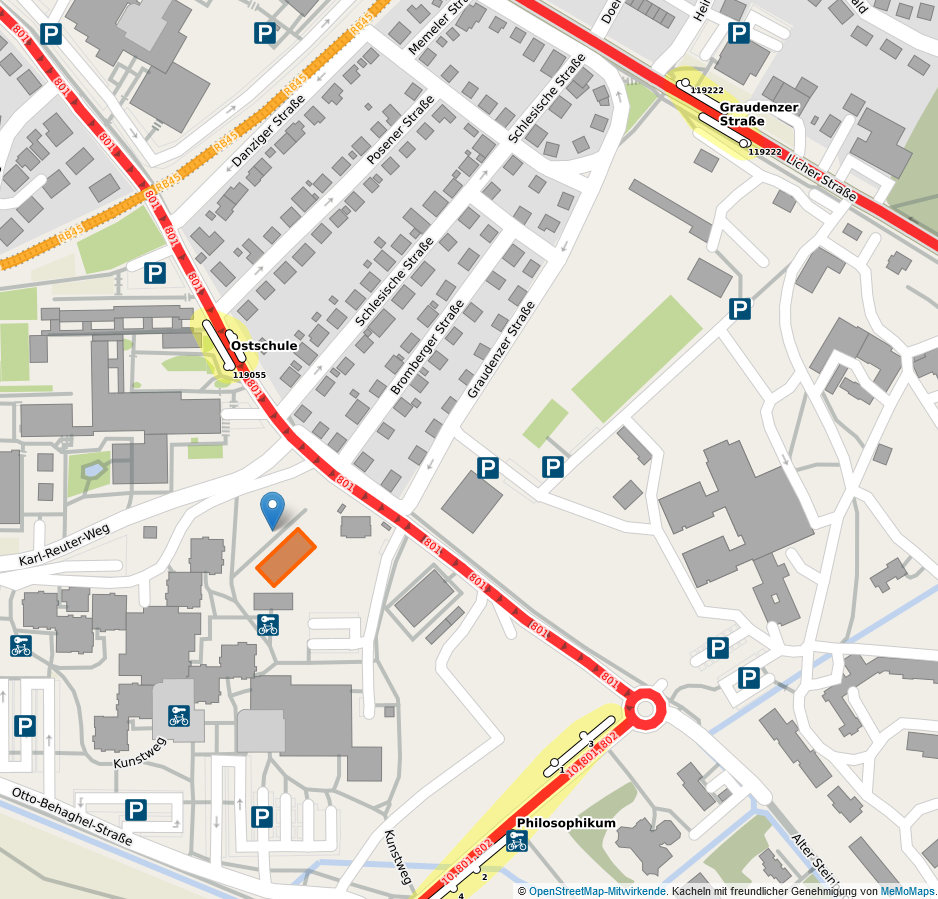
Find us by bus
From the train station Gießen Oswaldsgarten and the bus stop Gießen Marktplatz, the bus line 801 goes to the bus stop Ostschule. When you arrive at Gießen Ostschule, you will see the four-storey GGK/GCSC building. From the train station Gießen Bahnhof, you reach the stop Gießen Marktplatz with the bus lines 2, 5, 15, 24.
Alternative: Line 10 und 18 (from the main Gießen train station) and line 802 (Gießen Oswaldsgarten and Marktplatz) to the stop Giessen Philosophikum. The walk from there is about 10 minutes.
You will find the current route planner on the Stadtwerke Gießen website.
Find us by car (directions from the A5)
The GGK/GCSC is located on the corner of Alter Steinbacher Weg and Karl-Reuter-Weg.
From the South:
Follow the A5 toward Kassel. Turn off the A5 at the junction Gambacher Kreuz toward Giessen and get on the A45. Turn onto the A485 toward Giessen. Get off the A485 at the junction Giessen-Schiffenberger Tal toward the university and get on Schiffenberger Weg. Stay on the Schiffenberger Weg and turn right at the Burger King onto Rathenaustraße. Follow until Alter Steinbacher Weg then turn left. Take the first left in front of the transformer house (direction: 'Anlieferung Uni-Bibliothek' and you will reach the parking lot behind the university library. The four-storey GGK/GCSC building is now directly in front of you.
From the North:
Take the A5 towards Frankfurt, Giessen. Change at the junction Reiskirchener Dreieck from the A5 to the A480 towards Dortmund, Giessen. At the Giessener Nordkreuz change to the A485 towards Giessen, Stadtmitte. Get off the A485 at the junction Giessen-Schiffenberger Tal and get onto Schiffenberger Weg. Stay on Schiffenberger Weg and turn right at the Burger King onto Rathenaustraße. Follow until Alter Steinbacher Weg then turn left. Take the first left in front of the transformer house (direction: 'Anlieferung Uni-Bibliothek') and you will reach the parking lot behind the university library. The four-storey GGK/GCSC building is now directly in front of you.