
Content
Conference Abstract
Trees are in the air these days. Beginning in the late 1990s, during the early explosion of
internet enthusiasm in the west, the concept of a "wood wide web" began to be adopted by
botanists, dendrologists, and natural scientists, based in part upon research by Suzanne Simard
and others showing that trees reciprocally exchanged nutrients with mycorrhizal fungi through
their roots. Contemporary writers publish large, sweeping novels about humanity from an
arboreal perspective, of which Powers’ The Overstory is only the most well-known. And artists
create projects that dramatize the ecological implications of deforestation for climate change or
collaborate with trees as artistic agents and media.
Over the first decades of the 21st century, the analogy between arboreal and human
networks has captured the scholarly imagination, helping to create what Solvejg Nitzke and
Helga G. Braunbeck have called "arboreal imaginaries.” But scientific, literary, and artistic
interest in trees is not a new phenomenon. Many ancient and indigenous peoples have complex
legends, traditions, and practices involving trees as nonhuman people. Sacred groves have been
venerated in ancient religions. The world tree is a mythological concept that reappears in
mythologies across the world, and the tree of knowledge of good and evil is at the heart of
Judeo-Christian religion. From the classical era on, myths and stories about people turning into
trees or vice versa have inspired numerous works of literature, such as Ovid’s Metamorphoses,
Giovanni Bellini’s Apollo and Daphne, Grimm’s Fairy Tales, and Charles Chesnutt’s “Po’ Sandy.”
Western artists, too, have long taken trees as their subjects, from Dutch landscape painting of
the 17th century, to 19th and 20th century artists like Pisarro, Cezanne, and Emily Carr.
Historically, arboreal imaginaries have also played an important role in German cultural
imagination, particularly in German notions of belonging and Heimat. Trees and forests as
symbols, metaphors, and chronotopes have featured prominently in German negotiations of
national character, identity, modernity, and gendered constructions of nature/culture, but also
discourses on sustainability and environment.
Indigenous cultures, unlike those predominant in the west, have long treated trees and
plants (like human and nonhuman animals) as persons. Shaman Davi Kopenawa, in
collaboration with anthropologist Bruce Albert, has powerfully articulated the Yanomami belief
that "the forest is alive," but is being threatened by the destructive actions of white people.
Anishinabe scientists like Robin Wall Kimmerer and Mary Geniusz have written brilliantly on
the interconnections of native cosmologies with Western science. Kimmerer's Braiding
Sweetgrass, which narrates in part the difficulties she encountered as an indigenous woman in
her efforts to integrate Western science with Anishinabe traditional knowledge, has become a
best seller and is a regularly assigned reading on college and university syllabi across the
curriculum.
Recent academic interest in the arboreal crosses the disciplinary boundaries of human,
social, and natural sciences in pursuit of the complex relations among human, nonhuman, and
more-than human realms, drawing on the concept of entanglement developed by such scholars
as Anna Tsing, Donna Haraway, Bruno Latour, Isabelle Stengers, and others. Ideas of tree
communication, cooperation, and cognition are verified empirically by tracing chemicals
transferred among trees and fungal networks, measuring how trees attacked by insects and
other pests emit chemical warnings to their neighbors, and mapping how “mother trees” share
more nutrients with their kin than with other neighboring trees. These and other instances of
multispecies entanglement have led natural scientists to claim that trees share cognition with
humans, what anthropologist Eduardo Kohn might call “thinking like a forest.” They have also
inspired writers and artists to create literary and visual mediations of these arboreal-fungal
networks.
Arboreal entanglements figure in the recent explosion of novels about trees and forests.
Powers’ The Overstory, which traces the obvious and hidden relations among a network of
human, nonhuman, and more-than-human actants, has spawned a minor cottage industry of
critical essays. Annie Proulx’s Barkskins, an epic novel about the multi-century entanglement of
a North American logging dynasty with the displacement and decimation of a native Micmaw
family, has generated important scholarly work on the relations of settler colonialism, the
genocide of native peoples, and deforestation. But these two massive novels are hardly alone in
depicting the entanglement of trees, forests, and humans. Among other recent arboreal novels
are Michael Christie’s Greenwood, Daniel Mason’s North Woods, and Elif Shafak’s The Island of
Missing Trees. Recent interest in tree communication and cognition has inspired Norwegian
author Karl Ove Knausgård to include an extensive section on late 20th-century Russian
research on these topics in his recent Wolves of Eternity.
Artists as well have been inspired by these arboreal entanglements. In an extraordinary
exhibition from 2019 called Trees, the Fondation Cartier pour l’art contemporain in Paris
assembled an amazing group of artists, scientists, and philosophers to dramatize the multiple
arboreal entanglements of human, nonhuman, and more-than-human entities. Curated with
anthropologist Bruce Albert, the exhibition includes work by botanist Francis Hallé,
neurobiologist Stefano Mancuso, and philosopher Emanuele Coccia in dialogue with a wide
range of arboreal art, including contributions by artists primarily from Europe and South
America working in multiple media. Emerging and well-known artists across the world have
staged individual shows on arboreal entanglements, including Charles Gaines, Zoe Leponard,
Maya Lin, William Kentridge, and dozens of others.
On a planet where, at the end of the last Ice Age, trees and forests covered more than
half its land mass, arboreal entanglements have radically shaped human and nonhuman life on
this planet. Métis scholar Zoe Todd cites the claim by Simon Lewis and Mark Maslin that the
Anthropocene should be dated to what they call the “Orbis Spike” of 1610, the statistical dip in
carbon dioxide in the atmosphere caused by the death by disease and genocide of up to 50
million inhabitants of North America in the previous century. Because indigenous people had
for centuries cleared masses of trees for their own farming, rapid afforestation resulting from
this indigenous holocaust worked to sequester so much carbon dioxide that the planet saw a
period of global cooling.
Historians have traced the history of forestry and forest management and their proposed
solutions to planetary problems of land use and climate change brought about by thoughtless
and rapacious deforestation. Environmental activists deploy tree sits and other measures to try
to slow down deforestation and the destruction of old growth forests, at the same time as
massive neoliberal reforestation projects have been launched in the name of reducing
atmospheric carbon dioxide. Attention to planetarity brought about in part by recent discourse
on the anthropocene motivates atmospheric scientists to measure the global impact of loss of
forest cover on the climate change crisis. Jennifer Gabrys has shown how forests have become
increasingly networked by means of digital sensing technologies, to the point where they have
become technologies themselves for managing the planet’s environment.
Keynote Lecture I “Tree Mediation, or Arboreal Entanglement”
Prof. Richard Grusin
Keynote Lecture “Tree Mediation, or Arboreal Entanglement”
Arboreal imaginings have multiplied over the past three decades, not only in the natural sciences but in the popular imaginings of art, literature, and film. In the late 1990s, the heyday of internet enthusiasm in the west, the concept of a "wood-wide web" was coined by botanists and other natural scientists, based upon research showing that trees communicated with mycorrhizal fungi through infrastructural networks whose morphological formation was analogized to the World-Wide Web. In this lecture I will unpack what is at stake in this analogy, interrogating this increasingly popular comparison in order to explore how technical, human, and arboreal networks are linked by their participation in processes of radical tree mediation. I begin by taking up the question of plant mediation to understand what trees and plants have in common. I then lay out some of the operations of arboreal entanglement to begin to understand the specificity of trees among the plant world at large. I will conclude the talk by considering the effectiveness of metaphors like the wood wide web in raising ecopolitical awareness about forests, trees, and climate change generally.
 |
Richard Grusin (GCSC/RCSC Distinguished Research Fellow)
Richard Grusin is Distinguished Professor Emerit of English at University of Wisconsin-Milwaukee, where he served as Director of the Center for 21st Century Studies from 2010-2015 and 2017-2021. He has published four books in English and one in Italian: Transcendentalist Hermeneutics: Institutional Authority and the Higher Criticism of the Bible (Duke, 1991); Remediation: Understanding New Media, with Jay David Bolter (MIT, 1999), Culture, Technology, and the Creation of America’s National Parks (Cambridge, 2003); Premediation: Affect and Mediality after 9/11 (Palgrave, 2010), and Radical Mediation: Cinema, Estetica, e Tecnologie Digitali (Pellegrini, 2017). He has also edited six volumes with University of Minnesota Press: The Nonhuman Turn (2015); Anthropocene Feminism (2017); After Extinction (2018); Ends of Cinema (2020); Insecurity (2022); and The Long 2020 (2023). His current research interests focus on the arboreal humanities. He is currently a GCSC/RCSC Distinguished Research Fellow. |
Keynote Lecture II "Vegetal Ontology, as seen through Emily Dickinson’s Poetic Herbarium"
Prof. Michael Marder
Keynote Lecture "Vegetal Ontology, as seen through Emily Dickinson’s Poetic Herbarium" with Prof. Michael Marder
 |
Michael Marder is IKERBASQUE Research Professor in the Department of Philosophy at the University of the Basque Country (UPV-EHU), Vitoria-Gasteiz, Spain. His writings span the fields of ecological theory, phenomenology, and political thought. He is the author of numerous scientific articles and monographs, including Plant-Thinking (2013); The Philosopher’s Plant (2014); Dust (2016), Energy Dreams (2017), Heidegger (2018), Political Categories (2019), Pyropolitics (2015, 2020); Dump Philosophy (2020); Hegel's Energy (2021); Green Mass (2021), Philosophy for Passengers (2022), The Phoenix Complex (2023), Time Is a Plant (2023), and, with Edward S. Casey, The Place of Plants (2024).
|
Keynote Lecture III “Arboreal Revelation”
Caroline Edwards
Keynote Lecture “Arboreal Revelation”
This talk will outline my developing research into what I call arboreal revelation: a new way of thinking about human subjectivity and its inhuman possibilities. I will outline the elemental aesthetics of literary and cultural texts that privilege the nonhuman perspectives of trees, and other arboreal and mycological partners. These works, I argue, help us grasp a new way of thinking about human-arboreal relations outside of species boundaries and their restrictions. Arboreal revelation requires a radical perspectival shift that moves us into the multi-temporalities of nonhuman time, with their own woody, parenchymatous longue durée. This arboreal deep time gestures towards a sylvan realm of nonhuman futurity – this includes humans, reconstituted as inhuman agents within a post-anthropocentric ecosystem. If we are to adapt and survive what Rob Nixon called the “slow violence” of ecocatastrophe, we need to attune our elemental understanding of woods, trees, and the fungal and microbial worlds within which they are entangled.
|
Yo Mama (2003) by Wangechi Mutu. |
Caroline Edwards (Birkbeck, University of London)
Caroline Edwards is Senior Lecturer in Contemporary Literature & Culture at Birkbeck, University of London. Her research focuses on utopian possibility as it intersects with questions of aesthetic form, genre, temporality, political subjectivity, and post/inhuman agency. Caroline is author of Utopia and the Contemporary British Novel (Cambridge University Press, 2019), co-editor of China Miéville: Critical Essays (Gylphi, 2015) and Maggie Gee: Critical Essays (Gylphi, 2015) and editor of The Cambridge Companion to British Utopian Literature and Culture After 1945 (forthcoming). Caroline is currently writing her second monograph, Hopeful Inhumanism: The Elemental Aesthetics of Ecocatastrophe and edits C21: Journal of 21st-Century Writings for the British Association of Contemporary Literary Studies. Her research has been featured in the New Statesman, the Times Higher Education, the Guardian, SFX Magazine, BBC Radio 4, BBC Radio 3, BBC One South East, the Barbican Centre, the Institute of Contemporary Arts, Whitechapel Gallery, and in a dedicated exhibition at the Museum of London. |

Program
 |
Interdisciplinary Conference
|
Programme
-
June 19
-
8:30 Coffee & Conference Registration 9:00 Welcome & Opening Remarks (Richard Grusin, Jens Kugele, Anna Tabouratzidis) 9:15 Keynote I, Richard Grusin (GCSC/RCSC Distinguished Research Fellow), “Tree Mediation, or Arboreal Entanglement”
| Chair: Ansgar Nünning & Anna Tabouratzidis
10:30 Coffee break 11:00 Panel 1) More-than-human Communication, Interdisciplinary Perspectives
A) Solvejg Nitzke (Ruhr-University Bochum), “Wood Wide Weavings. The Cultural Poetics of Interspecies Communication”
B) Evan Wisdom (Department of English Language and Literature, University of Chicago), “Alternative Arboreal Temporalities. Figures in Wood, Strata in Seed”
C) Leslie Kremper (Physical Geography, Philipps University Marburg), “Atmospheric Frontiers. The Amazon Tall Tower Observatory's Aerosol Mission”| Chair: Jan Rupp
12:30 Lunch 14:00 Panel 2) Meandering Bodies & Thought in Arboreal Spaces
A) T. Hugh Crawford (Georgia Institute of Technology), “Walking with Trees”
B) Stephen O’Neill (Maynooth University), “The Arboreal Poetics of Cruising”
C) Paul Kaletsch (SOAS & GCSC), “The Trees Growing in Our Heads. A Sad Image of Thought”| Chair: Evan Wisdom
15:30 Break & Poster Session 16:30 Artist Talk & Presentation Sarah Bird (UC Santa Cruz)
"Trees/Place. A Strategy for Arboreal-Human Flourishing"| Chair: Jens Kugele (GCSC)
18:30 Dinner 19:30 Optional: Walk through forest -
June 20
| 9:00 |
Keynote II, Michael Marder (University of the Basque Country),“Vegetal Ontology, as seen through Emily Dickinson’s Poetic Herbarium” | Chair: Richard Grusin |
| 10:30 | Coffee break |
| 11:00 |
Panel 3) Cutting Edge/s | Chair: Solvejg Nitzke |
| 12:30 | Lunch |
| 14:00 |
Panel 4) Arboreal Imaginaries: Myth, Art, Activism | Chair: Paul Kaletsch |
| 15:30 | Walk to Botanical Garden |
| 16:00 | Guided Tour Botanical Garden with Volker Wissemann (Botany, Justus Liebig University) |
| 18:30 | Dinner |
-
June 21
| 9:00 |
Keynote III Caroline Edwards (Birkbeck, University of London), “Arboreal Revelation” | Chair: Richard Grusin |
| 10:30 |
Coffee Break |
| 11:00 |
Panel 5) Entanglements, Politics, Forms | Chair: Anna Tabouratzidis |
| 12:30 |
Concluding Discussion | Chairs: Richard Grusin, Jens Kugele, Anna Tabouratzidis |
| 13:00 | Lunch |
| 14:00 | Goodbye and bon voyage! |
Where to Find Us
| Address |
|---|
|
Justus-Liebig-Universität Gießen Otto-Behaghel-Str. 12 |
Coming by airplane (Frankfurt Airport)
You can take the train from the Frankfurt airport train station (Frankfurt(M)Flughafen) to the main train station (Frankfurt(Main)Hbf) in Frankfurt. From there take a regional train to Giessen (see the Deutsche Bahn website) and then a bus or a nextbike to the GGK/GCSC.
Find us by bus
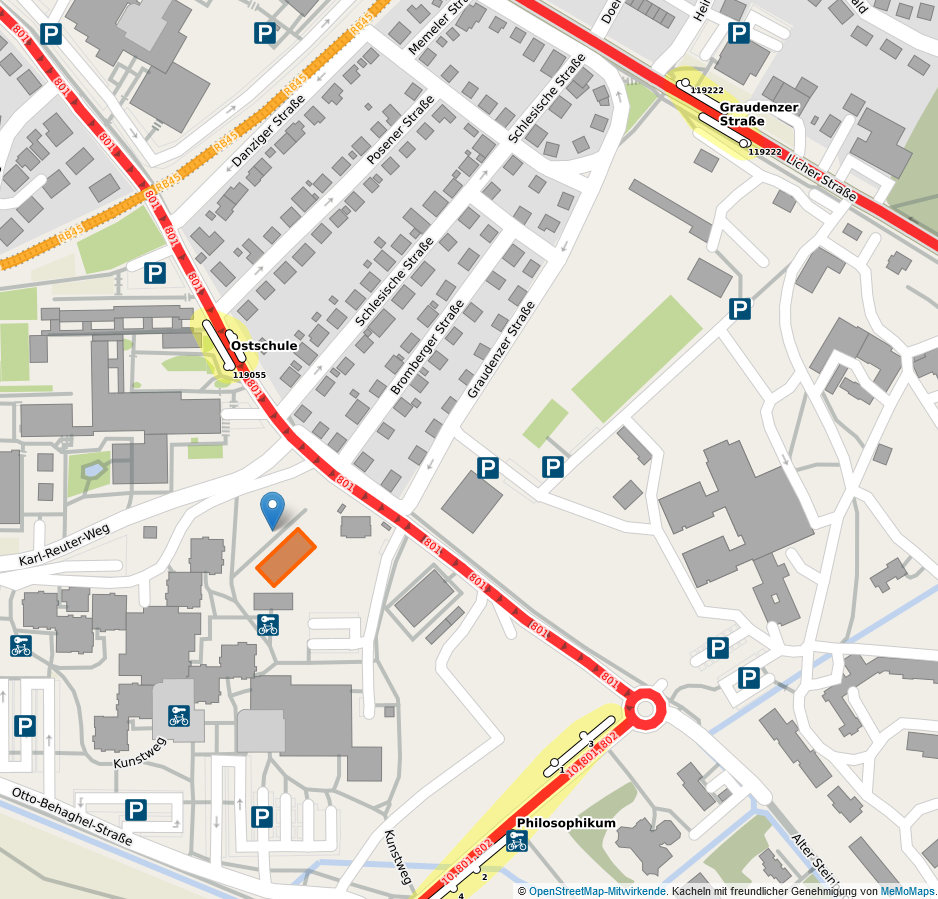
From the train station Gießen Oswaldsgarten and the bus stop Gießen Marktplatz, the bus line 801 goes to the bus stop Ostschule. When you arrive at Gießen Ostschule, you will see the four-storey GGK/GCSC building. From the train station Gießen Bahnhof, you reach the stop Gießen Marktplatz with the bus lines 2, 5, 15, 24.
Alternative: Line 10 und 18 (from the main Gießen train station) and line 802 (Gießen Oswaldsgarten and Marktplatz) to the stop Giessen Philosophikum. The walk from there is about 10 minutes.
You will find the current route planner on the Stadtwerke Gießen website.
Find us by car (directions from the A5)
The GGK/GCSC is located on the corner of Alter Steinbacher Weg and Karl-Reuter-Weg.
From the South:
Follow the A5 toward Kassel. Turn off the A5 at the junction Gambacher Kreuz toward Giessen and get on the A45. Turn onto the A485 toward Giessen. Get off the A485 at the junction Giessen-Schiffenberger Tal toward the university and get on Schiffenberger Weg. Stay on the Schiffenberger Weg and turn right at the Burger King onto Rathenaustraße. Follow until Alter Steinbacher Weg then turn left. Take the first left in front of the transformer house (direction: 'Anlieferung Uni-Bibliothek' and you will reach the parking lot behind the university library. The four-storey GGK/GCSC building is now directly in front of you.
From the North:
Take the A5 towards Frankfurt, Giessen. Change at the junction Reiskirchener Dreieck from the A5 to the A480 towards Dortmund, Giessen. At the Giessener Nordkreuz change to the A485 towards Giessen, Stadtmitte. Get off the A485 at the junction Giessen-Schiffenberger Tal and get onto Schiffenberger Weg. Stay on Schiffenberger Weg and turn right at the Burger King onto Rathenaustraße. Follow until Alter Steinbacher Weg then turn left. Take the first left in front of the transformer house (direction: 'Anlieferung Uni-Bibliothek') and you will reach the parking lot behind the university library. The four-storey GGK/GCSC building is now directly in front of you.