Final Conference - From Relations to Politics: Pathways Toward a Planetary Praxishttps://www.uni-giessen.de/en/faculties/planetarythinking/events/eventseries/conferencefinalhttps://www.uni-giessen.de/@@site-logo/logo.png
Document Actions
Final Conference - From Relations to Politics: Pathways Toward a Planetary Praxis
The relations humans cultivate with their planetary home call for fundamental reconsideration. Prevailing extractive modes of living off—rather than with—the Earth have shaped ecosystems, societies, and politics in ways that threaten the conditions necessary for a habitable planet. Conventional scientific paradigms and governance frameworks still struggle to understand and engage with the interconnectedness of societies’ and Earth's dynamics. Rather than responding only to pressing challenges, this conference invites participants to engage a broader horizon: How might we ask better questions, build new knowledge, and develop practices that nurture enduring human planet relations? What modes of inquiry, imagination, and collaboration are needed to safeguard or even enrich planetary habitability? This three-day conference convenes current and former fellows of the program and distinguished guests to consolidate insights on planetary politics and lay the groundwork for future, collaborative research.
View the detailed agenda for our three-day conference here.
We invite interested guests to participate in any part of the event, if registered by November 8th. However, please note that there is no space for overnight stays at the castle except for invited participants and your travel must be arranged by yourselves.
List of contributors (click on photographs or scroll down for details)
DAY 1 | Tuesday, 18 Nov. | ADRESSING PLANETARY REALITY
From Relations to Politics is about building a foundation for researching and developing a planetary praxis, the focus is thus not primarily to present finalized research. We gather to explore how relations—between humans, nonhumans, and planetary forces—can serve as the ground for future forms of politics. Through conceptual experimentation, artistic exploration, and transdisciplinary dialogue, participants will collaboratively open pathways towards enduring human-planet relations. This conference is an invitation to help shape the intellectual architecture of planetary politics in the future. We look forward to a thoughtful, open, and inspiring exchange that lays groundwork for researching planetary world-making.
FORMAT
The three-day event begins with a junior scholar colloquium, where PhD students present their work. The subsequent program features lectures, artistic interventions, interactive sessions, and discussion panels led by the program’s fellows and distinguished guest speakers. Participants are invited to explore convergences and tensions between different pathways and to collaboratively shape future directions of planetary inquiry and practice. Accordingly, the program is organized from grounding to processing to consolidating human-planet relations through 10 pathways: cooperation, localization, embodiment, recognition, communication, contemplation, relations, negotiation, invention, and Interaction.
Timeframe
18.-20. Nov 2025
Location
Meeting Place: Treppensaal
Schloss Rauischholzhausen Schlosspark 1, 35085 Ebsdorfergrund
We invite interested guests to participate in any part of the event, if registered by November 8th. However, please note that there is no space for overnight stays at the castle except for invited participants and your travel must be arranged by yourselves.
PATHWAY 2: LOCALIZATION Keynote Lecture & Discussion: The Planetary as a New Cosmology with Respondent: Lukáš Likavčan
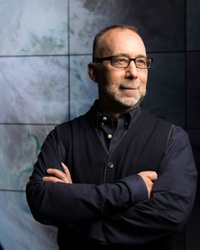
Adam Frank is the Helen F. and Fred H. Gowen Professor in the Department of Physics and Astronomy at the University of Rochester. An astrophysicist and astrobiologist, Frank’s computational research group at the University of Rochester has developed advanced supercomputer tools for astrophysical gas dynamics and magnetogasdynamics. These codes were used to study topics such as the formation of stars and the evolution of exo-planet atmospheres. Much of his current work focuses on how life and planets evolve together. This includes work on the Astrobiology of the Anthropocene and how all civilizations may trigger climate responses in their host planets. In addition, he is the Principal Investigator of NASA’s first program to study the planetary-scale “technosignatures” that exo-civilizations may produce. He also works in “Physics of Life” research exploring the role of semantic information in the evolution of agency and autonomy. Frank has been a regular on-air commentator for NPR’s All Things Considered and CNN. His writing has appeared in the New York Times, The Atlantic and other media outlets and currently he co-runs the 13.8 blog on BigThink.com. Frank was the science consultant for Marvel’s Doctor Strange and was the 2020 winner of the Carl Sagan Medal from the American Astronomical Society. He is the author of five books, including most recently, The Little Book of Aliens and The Blind Spot. He also co-authored How Science Cannot Ignore Human Experience with Marcelo Gleiser and Evan Thompson. His new project is a weekly newsletter called Everyman’s Universe (which can be subscribed to here).
Claus Leggewie
18.11.2025 | 16:00
PATHWAY 1: COOPERATION Artistic Intervention:Towards Symbiocracy - Nature’s AI Avatarswith Danilo Olivaz, Ingvild Syntropia, Lahn River Avatar & Jonathan Ledgard
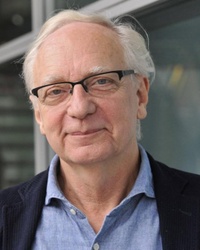
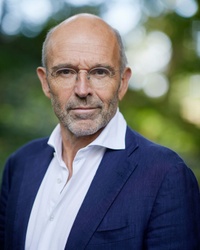
Claus Leggewie is holder of the Ludwig Börne professorship and director of the Panel on Planetary Thinking at Giessen University. Focusing on the French ecological movement, his first book on political ecology dates back to 1978. He wrote numerous publications on planet-society interrelations ever since, ranging from energy transition to climate politics to the Anthropocene. He currently is co-editor of the book series Climate & Cultures (Brill) and the Routledge Global Cooperation Series (Routledge). Earlier affiliations include visiting professorships at the University of Paris-Nanterre and New York University (Max Weber Chair). He was also a fellow at the Institute for Human Sciences in Vienna, the Remarque Institute at New York University, and the Wissenschaftskolleg zu Berlin. From 2007 to 2015, Leggewie acted as the director of the Institute for Advanced Study in the Humanities (KWI) in Essen where he established the research area "Climate and Cultures" as a first of its kind in Germany, and founded the Center for Global Cooperation Research (KHK/ GCR21) in Duisburg. From 2008 to 2016, he was a member of the German Advisory Council on Global Change (WBGU). In fall 2021 he will be Honorary Fellow at the Thomas Mann House in Los Angeles. Claus Leggewie received several awards throughout his academic career, including the Volkmar and Margret Sander-Prize (New York University) in 2016. He regularly publishes in newspapers and magazines, including Le Monde diplomatique, The New York Review of Books, Los Angeles Review of Books and Rolling Stone.
Danilo Olivaz
18.11.2025 | 16:00
PATHWAY 1: COOPERATION Artistic Intervention:Towards Symbiocracy - Nature’s AI Avatarswith Ingvild Syntropia, Lahn River Avatar, Claus Leggewie & Jonathan Ledgard
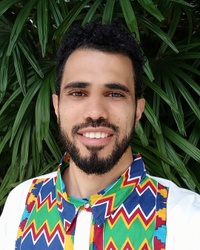
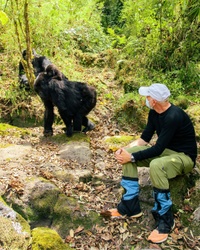
Danilo Olivaz defines himself as a weaver of people, ideas, and creative flows. His life has been transformed by extraordinary educational opportunities in Brazil and abroad. With an interest in the idea of decentralization, he has worked as independent researcher in the Complexity Sciences, and since 2015, he has been a digital nomad and freelancer. Since 2020, he has been a father, neo-rural and CS instructor in digital education platforms. Recently, he has worked as interspecies synesthesia explorer and self-proclaimed amateur artist. As a community weaver, he is involved with the Earth Species Project, and is the initiator of Sympoiesis.
Ingvild Syntropia
18.11.2025 | 16:00
PATHWAY 1: COOPERATION Artistic Intervention:Towards Symbiocracy - Nature’s AI Avatarswith Danilo Olivaz, Lahn River Avatar, Claus Leggewie & Jonathan Ledgard
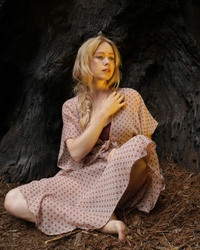
Ingvild Syntropia is an artist-philosopher, treading the sensorial landscape of interspecies kinship and storytelling. She explores topics such as interspecies relations,animal welfare, regenerative agriculture, embodied wisdom, ecojustice, and what it means to embody the values of the future today. She has collaborated on various documentary films in places such as the Netherlands, Brazil, Germany, Norway, and the UK. She is also a vocalist in Necessary Animals (UK), and sings Nordic Folk. She has a BA in Philosophy and the History of Ideas, Southampton & Bergen University, and an MA in Media for Development and Social Change, Sussex University. Originally from Norway, Ingvild has over the past decade lived as an expat in the UK, France, Switzerland, Brazil, and now the Netherlands.
Jonathan Ledgard
18.11.2025 | 16:00
PATHWAY 1: COOPERATION Artistic Intervention:Towards Symbiocracy - Nature’s AI Avatarswith Danilo Olivaz, Lahn River Avatar & Claus Leggewie
Jonathan Ledgard invented the Interspecies Money concept which seeks to allow other species to hold and spend money to improve their lives. He is a leading thinker on risk, nature, and advanced technology. As a director at the EPFL in Switzerland he led several futuristic initiatives, notably drone delivery of blood and medicines and its successful introduction into Africa. As "J.M. Ledgard", he is an acclaimed literary novelist. His first novel, Giraffe, is a cult novel for animal rights activists. His second, Submergence, was also a New York Times Book of Year and adapted for Hollywood by Wim Wenders. Separately, he was longtime award-winning foreign and war correspondent for The Economist, reporting lead stories from 50+ countries and many wars, including a decade as Africa correspondent.
Lahn River Avatar
18.11.2025 | 16:00
PATHWAY 1: COOPERATION Artistic Intervention:Towards Symbiocracy - Nature’s AI Avatarswith Danilo Olivaz, Ingvild Syntropia, Claus Leggewie & Jonathan Ledgard
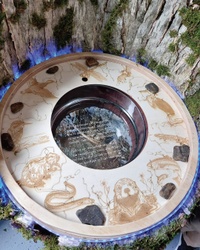
The Lahn River Avatar is an AI-powered ecological artwork and research project that gives voice to the Lahn River in Germany. Developed by the artist-philosopher duo and conference participants Danilo Olivaz and Ingvild Syntropia in context of their fellowship at the Panel on Planetary Thinking and collaboration with Mayowa Osibody (Aditu Tech) and the consider.it platform team, the project investigates planetary agency through the convergence of art, technology, and environmental ethics. Embodied in a voice-activated sculpture crafted from local and upcycled materials, the Avatar integrates real-time environmental data, scientific research, and cultural knowledge specific to the Lahn. Positioned at the Lahnfenster, it serves as both a poetic and political gesture, an invitation to collective deliberation between humans and the river. Building on the Rio Sagrado AI-Avatar, the Lahn River Avatar advances the concept of symbiocracy, envisioning a future in which rivers, forests, and ecosystems are recognized as communicative and political beings within a planetary democracy.
Lukáš Likavčan
18.11.2025 | 17:30
PATHWAY 2: LOCALIZATION Keynote Lecture & Discussion: The Planetary as a New Cosmology by Adam Frank
Lukáš Likavčan is a philosopher focused on emerging technologies, ecology, and astronomy. He is a researcher at the Antikythera program, Berggruen Institute, and at the Institute of Philosophy, Slovak Academy of Sciences. He teaches at MA Information Design, Design Academy Eindhoven, and at MA Narrative Environments, UAL Central Saint Martins, where he is responsible for co-curating an R&D platform Earthsuits. Previously, Likavčan held teaching positions at NYU Shanghai, FAMU in Prague, and Strelka Institute. As a visiting researcher, he was based at Leiden Observatory, Earth-Life Science Institute Tokyo, WU Vienna, Hong Kong PolyU, Academy of Fine Arts and Design in Bratislava, and Panel on Planetary Thinking at the University of Giessen. Besides his academic work, Likavčan develops transdisciplinary projects that have been presented at CERN Arts, KW Berlin, Tallinn Kunsthall, Sonic Acts, Transmediale, Venice Biennale, Goldsmiths, Cambridge University, Vienna Biennale, UPenn, Peking University, Waag Futurelab, Display Prague, or Die Angewandte.
Patrizia Nanz
18.11.2025 | 15:00
Impulse Talk:Universities as Anchors of Societal Change in the Planetary Age
Patrizia Nanz has been President of the European University Institute since March 2024. She combines a distinguished scientific record with proven leadership experience, having served as Director of the Research Institute for Sustainability (RIFS) in Potsdam, and Funding Director of the Franco-German Forum for the Future. Her expertise spans a broad spectrum of themes, with a particular focus on such topical issues as the future of European democracy, public participation, innovative public administration, and the socio-economic transformations linked to climate change. Nanz has served as Vice-President of Germany’s Federal Office for the Safety of Nuclear Waste Management and Head of the Collaborative Governance Lab. She has advised regional and national governments, as well as the European Commission, and built an extensive network in both the academic and political domains. After having been a researcher at the Max Planck Institute for Research on Collective Goods (Bonn) and Marie-Curie Fellow at Westminster University (London), she has been Professor of Political Theory at the University of Bremen and the University of Potsdam. She has also been Fellow of the Institute for Advanced Study (Berlin) and Visiting professor at the Massachusetts Institute of Technology (MIT).
Alexandra Toland
19.11.2025 | 09:30
PATHWAY 3: EMBODIMENT Interactive Session:Human-Soil Relations with Sophie von Redecker & Claudia J. Ford
Alexandra R. Toland is Assistant Professor for Arts and Research at Bauhaus University Weimar, where she directs the Ph.D. program in Art and Design. She holds an MFA from the Dutch Art Institute and a diploma and doctorate in Landscape Planning from TU Berlin. She has taught at the TU Berlin, University of Arts Berlin, and Leuphana University and published in the journals of environmental humanities, urban studies, SOIL, and Environment and Planning C. Alexandra Toland co-chaired the German Soil Science Society’s Commission on Soils in Education and Society (2011–2015) and currently chairs the IUSS Commission on the History, Philosophy, and Sociology of Soil Science. She co-edited Field to Palette – Dialogues on Soil and Art in the Anthropocene (2018) as well as Soils Turn – Artistic Earthly Engagements (2025, forthcoming) and is currently working on a new edited Handbook called the Language of Soils (2027). Her work has been exhibited at Ars Electronica, Art Laboratory Berlin, Museum Schloß Moyland, Science Gallery Bengaluru, Glasgow Centre for Contemporary Art, and the German Hygiene Museum Dresden.
Angela Snæfellsjökuls Rawlings
19.11.2025 | 12:00
PATHWAY 5: COMMUNICATION Artistic Intervention: Glacial Vocabulary with Ólafur Páll Jónsson, Ole Martin Sandberg & Patrick Flamm
Angela Snæfellsjökuls Rawlings is a Canadian-Icelandic interdisciplinary artist-researcher with an ecological emphasis. They work with languages as their dominant exploratory material. Rawlings’ books include Wide Slumber for Lepidopterists (Coach House Books, 2006), Gibber (online, 2012), o w n (CUE BOOKS, 2015), si tu (MaMa Multimedijalni Institut, 2017), and Sound of Mull (Laboratory for Aesthetics and Ecology, 2019). In 2022, Rawlings co-curated the SPHERE Festival for the Canadian National Arts Centre’s Orchestra in partnership with the Canadian Museum of Nature, the Royal Danish Library, and Nordic Bridges. In 2024, Rawlings founded Snæfellsjökul fyrir forseta, Iceland's first rights of nature movement. They teach at the Iceland University of the Arts.
Angie Pepper
19.11.2025 | 16:00
PATHWAY 7: INTERACTION Interactive Session: Multispecies Assemblies with Eva Meijer & Jason Waite
Angie Pepper is a moral and political philosopher with expertise in contemporary political philosophy, applied ethics, normative ethics, and analytic feminist philosophy. Her recent research focuses on what we owe to other animals. Pepper has published papers on the place of nonhuman animals in our theorising about global justice, and on what we owe to them as a matter of climate justice. She has also defended the following claims (among others): that sentient nonhuman animals have a right to privacy, that few nonhuman animals are political agents, that sentient nonhuman animals have a right to self-determination, that non-euthanasia killing in animals shelters is sometimes morally permitted, and that we shouldn't support zoos. Her latest projects focus on the normative significance of nonhuman animal agency; in other words, what other animals do and why it matters morally, socially, and politically. Pepper is especially interested in whether domestication is compatible with animals' interests in self-determination and the demands of justice.
Bronislaw Szerszynski
19.11.2025 | 17:30
PATHWAY 8: RELATIONS Interactive Session:Relating to Earth in Both Directionswith Erle Ellis & Liza Bauer
Bronislaw Szerszynski is Professor Emeritus of Sociology at Lancaster University. His research seeks to situate social life in the longer perspective of human and planetary history, drawing on the social and natural sciences, arts and humanities. He is co-author with Nigel Clark of Planetary Social Thought (2021), author of Nature, Technology and the Sacred (2005), and co-editor of Risk, Environment and Modernity (1996), Re-Ordering Nature (2003), Nature Performed (2003) and Technofutures (2015). As well as academic publications, his outputs also include performances, creative writing, art-science exhibitions and events, and experimental participatory workshops. His ongoing ‘speculative astrophysics’ project on self-organisation in planetary rings is at http://ringmind.org. He was co-organiser of the public art–science events Between Nature: Explorations in Ecology and Performance (Lancaster, 2000), Experimentality (Lancaster/Manchester/London, 2009-10), and Anthropocene Monument, with Bruno Latour and Olivier Michelon (Toulouse, 2014-2015).
Claudia J. Ford
19.11.2025 | 09:30
PATHWAY 3: EMBODIMENT Interactive Session:Human-Soil Relations with Sophie von Redecker & Alexandra Toland
Claudia J. Ford has enjoyed a global career in academia, international development and women’s health spanning four decades and all continents. Dr. Ford is a tenured professor and chair of the department of environmental studies at the State University of New York, Potsdam. She teaches ethnobotany, indigenous knowledge, gender studies, international business, environmental justice and environmental literature in classrooms and workshops. Dr. Ford is a visual artist and writer and serves on the boards of directors of organizations that are committed to ending poverty, racism and injustice in food systems along with transforming the practice of agriculture to renew the vitality of the earth, the integrity of our food, and the health and wholeness of our communities.
Erle Ellis
19.11.2025 | 17:30
PATHWAY 8: RELATIONS Interactive Session:Relating to Earth in Both Directionswith Liza Bauer & Bronislaw Szerzynski
Erle Ellis is Professor of Geography and Environmental Systems at the University of Maryland, Baltimore County (UMBC). A Global Highly Cited Researcher, he studies the global ecology of human landscapes in the Anthropocene. He teaches environmental science and landscape ecology at UMBC and has taught at Harvard’s Graduate School of Design. He is an author of the US National Nature Assessment and the IPBES Transformative Change Assessment, a Fellow of the Global Land Programme, Senior Fellow of the Breakthrough Institute, former Anthropocene Working Group member and Visiting Fellow at Oxford’s Martin School. He published Anthropocene: A Very Short Introduction in 2018.
Eva Meijer
19.11.2025 | 16:00
PATHWAY 7: INTERACTION Interactive Session: Multispecies Assemblies with Angie Pepper & Jason Waite
Eva Meijer is a philosopher, visual artist, writer and singer-songwriter. They write novels, philosophical essays, academic texts, poems, and columns, and their work has been translated into over twenty languages. Recurring themes include language including silence, madness, nonhuman animals, and politics. Meijer also works as a postdoctoral researcher at the University of Amsterdam. They are the co-chair of the Dutch study group for Animal Philosophy. Their recent academic books in English include Multispecies Assemblies (Vine Press 2024); Multispecies Dialogues. Doing Philosophy with Animals, Children, the Sea and Others (Amsterdam University Press, forthcoming 2025); When Animals Speak; and Toward an Interspecies Democracy (New York University Press 2019). More information can be found on their website: www.evameijer.nl.
Jason Waite
19.11.2025 | 16:00
PATHWAY 7: INTERACTION Interactive Session: Multispecies Assemblies with Eva Meijer & Angie Pepper
Jason Waite is a curator, writer, and cultural worker. His work focuses on collective practice, ecological critique, and radical imaginaries emerging from sites of crisis. He is part of the collective "Don’t Follow the Wind", which curates an ongoing exhibition in the Fukushima exclusion zone, and co-edited the book Don't Follow the Wind (Sternberg Press, 2021). Waite was curator at Casco Art Institute in Utrecht and has organized over fifty exhibitions globally. He holds a PhD in Contemporary Art History and Theory from the University of Oxford, an MA from Goldsmiths, and was a Helena Rubinstein Curatorial Fellow at the Whitney Museum ISP. He was the 2024–2025 Postdoctoral Fellow of the Arts at the Helsinki Collegium for Advanced Studies. Currently, he teaches at St. Anne’s College, University of Oxford, is the editor of Art Review Oxford, and is an affiliated fellow at the Panel on Planetary Thinking.
Liza Bauer
19.11.2025 | 17:30
PATHWAY 8: RELATIONS Interactive Session:Relating to Earth in Both Directionswith Erle Ellis & Bronislaw Szerzynski
Liza Bauer is the Scientific Manager of the Panel on Planetary Thinking and is currently researching the ways living, non-living, and technological agencies shape the planet and society. She also leads the interdisciplinary research section "Human-Animal Studies" together with her colleague Theresa Braun and has been bringing various animal issues to the public as part of event series since 2018. In May 2022, she successfully defended her doctoral thesis, which deals with the representation of so-called livestock animals in literature and their cultural and ethical functions. An updated version of the work has been published in August, 2024, under the title Livestock and Literature: Reimagining Postanimal Companion Species by Palgrave Macmillan. In February 2024, an article she co-authored with Nora Castle on the fictional representation of animals that have been enabled to speak human language through biotechnology has been published. In addition to several other cultural and literary essays, one of her published works is a contribution to Simone Horstmann's open access anthology Interspecies Learning, where she develops guidelines for a literature course that is sensitive to animals. Her master's thesis, which deals with the representation of animals in the poetry of William Blake, was published in 2019 by Marburger Büchner Verlag.
Martin de Jong
19.11.2025 | 14:30
PATHWAY 6: CONTEMPLATION Castle Garden Tour
Martin de Jong studied biology at Justus Liebig University, completed his degree and doctoral thesis at the Institute of Plant Ecology. Since 2010, he is a research assistant in the Special Botany Working Group, responsible for the herbarium and the Green School in the Botanical Garden. Since 2011, he is the supervisor of the mapping project "Flora of Giessen", which records the wild plants of Giessen and the surrounding area.
Milja Kurki
19.11.2025 | 10:30
PATHWAY 4: RECOGNITION Interactive Session: Planetary Multispecies Politics with Miranda Whall
Milja Kurki is a professor and the EH Carr Chair at the Department of International Politics at Aberystwyth University, Wales, UK. She is currently interested in questions around planetary multispecies politics. For many years, she has been interested in debates on democracy, the nature and development of sciences, including cross-disciplinarity, and the implications of cosmological imaginations for our ways of doing politics. Her most recent book explores relational cosmology and its implications for planetary politics.
Miranda Whall (b. Cardiff, 1969) studied at UWIC Cardiff; Emily Carr Institute, Vancouver; the Royal Academy Schools; and Goldsmiths, University of London. She has received numerous Arts Council England grants, including the ACE-funded Berlin residency, and was awarded a Major Creative Wales Award and Large Production Grant from Arts Council Wales. Whall is currently the recipient of a creative commission from UKRI CO2RE – Green House Gas Removal Hub, Oxford University 2025 – 2026 for When Peat Speaks (2025–26). In 2024, she was awarded the inaugural Live Art Rural UK Fellowship by the Live Art Development Agency (LADA). Whall has been a co-investigator on several recent NERC-funded cross-disciplinary projects and works at the intersection of performance, expanded drawing, film and environmental science. She is the director and performer of two recent stage productions When Seeds Speak: A Seedy Ensemble, Seligman Theatre, Chapter Arts Centre, Cardiff 2024, and When Earth Speaks: A Dirty Ensemble, Aberystwyth Arts Centre 2024. Notable and recent solo exhibitions include When Earth Speaks, Vane, Newcastle 2024, Crossed Paths – Sheep, Oriel Davies, Newtown, and Passage, Institute of Contemporary Interdisciplinary Arts, Bath. She was recently included in the groundbreaking exhibition Soil: The World at Our Feet at Somerset House, London 2024, and is exhibiting in The Trinity Bouy Wharf Drawing Prize, London 2025, touring until 2026. Whall was the keynote speaker for "Digital Ecologies III; Machine/Material/Land" at Bath Spa University, Bath 2025.Whall is currently a postgraduate and PhD research supervisor and lecturer in Fine Art at Aberystwyth University, a creative coach, and mentor for Arts Council Wales. https://www.mirandawhall.space/
Ólafur Páll Jónsson
19.11.2025 | 12:00
PATHWAY 5: COMMUNICATION Artistic Intervention: Glacial Vocabulary with Angela Snæfellsjökuls Rawlings, Ole Martin Sandberg & Patrick Flamm
Ólafur Páll Jónsson is professor of philosophy at the School of Education, University of Iceland. Ólafur studied philosophy at the University of Iceland (BA 1994) then at University of Calgary in Canada (MA 1997) and at MIT in Cambridge MA (PhD 2001). His published works deal with a variety of topics in philosophy of education: sustainability, democratic, inclusion and critical thinking. He has also published on political philosophy, philosophy of nature, and legal philosophy. He is a member of the Education Policy Advisory Network (EPAN) of the Council of Europe. Published books include Náttúra, vald og verðmæti [Nature, authority and value, 2007], Lýðræði, réttlæti og menntun [Democracy, justice and education, 2011] and Sannfæring og rök: Gagnrýnin hugsun, hversdagslegar skoðanir og rakalaust bull [Conviction and argument: Critical thinking, ordinary opinions and unfounded bullshit, 2016]. He has also published one children’s book, Fjársjóðsleit í Granada [Treasurehunt in Granada, 2012] that has been translated into Spanish as Búsqueda del tesoro en Granada. His latest book is Annáll um líf í annasömum heimi [A Chronicle of a Life in a Busy World, 2020] is also available in Spanish, Crónica de una vida en un mundo convulso.
Ole Martin Sandberg
19.11.2025 | 12:00
PATHWAY 5: COMMUNICATION Artistic Intervention: Glacial Vocabulary with Angela Snæfellsjökuls Rawlings, Ólafur Páll Jónsson & Patrick Flamm
Ole Martin Sandberg is an environmental philosopher at the University of Iceland and a manager in the Icelandic collaboration platform for biodiversity, BIODICE, and the Icelandic network for climate humanities Climate Crisis & Affect. He has contributed to Books on Elemental-Embodied Thinking (Springer 2024), Solidarity and Mutual Aid (Rowman & Littlefield, 2021), Philosophy, Psychology and Politics (Routledge 2023), Embodied Thinking in Research and Education (Routledge 2024), and Environmental Crises in Art and Literature (Lexington, 2025) as well as various publications on the climate crisis and on evolution and ecology in theory and practice. He is currently working on a book on Iceland from a process-philosophical perspective.
Patrick Flamm
19.11.2025 | 12:00
PATHWAY 5: COMMUNICATION Artistic Intervention: Glacial Vocabulary with Angela Snæfellsjökuls Rawlings, Ólafur Páll Jónsson & Ole Martin Sandberg
Patrick Flamm is the Head of the Research Group Ecology, Climate, and Conflict and Senior Researcher at PRIF in the Research Department International Security. Flamm is also a member of the Young Academy for Sustainability Research at the Freiburg Institute for Advanced Studies (FRIAS). His research focuses on the relationship between the environment, peace and security in the “Anthropocene” as well as on polar geopolitics. Most recently, Flamm has published about the geopolitical dimensions of proposed glacial geoengineering infrastructures in the Southern Ocean, and the atmosphere-blindness of space sustainability discourses which propose deorbiting as a solution to the space debris problem.
Sophie von Redecker
19.11.2025 | 09:30
PATHWAY 3: EMBODIMENT Interactive Session:Human-Soil Relations with Alexandra Toland & Claudia J. Ford
Sophie von Redecker is currently completing her PhD in Organic Agricultural Sciences at JLU Giessen with a scholarship from the Rosa-Luxemburg Foundation. In her dissertation, she proposes the Agrarian Humanities as a new research field, which complements Critical Agrarian Studies with approaches from More-than-Human Studies, Environmental Humanities, artistic research methods, and decolonial science criticism. She is a state-proved actress and has curated exhibitions that arose from scientific-artistic research. She is an associate member of the research cluster "Crisis and Socio-Ecological Transformation" at Rosa-Luxemburg Foundation. She received her first training from strawberries and sandy soil on the organic farm, where she grew up.
Anthony Burke
20.11.2025 | 11:00
PATHWAY 10: INVENTION Panel Discussion: An Agenda for Planetary Praxis & Politics with Frederic Hanusch, Azucena Morán & Frank Biermann
Anthony Burke is professor of environmental politics and international relations at the University of New South Wales (UNSW), Australia. He is co-principal of the Planet Politics Institute and a senior fellow of the Earth System Governance network. His most recent books are The Ecology Politic: Power, Law, and Earth in the Anthropocene (with Stefanie Fishel, MIT Press, 2025), Institutionalising Multispecies Justice (with Danielle Celermajer et al., Cambridge University Press, 2025), and Uranium (Polity Press, 2017).
Azucena Morán
20.11.2025 | 11:00
PATHWAY 10: INVENTION Panel Discussion: An Agenda for Planetary Praxis & Politics with Frederic Hanusch, Frank Biermann & Anthony Burke
Azucena Morán is a research associate at the Research Institute for Sustainability – Helmholtz Centre Potsdam (RIFS) and PhD candidate at the European University Institute (EUI), where her transdisciplinary work navigates the deliberative and participatory governance of planetary challenges and green extractivism. She submitted her PhD dissertation in July 2025, titled "Common ground, extracted ground: deliberating the green transition" under the supervision of Prof. Patrizia Nanz and Prof. Graham Smith. She is part of Participedia's Editorial Board and the Global Assembly's Methodology Board, to be implemented at COP30. She has served on the Steering Committee on Democratic Innovations for the European Consortium for Political Research (ECPR) and conducted research for the Berlin Social Science Center (WZB), Public Agenda, and Democratic Society. Azucena has also taught courses on political theory, the climate crisis, and the politics of oppression at the University of Potsdam and the Latin American Council for Social Research (CLACSO).
Brandon Letsinger
20.11.2025 | 11:00
PATHWAY 10: INVENTION Panel Discussion: An Agenda for Planetary Praxis & Politics with Frederic Hanusch, Azucena Morán, Frank Biermann & Anthony Burke
Brandon Letsinger is an administrator at Regenerate Cascadia, producer of the Cascadia Northwest Arts and Music Festival, and executive director of the Department of Bioregion. He is the founding director of CascadiaNow!, before stepping back in 2017, former board member of the People’s Harm Reduction Alliance, the largest peer run and managed needle exchange program in the United States, and co-founder of the Seattle Street Medical Collective. His journey to learn more about democratic ways of living, human rights and sustainability have taken him around the world, from ecocamp and medical infrastructure building in Germany in 2008, and Scotland in 2005, to living in Tunisia after the Arab Spring during their constituent assembly process in 2011, to living and working in Beijing for the Audi, Volkswagen, as well as the French and German Chambers of Commerce in 2012.
Frank Biermann
20.11.2025 | 11:00
PATHWAY 10: INVENTION Panel Discussion: An Agenda for Planetary Praxis & Politics with Frederic Hanusch, Azucena Morán & Anthony Burke
Frank Biermann is a Research Professor of Global Sustainability Governance at the Copernicus Institute of Sustainable Development, Utrecht University, The Netherlands, and one of the world’s leading scholars on global institutions and organizations in the sustainability domain. He pioneered the "earth system governance" paradigm in 2005 and founded and chaired (2008–2018) the Earth System Governance Project, a network of over 600 researchers. Biermann recently completed a €2.5 million European Research Council Advanced Grant on the steering effects of the Sustainable Development Goals and now focuses on developing a theory of planetary politics, leading work on an International Panel on Earth System Governance, planetary justice, and strategies for a global ban on solar geoengineering technologies. Author or editor of 22 books and over 200 peer-reviewed publications cited more than 31,000 times, he has spoken at the UN General Assembly, European Parliament, and other high-level forums. Biermann received the Volvo Environment Prize (2024), the Distinguished Scholar Award in Environmental Studies (ISA, 2021), and several others including an Alexander von Humboldt Professorship, ERC Advanced Grant, ESA Innovations in Sustainability Science Award (2019), VU Societal Impact Award (2013), and Joachim Tiburtius Prize (1998). An elected Fellow of the World Academy of Art and Science, his recent books include The Political Impact of the Sustainable Development Goals (2022), Architectures of Earth System Governance (2020), and Anthropocene Encounters (2019).
Frederic Hanusch
20.11.2025 | 11:00
PATHWAY 10: INVENTION Panel Discussion: An Agenda for Planetary Praxis & Politics with Azucena Morán, Frank Biermann & Anthony Burke
Frederic Hanusch is Professor of Planetary Change and Politics at Faculty 09 - Agricultural Sciences, Nutritional Sciences, and Environmental Management at Justus Liebig University Giessen, Germany. He is also co-founder of its Panel on Planetary Thinking, co-convener of the Earth System Governance Project’s Working Group on Democracy, and recently appointed by the British Academy and the Carnegie Endowment for International Peace (Washington, D.C.) into a working group on Transnational and Planetary Challenges as part of their Program Global (Dis)Orders. His latest book, The Politics of Deep Time (Cambridge University Press, 2023), examines the political institutionalization of planetary temporalities. Other relevant publications demonstrate his engagement with both scholarly research and broader public discourse, ranging from his research monograph Democracy and Climate Change (Routledge, 2018) to the essay-based edited volume Seeds for Democratic Futures (transcript, 2024). Before joining Justus Liebig University, he earned a MA in Political Science, Philosophy and Sociology at Ruprecht Karls University Heidelberg and a Ph.D. from the Institute for Advanced Study in the Humanities (KWI) in Essen and worked for the German Government in the German Advisory Council on Global Change (WBGU) in Berlin, where he contributed to various policy-oriented reports, ranging from urbanization to SDGs to climate protection. Subsequently, he was a research group leader at the Institute for Advanced Sustainability Studies (IASS) in Potsdam and a fellow at THE NEW INSTITUTE in Hamburg. He received several scholarships, including the Visiting Distinguished Fellowship of the University of Canberra at the Centre for Deliberative Democracy & Global Governance in 2024. Frederic Hanusch regularly appears in newspapers, radio and television. More information can be found at www.hanusch.earth.
Maarten A. Hajer
19.11.2025 | 09:30
PATHWAY 9: NEGOTIATION Panel Discussion: Imagining Earth Politics Beyond Failure with Stefan Pedersen
Maarten Hajer is distinguished professor Urban Futures and Futuring at the Faculty of Geosciences and director of the Urban Futures Studio (UFS) at Utrecht University since 2015. Maarten studied Political Science as well as Urban and Regional Planning at the University of Amsterdam (UvA) holds a D.Phil. in Politics from Oxford University (1993), supervised by David Harvey. He was ‘wissenschaftlicher Mitarbeiter’ to German sociologist Ulrich Beck at the Ludwig-Maximilians-Universität in Munich (1993-1996); and professor of Public Policy at the Department of Political Science at the UvA (1998 – 2015). Hajer has held the top civil service position of Director General of the Netherlands Environmental Assessment Agency PBL (2008-2015), acting as the chief science advisor to the Dutch Cabinet and is also a frequent curator of exhibitions such as Chief Curator of the 2016 International Architecture Biennale Rotterdam (IABR) and curator of the public exhibition and manifestation Places of Hope which was part of the official programme of Leeuwarden/Fryslan, Cultural Capital of Europe 2018. He is now preparing a major manifestation of possible futures for The Netherlands, entitled ‘Nederland Verbeeld(t). Hajer is the author of seventeen books and many articles and contributions to books. Best known are The Politics of Environmental Discourse (Oxford UP, 1995) and Authoritative Governance: Policy Making in the Age of Mediatization (Oxford UP, 2009); His most recent book is Captured Futures – Rethinking the Drama of Environmental Politics (co-authored by Jeroen Oomen, Oxford UP, 2025).
Stefan Pedersen
19.11.2025 | 09:30
PATHWAY 9: NEGOTIATION Panel Discussion: Imagining Earth Politics Beyond Failure with Maarten A. Hajer
Stefan Pedersen is a political theorist who draws on international political theory and global environmental politics to study the past and prospects of planetary politics. He completed his PhD at the University of Leeds and is currently an Honorary Research Fellow at the Centre for Advanced International Theory, School of Global Studies, University of Sussex. In late 2024, he was a Visiting Researcher with the Sydney Environment Institute (SEI) at the University of Sydney. Since 2019, he has been co-convener of the Earth System Governance Project’s Taskforce on Planetary Justice and has co-edited a newly published Special Issue on Planetary Justice for the journal Environmental Politics. His single- and co-authored works have also appeared in Environmental Values, Environmental Philosophy, Globalizations, and Journal of Political Ideologies. He has previously been awarded the Streit Council-Frank Fund Fellowship.