
Composition of the Study Programme
Degree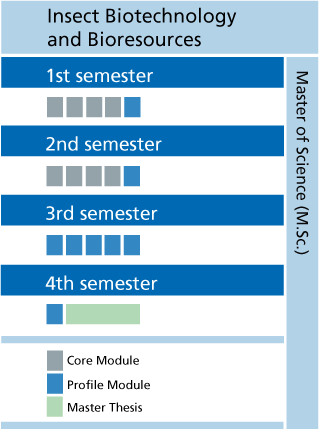
Master of Science (MSc)
Duration of studies
4 semesters – 120 credit points (cp)
Composition of degree programme
The study programme is organized in modules. Each module comprises four semester hours per week and is completed with a final examination as given in the module description. The final grade of the study programme is calculated from the achieved module grades.
The course consists of 8 mandatory modules (core modules) and 8 optional modules (profile modules) and the master thesis. The concept of choosing individually profile modules enables a diverse range of study focuses on the basis of a fundamental scientific education (core modules).
Core Modules
- Bioprocess Engineering I (6 CP)
- Biostatistics and Experimental Design (6 CP)
- Entomology I (6 CP)
- Entomology II (6 CP)
- Food Technology (6 CP)
- Integrated Pest Management (6 CP)
- Natural Product Discovery Platforms (6 CP)
- Natural Product Chemistry (6 CP)
Profile Modules
Students tailor their individual profile by selecting 8 modules from the entire profile module catalogue of the faculty. Selection of recommended English modules for this study program:
- Antibiotics: present, past, and future
- Bioinformatics
- Bioprocess Engineering II – Advanced
- Insect Biotechnology
- Insects for food and feed production systems
- Instrumental, biochemical and trace analytical methods in food analysis
- Laboratory Course I
- Laboratory Course II
- Method development in food analysis and food biotechnology
- Milestones of Insect Biotechnology & Bioresources
- Molecular Techniques
- Pharmaceutical Basics
- Selected Chapters of Pharmaceutical & Industrial Biotechnology
- Trends and Advances in Natural Product Research
- Quality Management
Master's Thesis (24 CP)
The major part of the 4th semester is dedicated to writing the master’s thesis. With the thesis students proof their capability to independently research a given topic scientifically within a limited period.