
Ehemalige AG Integrative Sinnesphysiologie
- firstpage
-
Welcome!
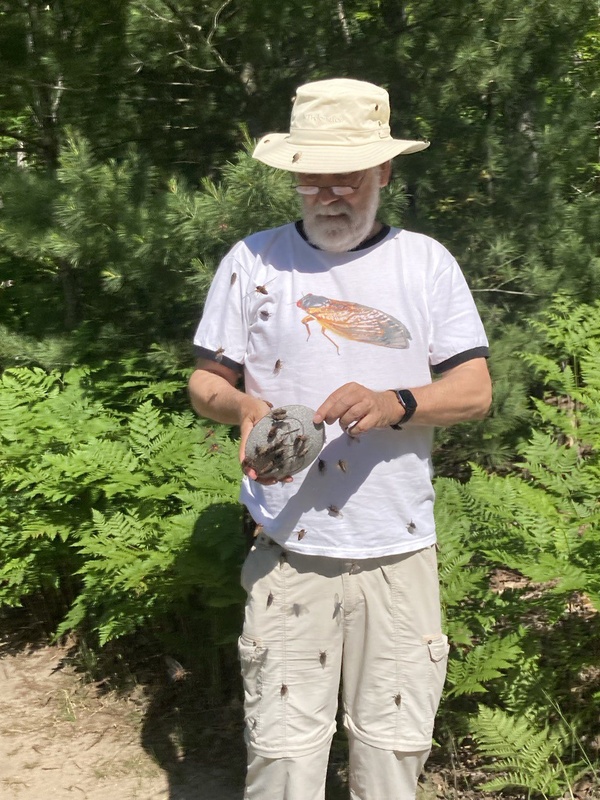
The former group "Integrative Sinnesphysiologie" headed by Professor Dr. Reinhard Lakes-Harlan studied development, function and anatomy of mechanosensory sense organs of insects, as well as bioacoustics in ecosystems.
You can still find news on outreach of the research and new data reports at this site (see below).
Prof. Dr. Reinhard Lakes-Harlan i.R.
Contact:
email: Reinhard Lakes-Harlan (at) physzool.bio.uni-giessen.de
Postal address:
Institut für Tierphysiologie
Heinrich-Buff-Ring 26 (IFZ)
35392 Giessen
Germany


- News
-
Insect of the year 2026: Decticus verrucivorus (Warzenbeisser)
The bush cricket Decticus verrucivorus has been chosen by the "Kuratorium Insekt des Jahres" as a representative insect for biotopes in danger!
The bush cricket does occur in Hessia and has served as a model species for acoustic communication. Its hearing capabilities have been studied already some years ago, as well as the ability of males to produce sounds to attract females. The species does not form large aggregations, but individuals are distributed within permissive habitats, perhaps based on acoustic signals.
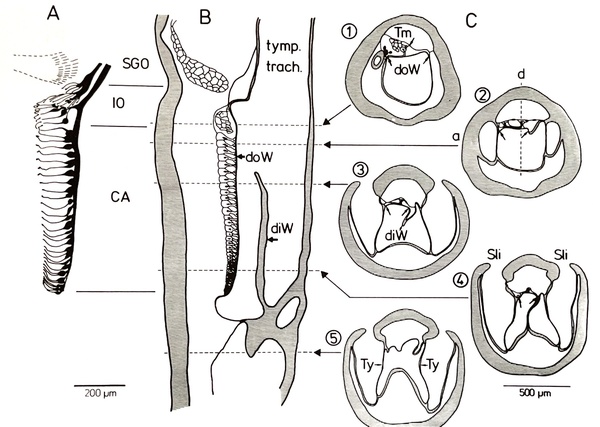
The figure shows the cellular arrangement of the auditory organ in the foreleg (A) and the histology (B, C). The hearing organ contains 33 sensory cells which are tuned to different sound frequencies, showing species specific adaptations. For details of the figure see Kalmring et al., Zool. Jb. Physiol., 1993.
Socializing bats (August 2025)
Not new, but nice: The bat Pipistrellus pipistrellus vocalizes according to the context. Echolocation calls for food searching and navigating are rather short and have a main frequency component around 40 kHz. At their shelter, the calls have different temporal structures and frequency compositions for communication between individuals. Thus, calls of bats are variable and context dependent.
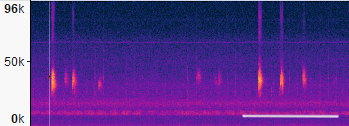
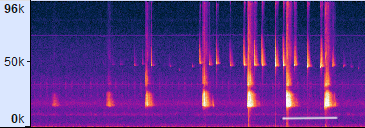
Explanation of the picture: Audiospectrograms of two different situations. Left: Echolocation calls during free flight; right: calls in social context. The white marker indicates one second.
Bat versus katydid (July 2025)
An insect, the katydid Tettigonia virridissima continues singing despite the presence of a food searching bat (Pipistrellus pipistrellus) using ultrasound for echolocation. Why is this interesting? Bats feed on insects and insects do not like to be eaten. Therefore insects typically react to ultrasound with avoidance, silence or escape behaviour. The new - anecdotal - finding of continueos singing needs further observations and experiments to explain the discrepancy.
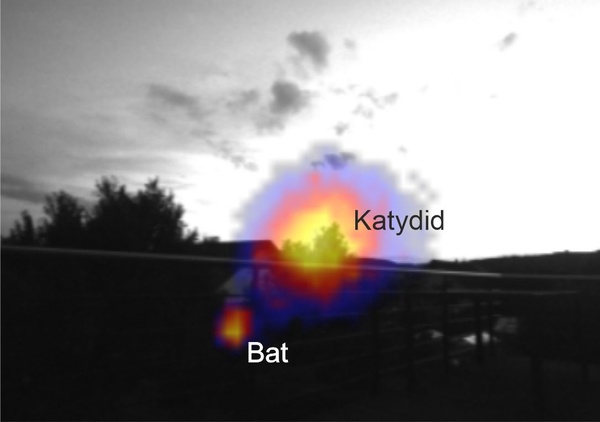
Explanation of the picture: Screenshot from a soundcam, which depicts the origin and intensity of sounds in a black-and-white video. It shows an evening scene with simultaneous sounds from both, katydid and bat. The bat was on a flight path and the katydid was sitting in the tree behind. The intensity of the sound is colour-coded.
Testing acoustic behavior in the field (July 2025)
New publication: Lakes-Harlan, R., Do, M. & Alt, J.: A mobile trackball system for studying phonotaxis of insects in the field. Bulletin of Insectology, 78, 2025, 51–57 DOI 10.3897/bull.insectology.164055
In a Masterthesis project, a mobile trackball system for generating quantitative behavioural data of insects has been tested in the field. Experiments for determination of the phonotactic threshold of two insect species of a parasitoid-host system proofed the utility and usability of this method. The threshold of the parasitoid fly Emblemasoma auditrix (Shewell, 1976) in response to the calling song of the host cicada Okanagana rimosa (Say, 1830) could be confirmed with 61 dB SPL. The behavioural threshold of female cicadas O. rimosa could be determined for the first time to 62 dB SPL. The field system allowed behavioural testing of the cicada, which was not possible in a laboratory. Furthermore, the method allows testing of intact animals and to release them immediately after the experiment in their habitat.
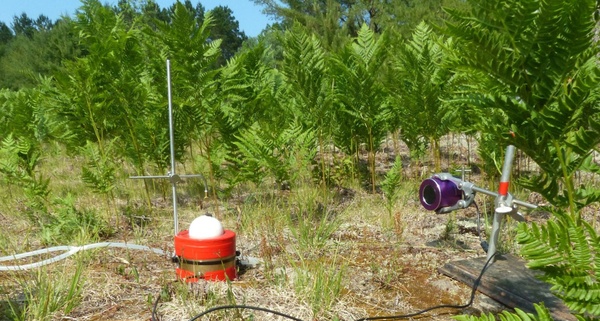
Explanation of the picture: The trackball (white styrofoam ball in the red stand) is moved by a fly on top of it. The movement is registered with a computer mouse sensor. The loudspeaker (right) plays the acoustic signal which elicits the phonotacic behaviour. For videos see: https://doi.org/10.22029/jlupub-20041
The cell surface molecule Fasciclin 2 is important in mechanosensory transduction (from long ago until July 2025)
New publication: Alt, J. & Lakes-Harlan, R.: Sensing biotremulation: recent aspects of molecular biology of chordotonal organs in insects. Trends in Entomology, 20, 1 – 7
The immunoglobulin Fasciclin 2 occurs in neuronal membranes mainly during development of insects. It has long been known to be an important guidance molecule in embryonic development of the nervous system. In addition to its multiple functions, it occurs also in so-called scolopidial units of fully differentiated insect mechanoreceptors, like the hearing organ of locust or in the antenna of Drosophila. The presence in sense organs suggests a physiological function. This could be proven in Drosophila mutants with reduced expression of Fasciclin 2, which show a reduced neuronal response to mechanosensory stimuli.
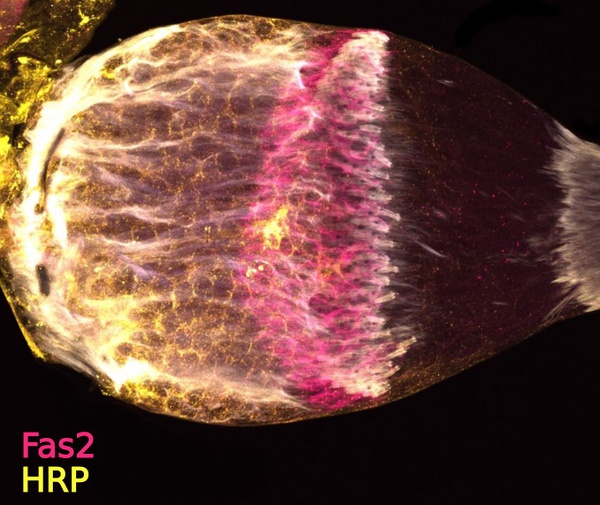
Explanation of the picture: immunocytological staining of the femoral chordotonal organ of the locust Schistocerca gregaria with two antibodies. Anti-HRP marks the sensory neurons (yellow-brownish), anti-Fasciclin 2 marks the sensory dendrite (red).
Insects feel substrate vibrations with their abdomen (June 2025)
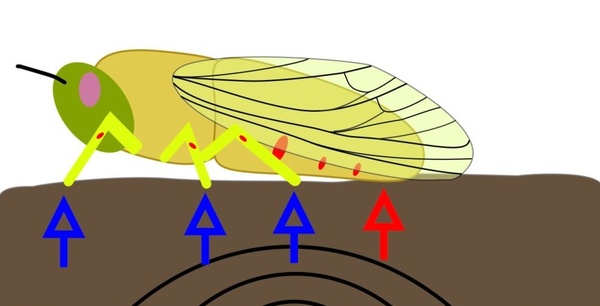
New publication: Alt, J. & Lakes-Harlan, R.: Abdominal sensing of substrate vibrations in insect. Zoology 171 (2025) 126282
In grasshoppers, as well as in cicadas, abdominal nerves, including the tympanal nerve, react sensitive to substrate vibrations in addition to the leg nerves. The results show that chordotonal sense organs in the abdomen can significantly contribute to vibration perception in resting insects.
Videos on the fantastic world of cicadas (USA, May 2025, with interview):
Episode 1: https://www.13abc.com/2025/05/20/moment-science-cicadas/
Episode 2: https://www.13abc.com/video/2025/05/28/moment-science-curious-case-cicada-fly-fungus/
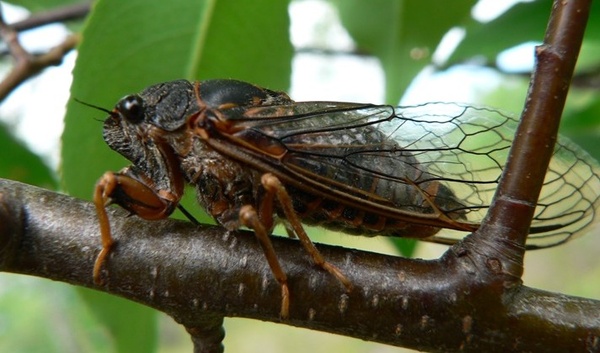
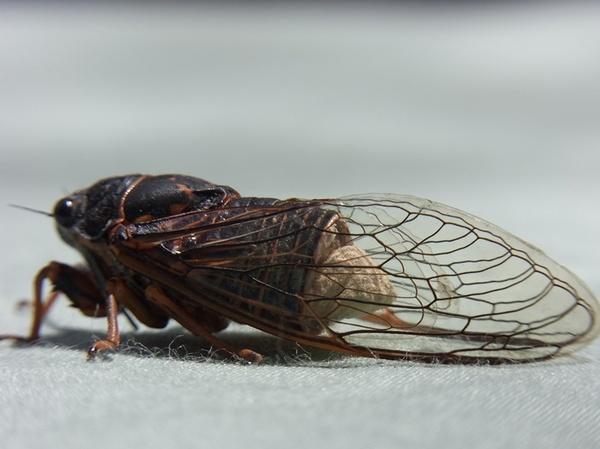
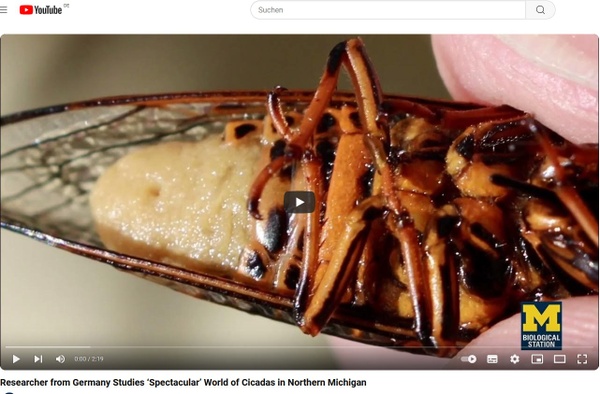
Video: Interview on research at the Biological Field Station of the University of Michigan, USA (June 2024):
https://www.youtube.com/watch?v=Kkn3iLYp-PM
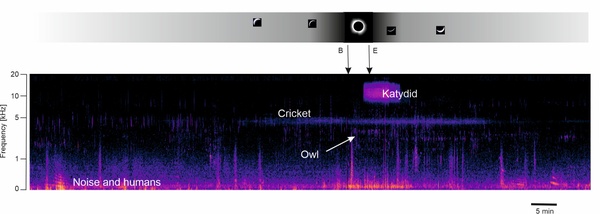
Influence of a solar eclipse on acoustic communication (Arkansas, USA 8.4.2024):
A solar eclipse darkens the sky during daylight and triggers acoustic activity of animals normally active during dusk and night. The audiospectrogram below shows acoustic activity before, during and after the totality with blueish-redish colors. Shortly before the totality (beginning marked "B" and end marked "E") a duskactive cricket started to sing. During the totality a katydid started its acoustic communication signal. Furthermore a call of an owl was registered, as well as calls and music of people (Noise and humans) enjoying the solar eclipse. Shortly after totality, the animals returned to normal daylight behaviour.
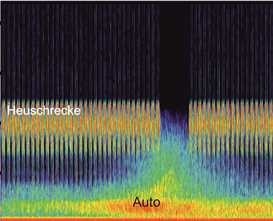
Traffic noise disturbs acoustic communication of bushcrickets (Gießen, 2023):
In the audiospectrogram below the acoustic activity of a bushcricket ("Heuschrecke", in the middle) is interrupted by a passing car ("Auto", bottom of the spectrogram).
Pain perception in insects (2023, with interview):
An audioreport by Tanja Munsch from the Bavarian broadcast "BR24 #Faktenfuchs"
https://www.br.de/nachrichten/wissen/faktenfuchs-koennen-insekten-schmerz-empfinden,Tllw7jW
------------------------------------------------------------------------------------------------------------------------------------


- Publications
- Research findings in some selected publications of the group