
Lecturers 2023
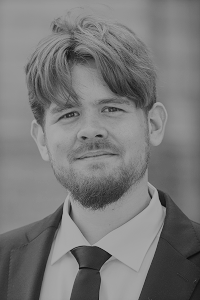
Dr. Barry de Vries is a Research Associate at the Chair of Public Law and International Law at the Justus Liebig University Giessen and Associate Fellow at PRIF's research department International Institutions. He is specialized in International Law, especially International Criminal Law, International Humanitarian Law, Arms Control Law and Human Rights Law.
Prof. Dr. Claudia Maria Hofmann holds the Chair of Public Law and European Social Law with a Focus on Interdisciplinary Social Law Research at the European University Viadrina in Frankfurt (Oder). During her course of studies in law at the Ludwig Maximilian University of Munich and her mandatory legal apprenticeship, she worked, inter alia , at the Max Planck Institute for Social Law and Social Policy in Munich and for the German Agency for International Cooperation (GIZ) in Pretoria (South Africa). She holds two German law degrees (first and second legal state exam) and a doctorate in law (University of Kassel). With completing her habilitation (post-doctoral degree) at the University of Regensburg, Hofmann received the venia legendi for public law, international and European law, social law, sociology of law and comparative law. Before joining the European University Viadrina in 2020, she worked as an interim professor for public law with a focus on social law at the Goethe University Frankfurt am Main. Since 2018, Hofmann has been advising the German Trade Union Federation as a delegate in the Conference Committee on the Application of Standards at the International Labour Conferences of the International Labour Organization. Her research interests focus on questions at the interface between the “law in the books” and the legal reality. In this context, she has, for example, published work on the national influence of international social standards in South Africa, legal responses to social inequality in international, European and German law or questions concerning the guarantee of socio-economic rights for asylum seekers and refugees in Germany.

Farnaz Dezfouli Asl is a Researcher with the CBWNet Project at PRIF's Research Department International Security and a Doctoral Candidate in Public International Law at Justus Liebig University Gießen. She holds an LL.M in International Humanitarian Law and Human Rights from the Geneva Graduate Institute. Her work explores the interplay between International Humanitarian Law and International Human Rights Law, focusing on fact-finding and accountability. She has worked with the International Humanitarian Fact Finding Commission, OHCHR, and UNHCR at the intersection of international law, policy, and practice.
Kristoffer Burck studied International Relations and Public Law at the University of Erfurt and the Kyung Hee University in Korea (Bachelor of Arts) and the interdisciplinary course Law and Politics of International Security at the Vrije Universiteit Amsterdam (LLM). During his study he worked as a student assistant at the chair for Public Law, International Law and European Integration at the University of Erfurt and was a Research Associate in the Area of International und Transnational Criminal Law at the Public International Law and Policy Group. He finished various internenship, such as in the Ministry of Foreign Affairs, the T.M.C Asser Instituut und the PAX for Peace.
Since May 2022 he works as a Research Assistant in the Project CBWNet and does research under the lead of Professor Dr. Thilo Marauhn the national, regional, and international Normative regime for the prevention of chemical and biological weapons.

| Dr. León Castellanos-Jankiewicz is Researcher in International Law at the Asser Institute for International and European Law and Academic Coordinator of the Netherlands Network for Human Rights Research. His work focuses on international human rights law, the history of international law and minority protection. Prior to taking his position at the Asser Institute, León was Max Weber Postdoctoral Fellow at the European University Institute, Florence. He holds a PhD in International Law from the Geneva Graduate Institute of International and Development Studies and an LLB from the Universidad Anáhuac-Mayab, Mexico. León is the author of several articles and book chapters addressing various aspects of international human rights law, and he has delivered expert legal opinions at various international organizations and governmental institutions. He sits on the Advisory Committee of Global Action on Gun Violence, and is an Associate Member of the Consejo Mexicano de Asuntos Internacionales. |
|
Louise Crowley is a Professor in Family law in the School of Law, University College Cork, Ireland where she is the Director of the LLM (Children’s Rights and Family Law). She is the author of the leading Irish text Family Law (Roundhall Thomson) and her research focusses on the regulation of families and relationship breakdown in modern Ireland, and the nature of inter parte financial obligations post-divorce. Professor Crowley is recognised as a national voice on intimate partner violence having published widely on the challenges of gender-based violence and the shortcomings of national and international domestic violence and intimate partner abuse laws.
|
Prof. Dr. Michael Bothe is Professor emeritus of Public Law at the J.W. Goethe University Frankfurt/Main. He held a Chair in Public International Law at the Universities of Hannover and Frankfurt (where he also was Dean), served as a visiting professor in many universities around the world, and was inter alia coordinator of the Tacis Project for creating an Institute of European Law at the Moscow State Institute of International Relations (MGIMO). He was a research fellow at the Max Planck Institute of Comparative Public Law and International Law in Heidelberg, later served as chair of the Institute’s Scientific Advisory Board and is currently a member of the Kuratorium. He was president of the German Society for International Law and of the European Environmental Law Association as well as President of the International Humanitarian Fact-finding Commission and Chairperson of the German Committee for International Humanitarian Law. He served as a delegate or adviser in a number of international conferences (including the Diplomatic Conference for the Reaffirmation and Development of International Humanitarian Law 1974-1977) and as a counsel before the International Court of Justice and the German Federal Constitutional Court. Distinctions: Prix Giuseppe Ciardi of the International Society for Military Law and the Law of War, Elisabeth Haub Prize for International Environmental Law, Prize of the International Institute of Humanitarian Law (San Remo), Henry Dunant Medal of the International Movement of the Red Cross and Red Crescent. He is the author of many books and articles on questions of international law (in particular as it relates to legal restraints on the use of military force and to the protection of the environment), comparative public law, European law and constitutional law.
Nadya E. Japaz is a lawyer from Mendoza, Argentina, specialized in Human Rights and International Law, with experience in International and Public Policy. Since last Year she is research associate at the Chair of Public Law and Human Rights, Prof. Dr. Michaela Hailbronner, Justus Liebig University Giessen. Her professional path began in 2014, as a member of her University’s International Public Law Moot Court Team for the Charles Rousseau Competition (twice: France and Canada). In Mendoza she has worked for two years in the Senate House as an advisor on Public Policies. In July 2020 she was granted the Universidad Nacional de Cuyo Research Scholarship to investigate Good Governance Principles Delimitation.
Dr. Omar Fassatoui is an UN Human Rights Officer with experience in the field in Tunisia and Mauritania. He is experienced in working on non-discrimination, engaging with the government, parliament and national human rights mechanisms (NMRF, NPM, NHRI), supporting UN treaty bodies work and special procedures visits. He is also a certified trainer in human rights with long experience in capacity building of civil society and human rights defenders.
Before OHCHR, Dr. Omar Fassatoui worked as a lawyer and as a lecturer/Post doc researcher with field research in the MENA region and published articles.
Dr. Rebecca Smyth is a lecturer in Law at Birmingham City University. She completed her LLM and PhD in International Human Rights Law at the University of Edinburgh. Dr Smyth specialises in intersectional feminist approaches to international human rights law, particularly abortion access and sexual and reproductive health and rights (SRHRs). Her research is informed by an interest in the (sometimes productive) tensions arising from historically oppressed groups engaging with the language and mechanisms of human rights.
| Prof. Rhona Smith is professor of international human rights at Newcastle Law School. She has previously worked in various universities in the UK and held visiting positions at a number of institutions overseas. Her principal areas of interest are international human rights, human rights/civil liberties and public law. Her publications range across human rights including UN monitoring systems, human rights education and the rights of vulnerable groups. She was the United Nations special rapporteur for Cambodia from 2015-2021. |
Dr. Robert Heinsch is an Associate Professor of Public International Law at the Grotius Centre for International Legal Studies of Leiden University, and is the Director of its Kalshoven-Gieskes Forum on International Humanitarian Law at Leiden University and the founder of the Leiden IHL clinic. From 1 April 2018 to 28 February 2019 he held the DAAD Guest Chair for International Humanitarian Law, International Criminal Law and Applied Legal Theory at the Institute of Peace and Armed Conflict (IFHV) of Bochum University in Germany. During his time at the IFHV he successfully created the Bochum IHL Clinic. He has published numerous articles in the field of international criminal law and international humanitarian law, including a monograph on the jurisprudence of the Yugoslavia and Rwanda War Crimes Tribunals and its impact on the development of IHL. Previously, he has worked as a Legal Advisor in the IHL Department of the Red Cross Headquarters in Berlin, and as a Legal Officer in the Trial Chamber of the International Criminal Court in The Hague.
|
Sannimari Veini studied law at the University of Turku, Finland, and graduated with an LL.M. degree in 2021. During her studies, Sannimari specialized in public international law and wrote her Master’s thesis with the title “Redrawing the Red Line: Researching Possibilities of International Law to Secure Accountability for the Use of Chemical Weapons in Syria Through Individual Criminal Responsibility”. Later, Sannimari worked as a research assistant at the Chair of Public Law and International Law at the University of Giessen and was an Associated Researcher at the Peace Research Institute Frankfurt and the CBWNet project. Sannimari is currently also an Emerging Expert of the Forum on the Arms Trade and is based in Finland. Sannimari’s main research interests include issues of arms control and disarmament, and the interaction of these fields with other fields of international law, mainly international criminal and humanitarian law, and politics. She is especially focused on chemical weapons and questions surrounding different avenues of accountability for their use, and she has taught various subjects, including international criminal and humanitarian law. |


| Dr. Sorcha MacLeod is an Associate Professor and Marie Skłodowska Curie Individual Fellow at the Centre for Private Governance (CEPRI) in the Faculty of Law at the University of Copenhagen. She is an international human rights law expert specialising in researching and teaching business, human rights and security, in particular the human rights impacts and regulation of Private Military and Security Companies. She holds a PhD from the University of Glasgow, UK, and an LLM in International Natural Resources Law and LLB (Hons) in Scots Law from the University of Dundee, UK. Prior to moving to Copenhagen she taught at Free University Berlin and at the University of Sheffield, UK. In July 2018 she was appointed for six years as an independent human rights expert to the UN Working Group on the use of Mercenaries under the Human Rights Council's Special Procedures. She is an invited expert to the UN Open-ended Inter-governmental Working Group on PMSCs and participated in the drafting of the Montreux Document on PMSCs and the International Code of Conduct for Private Security Providers. She has Observer Status at the International Code of Conduct Association. She advises governments, industry and civil society organisations on business, human rights and security issues. |
Dr. Stavros Evdokimos Pantazopoulos is a Researcher in International Law with the Asser Institute. Stavros is also a post-doctoral researcher with the Toxic Crimes Project of the Erik Castrén Institute at the University of Helsinki, and a Fellow of the Athens Public International Law Center. He is a founding member of the Environmental Peacebuilding Association and the Chair of its Law Interest Group. Stavros is a member of the World Commission on Environmental Law and the Managing Editor of the Yearbook of International Humanitarian Law . Prior to joining the Asser Institute, Stavros was the Legal and Policy Analyst of the Conflict and Environment Observatory, a UK-based NGO aiming to raise awareness of the environmental impacts of armed conflict. His research focuses on the legal aspects of environmental protection during and after armed conflict.
Stavros obtained his PhD degree in international law from the European University Institute for his thesis ‘Protecting the Environment Against the Impacts of Armed Conflict’. He holds three LLM degrees in international law (University of Athens, LSE, EUI) and visited the University of Michigan Law School as Michigan Grotius Research Scholar (2016). Stavros has been a visiting researcher at iCourts (2019) and a Teaching Fellow at the Euro-American programme of SciencesPo, Reims campus (2017-2018). In 2015, he was an assistant to the then ILC Special Rapporteur on the topic ‘Protection of the Environment in Relation to Armed Conflicts’, Ambassador Marie Jacobsson, and during this year’s ILC session Stavros assisted the current ILC Special Rapporteur on the same topic, Ambassador Marja Lehto.
Stavros has taught public international law, international humanitarian law, international environmental law, international human rights law, and law of the use of force. He has published in the fields of international environmental law, international humanitarian law, international cultural heritage law, and autonomous weapons systems.

Thilo Marauhn is a German expert on international law. He holds the Chair for Public Law and International Law at the Justus Liebig University Giessen and heads the research group on international law at the Leibniz Institute Hessische Stiftung Friedens- und Konfliktforschung / Peace Research Institute Frankfurt (PRIF). Educated at the Universities of Mannheim, Wales (Aberystwyth, U.K.), Bonn and Heidelberg, Professor Marauhn holds a law degree (state exam, equivalent to J.D., Heidelberg), a Postgraduate Diploma in International Law and Relations (Wales), an M.Phil. in International Relations (Wales), and a Dr. iur. utr. (Heidelberg). He earned his venia legendi in public law, international and European law from the University of Frankfurt/Main. Marauhn has been a visiting professor at various universities, including the University of Lapland (Rovaniemi, Finland), the University of Bergen (Norway), the University of Warwick (UK) and the University of Wisconsin – Madison Law School (US). Since 2001, he has held a permanent visiting professorship in Constitutional Theory at the Law Faculty of the University of Lucerne (Switzerland). Since 1995, Marauhn has been a member of Germany’s National IHL (International Humanitarian Law) Committee and its chairman since 2014. From 2008 onwards, Marauhn has been a member of the Advisory Board of the German Foreign Office on the United Nations. In 2011, he was elected as a member of the International Humanitarian Fact-Finding Commission (IHFFC) for the term from 2012 to 2016. Marauhn was re-elected in 2016. In 2015, he was elected First Vice-President and later President (2017) of the Fact-Finding Commission. Since 2005, he has been the academic director of the “International Summer University” of the Justus Liebig University in Giessen. From 2009 onwards, Marauhn has been the co-director of the “US-German Summer School in International and Comparative Law”, currently together with professors Anuj Desai (University of Wisconsin) and Edward Fallone (Marquette University). From 2009 to 2013 and from 2017 until 2019, Marauhn served as an elected member of the Senate of the Justus Liebig University in Giessen. In 2016, he was a visiting scholar in the research group “The International Rule of Law – Rise or Decline?” in Berlin. In 2018, Marauhn was a visiting scholar at the Lauterpacht Centre for International Law and at Sidney Sussex College, University of Cambridge (UK).
|
Victoria Scheyer is a research associate at Peace Research Institute Frankfurt, where she researches about feminist foreign policy, the Women, Peace and Security Agenda and resistances to gender-sensitive human rights in peacebuilding. At the Gender, Peace and Security Center at Monash University she is pursuing her doctoral thesis about the dynamics of gender at radical right movements transnationally in Europe. Victoria Scheyer is co-president of the German section of the Women’s International League for Peace and Freedom, where she is advocating for the implementation of the Women, Peace and Security Agenda, including international disarmament and gender equality. |