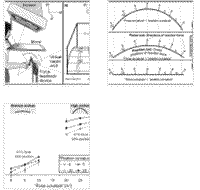
When combining a saccade towards a visual target and a concurrent hand movement, the saccade is faster than when it is executed in isolation (Snyder et al, 2002 Journal of Neurophysiology 87 2279-2286). This coordination advantage may result from specifying the same movement goal for hand and eye, or it may be due to the shared trajectories of hand and eye. Participants (N= 16) in our experiment made a saccade in isolation, or a saccade accompanied by a pointing movement. Saccades and pointing movements aimed at the same or different goals, and followed similar or different trajectories (ie in the same or opposite direction). Start and target points for the movements were visually specified, the'go'signal was auditory. Simultaneous pointing movements increased saccadic peak velocity only when eye and hand followed similar trajectories--independently of whether eye and hand shared the movement Drewing, K., & Spering, M. (2006). Saccades are faster when accompanied by a hand movement--effect of shared goals, shared trajectories, or both?. Perception ECVP abstract, 35, 0-0.
This article systematically explores cue integration within active touch. Our research builds upon a recently made distinction between position and force cues for haptic shape perception [Robles-de-la-Torre, G., Hayward, V., 2001. Force can overcome object geometry in the perception of shape through active touch, Nature 412, 445–448]: when sliding a finger across a bumpy surface, the finger follows the surface geometry (position cue). At the same time, the finger is exposed to forces related to the slope of the surface (force cue). Experiment 1 independently varied force and position cues to the curvature of 3D arches. Perceived curvature could be well described as a weighted average of the two cues. Experiment 2 found more weight of the position cue for more convex high arches and higher weight of the force cue for less convex shallow arches—probably mediated through a change in relative cue reliability. Drewing, K., & Ernst, M. O. (2006). Integration of force and position cues for shape perception through active touch. Brain research, 1078(1), 92-100.
The present study investigates the contribution of general processing resources as well as other more specific factors to the life-span development of sensorimotor synchronization and its component processes. Within a synchronization tapping paradigm, a group of 286 participants, 6 to 88 years of age, were asked to synchronize finger taps with sequences of auditory signals. The auditory signals were given either isochronously with short or long interstimulus intervals in a regular condition or in a more demanding condition with alternating short and long intervals. The results provided the first direct life-span evidence showing that performance in these tasks improves substantially during childhood until about late teens, and thereon remains at least relatively stable until old age. This pattern of life-span age gradient holds for measures of different component processes of sensorimotor synchronization, such as basic timekeeping and error correction processes. The findings are not in line with simple general factor accounts of development. They rather suggest a more complex interaction between general resources and other specific factors in the life-span development of different components of sensorimotor synchronization. Drewing, K., Aschersleben, G., & Li, S.-C. (2006). Sensorimotor synchronization across the life span. International Journal of Behavioral Development, 30(3), 280–287.