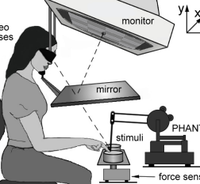
Haptic perception essentially depends on the executed exploratory movements. It has been speculated that spontaneously executed movements are optimized for the computation of associated haptic properties. We investigated to what extent people strategically execute movements that are tuned for softness discrimination of objects with deformable surfaces. In Experiment 1, we investigated how movement parameters depend on expected stimulus compliance. In a discrimination task, we measured exploratory forces for less compliant (hard) stimuli and for more compliant (soft) stimuli. In Experiment 2, we investigated whether exploratory force also depends on the expected compliance difference between the two stimuli. Kaim, L., & Drewing, K. (2011). Exploratory strategies in haptic softness discrimination are tuned to achieve high levels of task performance. IEEE Transactions on Haptics, 4(4), 242-252.
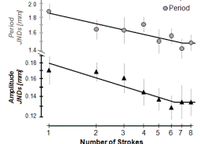
The active control of exploratory movements is an integral part of active touch. We investigated how the spatio-temporal extension of an exploration affects texture discrimination via active touch and how participants spontaneously control the extension of their exploration. Participants stroke one to 8 times across a virtual grating. Half of the participants judged the grating according to ridge amplitude, the other half judged ridge period. In both tasks just noticeable differences (JNDs) decreased with an increasing number of strokes, down to a (presumably) minimum JND for stroke numbers of about 6-7 or higher (according to a model fit). This extends previous findings on the perceptual effects of extended stimulation to the domain of active touch. Drewing, K., Lezkan, A., & Ludwig, S. (2011, June). Texture discrimination in active touch: Effects of the extension of the exploration and their exploitation. In 2011 IEEE World Haptics Conference (pp. 215-220). IEEE.