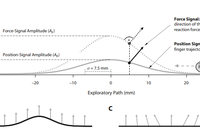
In this study of the haptic perception of small bumps, we investigated the influence of exploratory movement variation on signal integration and the percept’s reliability. When sliding across a bump on a surface, the finger follows the geometry of the bump (i.e., the position signal). At the same time, patterns of forces depending on the gradient of the bump act on the finger (i.e., the force signal; Robles-de-la-Torre & Hayward, 2001). Consistent with the maximum likelihood estimation (MLE) model, haptically perceived shape can be described by a weighted average of the shapes signaled by the position and force signals (Drewing & Ernst, 2006; Ernst & Banks, 2002). Here, we found that the weights of the position and force signals and the reliability of the shape percept depend on the pressure (and velocity) of the exploratory movement (Experiment 1). Kaim, L., & Drewing, K. (2010). Exploratory pressure influences haptic shape perception via force signals. Attention, Perception, & Psychophysics, 72(3), 823-838.
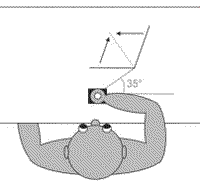
Many studies demonstrated a higher accuracy in perception and action when using more than one sense. The maximum-likelihood estimation (MLE) model offers a recent approach on how perceptual information is integrated across different sensory modalities suggesting statistically optimal integration. The purpose of the present study was to investigate how visual and proprioceptive movement information is integrated for the perception of trajectory geometry. To test this, participants sat in front of an apparatus that moved a handle along a horizontal plane. Participants had to decide whether two consecutive trajectories formed an acute or an obtuse movement path. Judgments had to be based on information from a single modality alone, i.e., vision or proprioception, or on the combined information of both modalities. Reuschel, J., Drewing, K., Henriques, D. Y., Rösler, F., & Fiehler, K. (2010). Optimal integration of visual and proprioceptive movement information for the perception of trajectory geometry. Experimental brain research, 201(4), 853-862.
If participants simultaneously feel an object and see it through an anamorphic lens, adults judge object size to be in-between seen and felt size [1]. Young children’s judgments were, however, dominated by vision [2]. We investigated whether this age difference depends on the magnitude of the intersensory discrepancy. 6-year old children and adults judged the length of objects that were presented to vision, haptics or both senses. Lenses reduced or magnified seen length. With large intersensory discrepancies, children’s visuo-haptic judgments were dominated by vision (~90% visual weight), whereas adults weighted vision just by ~40%. With smaller discrepancies, the children’s visual weight (~50%) approximated that of the adults (~35%)–and a model of multisensory integration predicted discrimination performance in both age groups. Drewing, K., & Jovanovic, B. (2010, July). Visuo-haptic length judgments in children and adults. In International Conference on Human Haptic Sensing and Touch Enabled Computer Applications (pp. 438-444). Springer, Berlin, Heidelberg.
Softness perception intrinsically relies on haptic information. Everyday-life experience teaches us some correspondence rules between perceived softness and the concurring visual effects of exploratory movements that are executed to feel softness. We investigated whether and how the brain integrates visual and haptic information while estimating the softness of deformable objects. We created 2 sets of rubber specimens, whose compliance varied in a controlled fashion: a hard set (0.12 to 0.25 mm/N) and a soft set (0.74 to 1.26 mm/N). In the experiment, participants touched these real stimuli, while they watched a simulation of their finger movements and stimulus deformation on a collocated visual 3D display. The experiment used the method of constant stimuli combined with a 2AFC task: participants always explored two stimuli and judged which one was softer. Cellini, C., Kaim, L., & Drewing, K. (2010). Visuohaptic integration in softness estimation of softness of deformable objects. Perception ECVP abstract, 39, 130-130.