
Demokratie und Governance / Democracy and Governance (M.A.)
How can democratic governance succeed in global crises? The Master's in Democracy and Governance at JLU links political science with pressing future issues.
This course of study is taught in German.

Overview
How can democratic governance succeed in the face of global crises and shifting power structures? In the Master's in Democracy and Governance, you analyse the interplay between states, NGOs and businesses as well as questions of political legitimacy. You explore how challenges like climate change, poverty or democratic erosion are tackled.

Start of studies
Winter semester and summer semester
Mode of admission
No admission restriction

Duration of studies
4 semesters
Workload
120 credit points (CP)

Degree
Master of Arts (M.A.)
Language of instruction
German
Composition of the Study Programme
What can I expect from this programme?
Democracy and democratic governance are the central guiding themes of political science. Yet how can democratic principles be realised in practice in light of increasingly borderless problems and new, often informal governance structures? This is the key question addressed in this degree programme, which is currently the only Master’s programme in Germany to focus on the interrelationships between democracy and governance.
The starting point for this focus is an ambivalent situation. At the beginning of the 21st century, an unprecedented number of states embraced the principle of democratic legitimacy. Both the ‘Arab Spring’ and the transformation processes in Eastern European countries are examples of cross-border waves of democratisation. At the same time, however, we are witnessing processes of erosion in established democracies in Europe and North America, as well as the failure of sustainable democratisation in young democracies. For this reason, the term ‘post-democratic era’ has already been coined.
New protest movements, demonstrations on the fringes of global economic summits and the not exclusively positive consequences of globalisation illustrate that new problems have emerged at the interface between (national or transnational) democracy and (national and global) cooperation among political, social and economic actors. Addressing these problems democratically requires the involvement of diverse types of actors. Only in this way can the principle of democracy, the principle of justice and the requirement for effective problem-solving be realised as central components of a modern political order.
Within and beyond the state, new forms of formal and informal cooperation have been developed in recent years with the aim of enabling a more effective approach to the increasingly borderless problems of the era of globalisation. Alongside the state, transnational NGOs and companies are often involved in these processes. International political science examines these diverse, non-hierarchical forms of governing as well as the extent and sources of their legitimacy under the governance paradigm.
Combining research on governance and democracy addresses one of the central political challenges of our time. Without social acceptance, cross-border problems such as climate change, poverty, terrorism or cybercrime cannot be tackled sustainably.
How is the programme structured?
-
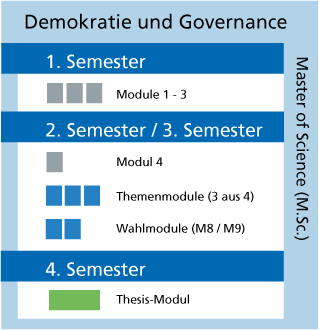 Core elements of your Master’s programme in the first semesters are foundational modules in the areas of:
- Democracy (M1),
- Democratisation Processes (M2) and
- Methods (M3).
The main part of the programme consists of the specialist political science study area in the 2nd and 3rd semesters (M4–M9). The fourth semester is scheduled for preparing the Master’s thesis and completing the associated Master’s examination.
Two elective modules offer the opportunity to attend courses in related disciplines such as history, economics and philosophy.
Recommended modules include:
- from the Master’s programme in Modern Societies and Cultures (Sociology): Modules 6, 7 and 8;
- from the Master’s programme in History: all dedicated Master’s-level courses;
- from the Master’s programme in Economic Geography, Mobility and Spatial Development Policy: Modules 1, 2, 4, 6, 7 and 8 (attendance of Modules 2, 4 and 7 is particularly recommended);
- economics modules offered by the Faculty of Economics and Business Studies may be taken in consultation with the lecturers. Depending on prior knowledge of economics, either Bachelor’s or Master’s modules may be attended. Students with limited prior knowledge are advised to attend Bachelor’s modules.
Further modules are possible upon agreement.
The modules also serve as mobility windows, particularly within the framework of the ERASMUS programme; numerous exchange agreements exist with other European universities for this purpose.
Course of study
1st semester M1: Democracy (10 CP) M2: Democratisation Processes in International Comparison (10 CP) M3: Empirical Methods of Research on Democracy and Governance (10 CP) 2nd / 3rd semester 4th semester M4: Governance and International Integration (10 CP) M10: Thesis Module (30 CP) Thematic modules (choose 3 out of 4 topics):
- M5: Government and Governance (10 CP),
- M6: Norms and Institutions (10 CP),
- M7: Policy Fields (10 CP),
- M11: Media and Governance (10 CP).
M8: Elective Module 1 (10 CP) M9: Elective Module 2 (10 CP) A description of the course structure and module contents can be found in the Special Regulations for the degree programme (appendices ‘Course of study plans’ and ‘Module descriptions’, in German).
Career Options
What career paths can I pursue after graduation?
A Master’s degree in Democracy and Governance qualifies you for a wide range of career fields:
- as an academic researcher at universities in connection with doctoral studies,
- in public opinion research,
- as a political consultant,
- as a consultant for non-governmental organisations (NGOs),
- in public administration or
- in civic and political education.
Can I pursue a doctorate after my Master’s degree?
-
After successful completion of the Master’s degree, it is possible to pursue doctoral studies, opening up further academic career opportunities.
Application and Enrolment
Requirements
The admission requirement is a relevant Bachelor’s degree. The course contents of the Bachelor’s degree programme relevant for admission must ensure that applicants have acquired appropriate subject-specific and methodological qualifications. As a rule, social science disciplines (political science, sociology, economics) or combined degree programmes with a focus on the social sciences (such as area studies) are eligible. Required knowledge may also be demonstrated within the framework of a preparatory course (propaedeutic course) during the 1
st
semester.
Applicants without a Bachelor’s major in Political Science are asked to submit the module descriptions of their degree programme in addition to their Transcript of Records when applying.
Applicants with a foreign university entrance qualification should also note the required proof of
German language proficiency
.
Application Deadline
Summer semester 2027
Opening of application period
1 December 2026
Application deadline
- for applicants with a German Bachelor's degree: 20 March 2027
-
for applicants with an international Bachelor's degree: 28 February 2027
Winter semester 2027/28
The application deadlines for the winter semester 2027/28 are currently being prepared and are expected to be published here in spring 2027.
International applicants can find further information on the International Office website.
ㅤ
Further Information
Where can I find official documents about the programme?
Examination and study regulations
Special Regulations (with module descriptions and module plans)
General Regulations for Bachelor's and Master's programmes
Please note that only the German version of the regulation is official and legally binding. The English version is for informative purposes only.
Courses offered in the course catalogue
Electronical course catalogue (eVV) (in German)
Accreditation
The degree programme has been accredited since 18 May 2010.
Where can I find more information about the faculty?
Links
Faculty 03 – Social and Cultural StudiesDean's Office
Examinations Office for the Humanities
Student Representatives
Master's Degree Programmes of Faculty 03
Angewandte Musikwissenschaft / Applied Musicology
Berufliche und Betriebliche Bildung / Vocational Education and Training
Bildungswissenschaft / Educational Science
Demokratie und Governance / Democracy and Governance
Erziehungswissenschaft mit dem Schwerpunkt Außerschulische Bildung / Educational Science: Adult and Continuing Education, Extracurricular Education
Gesellschaft und Kulturen der Moderne / Modern Societies and Cultures
Inklusive Pädagogik und Elementarbildung / Inclusive and Elementary Education
Kunstpädagogik / Art Education
How do I have a successful start at JLU?
To help you get off to a smooth start with your studies, we cordially invite you to our orientation events. Here you will learn everything you need to know about starting your studies:
- creating your timetable,
- examination regulations and registration deadlines,
- campus areas and recreational activities,
- and much more.
At the same time, you will have the opportunity to get to know your future fellow students.
Start of studies at JLUContact
Subject Advisor
Prof. Dr. Andrea Gawrich
Institute of Political Science
Philosophikum II, House E, Room 201a
35394 Giessen
Phone: +49 641 99 23136
Email:
Andrea.Gawrich
Office hours: by appointment via email
Central Study Advisor
Frank Uhlmann
Central Student Advisory Service
Erwin-Stein-Gebäude, 1st floor
Goethestrasse 58
35390 Giessen
International Office
Assistance for incoming, outgoing and Erasmus+ students
International Office
Goethestrasse 58
35390 Giessen