
Spirooxindoles
The development of novel antiviral therapeutics requires the identification of viral proteins that are both essential for replication and sufficiently distinct from host enzymes. For SARS-CoV-2[1], the main protease (Mpro or 3CLpro) plays a crucial part in the viral life cycle[2]. Multiple strategies have been explored to discover SARS-CoV-2 Mpro inhibitors, including both the repurposing of existing drugs and the de novo design of novel compounds[3]. However, as with many other approved or advanced agents today, these are mostly peptidomimetic or peptide-derived candidates[4]. They therefore carry the typical limitations of that class, including poor oral bioavailability[5], metabolic instability and complex pharmacokinetics. To overcome these disadvantages, current research increasingly focuses on the development of non-peptidic small-molecule inhibitors with improved pharmacokinetic profiles[6].
From a chemical perspective, the field has identified three design requirements for next-generation Mpro inhibitors: compact, conformationally restricted scaffolds; tuneable polarity/lipophilicity to balance cell permeability with aqueous solubility; and modular handles for late-stage derivatisation. Spirocyclic indole scaffolds are particularly well suited to these criteria. Additionally, the spiro carbon gives spirooxindoles a unique three-dimensional architecture. In light of the ongoing efforts to “escape from flatland”[7], this three-dimensionality has made the spirooxindole framework a valuable chemotype in antiviral drug discovery.
The Padua Pharmacochemistry Group Sosic identified a promising, chiral, non-peptidic Mpro inhibitor through docking and preliminary assays. The binding mode is consistent with multipocket engagement[8].
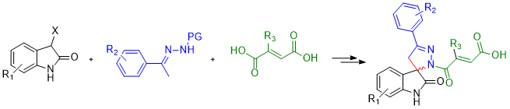
Figure 1. Modular synthetic strategy for generating spirooxindole derivatives from three variable building blocks to explore electronic, steric and ADMET-related effects.
With the main goal of creating a small compound library in mind, the first step of the project will focus on further optimising the synthetic pathways with respect to functional group tolerance, enabling the introduction of diverse substitution patterns, as well as on the development of a fully enantioselective route. This can be achieved by either integrating a chiral catalytic system[9] or by using a suitable auxiliary[10].
The resulting compound library will subsequently be evaluated for biological activity against SARS-CoV-2 in collaboration with our cooperation partners at the University of Padua.
References
| [1] | E. Manirambona, O. J. Okesanya, N. O. Olaleke, T. A. Oso, D. E. Lucero-Prisno, Discov Public Health 2024, 21. |
| [2] | B. Xia, X. Kang, Protein & Cell 2011, 2, 282. |
| [3] | Y. Yang, Y.-D. Luo, C.-B. Zhang, Y. Xiang, X.-Y. Bai, D. Zhang, Z.-Y. Fu, R.-B. Hao, X.-L. Liu, ACS Omega 2024, 9, 34196. |
| [4] | N. Qvit, S. J. S. Rubin, T. J. Urban, D. Mochly-Rosen, E. R. Gross, Drug Discovery Today 2017, 22, 454. |
| [5] | G. M. Pauletti, S. Gangwar, T. J. Siahaan, J. Aubé, R. T. Borchardt, Advanced Drug Delivery Reviews 1997, 27, 235. |
| [6] | L. Braconi, A. Sosic, L. Crocetti, Bioorganic & Medicinal Chemistry 2025, 128, 118247. |
| [7] | F. Lovering, J. Bikker, C. Humblet, Journal of Medicinal Chemistry 2009, 52, 6752. |
| [8] | A. Stank, D. B. Kokh, J. C. Fuller, R. C. Wade, Accounts of Chemical Research 2016, 49, 809. |
| [9] | K. Hu, D. Zhang, S. Wang, L. Lin, X. Feng, Organic Chemistry Frontiers 2023, 10, 2422. |
| [10] | J. A. Ellman, T. D. Owens, T. P. Tang, Accounts of chemical research 2002, 35, 984. |
| Project-Director: | Prof. Dr. Richard Göttlich |
|---|---|
| Co-Workers: | M. Sc. Yana Dubinina |