
Global Food Systems
Bachelor of Science (B.Sc.)
Overview
-
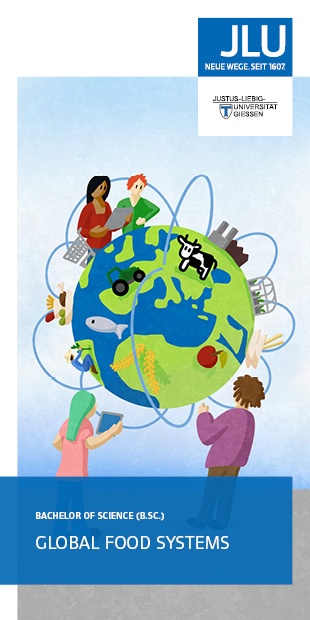
Grafik: Till Schürmann
- Englischer Studiengang
-
 This course of study is taught in English.
- Überblick
-
How can we ensure food security for a growing world population? How do climate change, global trade and political decisions shape what we eat? And how can sustainable food systems be designed at local and global levels?
The internationally oriented Bachelor’s programme in Global Food Systems examines food systems at the macro, meso and micro levels – from global supply chains and climate impacts to governance structures and local production systems. The programme combines natural, social and economic sciences at the interface of nutrition, agriculture, the environment and international development cooperation.
In the first semesters, you acquire fundamental knowledge in biology, chemistry, environmental and agricultural systems, as well as human nutrition in ecological and social contexts. Building on this foundation, you explore sustainable production systems, global food security, animal husbandry and food economics.
The programme links scientific theory with practical experience. You collect and analyse agricultural and nutritional data, apply basic statistical methods and deepen your understanding of intercultural communication. In the final phase of your studies the Bachelor’s Thesis provides the opportunity to carry out independent research and apply scientific methods to real-world challenges.
The programme combines an international orientation in English with compulsory German modules (or another language for native German speakers), fostering intercultural competence and preparing you for a global career in research and practice.
- WiSe, kein NC
-


- Open Campus Day-Button
-

Composition of the Study Programme
- Studienaufbau
-
Duration of Studies
6 semesters – 180 credit points (cp)
Composition of the Degree Programme
The study programme is a full-time programme requiring approximately 40 hours of workload per week, including preparation and follow-up. The programme is organized in modules (courses). Each module comprises four semester hours per week and is completed with a final examination as given in the module description. The final grade of the study programme is calculated from the achieved module grades.
In the first four semesters, students build up their knowledge base in a total of 20 mandatory modules (core modules). Having completed the core modules, the students are well equipped with a solid scientific education and ready to deepen their knowledge in specific research areas.
By individually choosing their 8 optional modules (profile modules) from a diverse range of study areas, students shape their individual competence profile. Two profile modules can be replaced by a work placement in order to gain initial professional experience.
In the final semester the students work on their Bachelor's thesis, demonstrating their ability to independently address a well-defined task within a given timeframe using established scientific methods.
Structure of the Bachelor’s Degree Course
The Bachelor’s degree course consists of 27 modules (180 credits):
Modules Core Competence (mandatory modules)
20 modules 120 credits Profile Competence (optional modules)
8 modules 48 credits Bachelor‘s thesis 12 credits Total 28 modules 180 credits Core Modules (Mandatory Courses,6 CP each)
(subject to approval by the responsible committees)
- Introduction to Biochemistry
- Biology
- Mathematics and Statistics
- Introduction to Global Food Systems
- Language Acquisition I*
- Language Acquisition II*
- Ecology and Biodiversity
- Agriculture and Environment
- Policy and Food Systems
- Foundation of Nutritional Physiology
- Land Use Systems
- Climate Science
- Food Production: Animals
- International Food and Nutrition Security
- Intercultural Communication
- Life Cycle Assessment
- Food Production: Plants
- Sustainability of Food
- Food Economic
- Thesis Lab: Scientific Writing and Communication
*In the two Language Acquisition modules, students expand and deepen their knowledge of the German language. In addition, further German modules can be incorporated into the programme as profile modules. Gradually improving their German language skills in this way enables students to reach CEFR level C1 by the end of their studies, thereby fulfilling the language requirements for German-language Master's programmes.
These two language modules are also mandatory for native German speakers. Instead of German, you may choose another language from the full range of languages offered at JLU. This will enable you to develop your intercultural skills and prepare for an international career.
Profile Modules (6 CP each)
Broad allround knowledge or specialisation - both are possible. Our students have it in their hands, they put together their studies according to their individual inclinations from the range of profile modules. Students can select profile modules from subject areas such as:
- International Cooperation
- Regional Analysis and Planning
- Sustainability Assessment
- Policy and Economics
- Agricultural Production
- Natural Resources
- Lanscape ecology and Ecosystem Function
- Modelling and Monitoring
Work Placement (optional) (12 CP)
The programme offers a voluntary work placement that enables our students to gain an initial insight into the various areas of professional activity in which they hope to pursue in the future. The work placement also enables them to collect hands-on professional experience and establish contacts with potential employers. The variety of contacts that our faculty possesses allows us to provide expert support to students seeking a work placement.
The work placement module replaces two profile modules (12 CP).
Application
- Start WS-engl: Commencement of studies
-
Commencement of Studies
Only possible in the winter semester.
- Application: Admission requirements
-
Entrance requirements
A valid university entrance qualification:
- From Germany: Allgemeine Hochschulreife (= Abitur or similar qualifications), Fachhochschulreife, Meisterprüfung, Hochschulzugangsberechtigung für beruflich Qualifizierte. Further Information
- From outside of Germany: You can find out whether your university entrance qualification from your home country entitles you to enrol directly in a degree programme in Germany on the Information System for Foreign Applicants (anabin).
English
As the entire degree course is taught in English, applicants must provide proof of very good knowledge of written and spoken English at level C1 of the Common European Framework of Reference for Languages (CEFR). The required level of proficiency must be certified by one of the following:
- TOEFL IBT test, IELTS test, Cambridge English Language Assessment, Pearson PTE Academic, TOEIC, telc, UNIcert, IGSCE
- proof of university entrance qualification in one of the following countries: Australia, Ireland, Canada, New Zealand, USA, United Kingdom, South Africa
- proof of completion of an English-language Bachelor's degree programme in one of the following countries: Australia, Ireland, Canada, New Zealand, USA, United Kingdom, South Africa.
German
(not applicable to applicants with a German university entrance qualification)In addition to a sound knowledge of English, a basic knowledge of German at level A2 (CEFR) is required. This requirement ensures that students have the minimum language skills necessary to cope with administrative and everyday situations in university and social life immediately after starting their studies. The required level of proficiency must be certified by one of the following:
- Goethe certificate
- telc certificate
- ÖSD certificate
- DTZ certificate (g.a.s.t.)
- Bewerbergruppen-engl
-
Application Procedure
Depending on where you obtained your university entrance certificate, we differentiate two application procedures:
Case A
You need to use JLU’s application portal if
- you obtained your university entrance certificate in Germany.
- you want to change to another degree programme at JLU. The country of origin of your university entrance certificate is of no importance.
Case B
You need to submit your application to uni-assist if
- you obtained your university entrance certificate abroad.
- Application: deadline, intake capacity, fees
-
Intake capacity ("Numerus Clausus")
The intake capacity of this degree programme is not limited internally by the university.
Deadlines
Application for enrolment period winter semester 2026/27
Application for enrolment starts
- for applicants with a German entrance qualification (e.g. Abitur or Fachhochschulreife): 1 June 2026
- for applicants with a non-German entrance qualification: 1 May 2026
Application deadline
- for applicants with a German entrance qualification (e.g. Abitur or Fachhochschulreife): 1 September 2026
- for applicants with a non-German entrance qualification: 15 June 2026
Fees
No study fees are charged for this study program. However, students have to pay a semester contribution of approx. 400 EUR for administration and the Germany semester ticket (details).
- Further information-admission international
-
For further information please contact:
Registrar’s Office / Studierendensekretariat
Goethestrasse 58
Postal address: Postfach 11 14 40, 35359 Giessen
Tel.: 0641/99-16400
international.admission@admin.uni-giessen.de / stud-sekretariat@admin.uni-giessen.de
- WiSe, kein NC
-
Career Options
- Perspektiven
-
Options for further study at JLU
After successful completion of the Bachelor's degree, the following consecutive Master's degree programmes can be studied at JLU:
- Ökotrophologie (M.Sc.) (taught in German)
- Nachhaltige Ernährungswirtschaft (M.Sc.) (taught in German)
- Sustainable Transition (M.Sc.) - (taught in English, digital)
- Transition Management (M.Sc.) - (taught in English)
Additionally, Faculty 09 at JLU offers further Master's degrees.
Career Options
Graduates of the B.Sc. Environmental Sciences have a solid background in natural sciences with a focus on quantitative analysis and environmental modelling. Their knowledge of ecology, biology, soil science, environmental chemistry and climate sciences qualifies them for positions in
- the agricultural and food industry,
- sustainability and quality management,
- project and consulting, as well as in international organizations,
- NGOs,
- and development policy contexts.
The programme’s practical and analytical orientation enables direct entry into science-related professional fields or provides an excellent basis for further Master’s studies.
Further Information
- Weitere Infos: Dokumente
-
Examination- and study regulations
- Special regulations (in German)
(Please note that only the German version of the modules is offical and legally binding.) - General study regulations for modular and multi-stage study programmes
Courses offered in the course catalogue
- Electronical course catalogue (in German)
- Special regulations (in German)
- Bachelor's Degree Programmes of Faculty 09
-
- Agricultural Sciences
- Environmental Sciences (taught in English; start in winter semester 2026/27)
- Global Food Systems (taught in English; start in winter semester 2026/27)
- Nutritional Sciences
- Nutritional Sciences and Home Economics
- Environmental Management
Contact
- Course Director
- Global Food Systems (englischsprachiger Studiengang)
-
Prof. Dr. Gudrun Keding
Department of Nutritional Science
Senckenbergstr. 3
35390 Giessen
Phone: +49 (0) 641 99 39304
Office hours: by appointment
studies@fb09.uni-giessen.de
Team for Studies and Doctorates of Faculty 09
studies@fb09.uni-giessen.de
- Central Study Advisor