
Crop Science (M.Sc.)
Taught in German
Overview
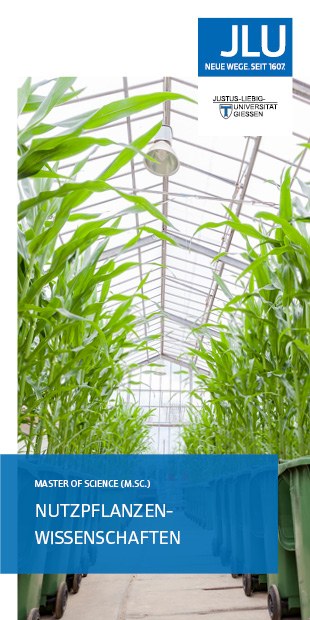
-
Image: Jochen Gerhardt
- Overview
-
How can we source plant-based raw materials and produce plant-based food in a responsible and environmentally friendly way? How can we adapt farming systems to different environmental conditions and climate change? How can we improve the quality of crops? The Master’s degree programme in Crop Science addresses these questions.
Overview
Crop Science deals with the fundamentals and interrelationships involved in the production of high-quality plant-based food and animal feed, as well as renewable raw materials, at both national and international levels. These include, amongst others, Issues relating to plant nutrition, breeding, production techniques, preventative protection against diseases, the maintenance and improvement of the quality of the products produced, and the adaptation of agriculture to constantly changing climatic conditions.
For example, you will learn about various methods of cultivating crops and their environmental implications, study the nutritional physiology of plants, explore fertilisation and plant breeding methods, and familiarise yourself with pests and the associated control strategies.
Teaching and research are carried out in the following areas:
- Crop production and plant breeding
- Plant nutrition
- Phytopathology and plant protection
- Sustainable agriculture
- Statistics and experimental design
- Agricultural bioinformatics
- Duration of studies 4 Semester 120 Credit Points (CP)
-
Duration of Studies
4 Semesters - 120 Credit Points (CP)
-
Accreditation
Accredited since September 28, 2007
Composition of the study programme
- Composition of the study programme
-
Duration of Studies
4 semesters - 120 credit points (CP)
Composition of the study programme
The degree programme consists of 8 core modules (compulsory modules) and 8 specialism modules (optional modules). Each module is worth 6 CP (4 hours per week) and concludes with an examination taken during the course. The marks achieved in the individual module examinations determine the final degree mark. In addition, the degree programme includes a Master’s thesis, which is equivalent to 4 modules. This demonstrates that you are capable of producing an academic paper independently.
The core modules (compulsory modules) are:
- Plant Breeding and Seed Production I
- Molecular Phytopathology
- Nutritional Physiology of Crop Plants
- Population Genetics
- Applied Statistics
- Current Research in Crop Science
- Biological and Chemical Plant Protection
- Sustainable Agroecosystems
Individual Profile
Developing an individual profile plays a major role in the programme. Our students decide for themselves whether they wish to acquire a broad, all-round knowledge or would prefer to specialise, and whether they would like their course to be more practice-oriented or more academic and theoretical. The profile modules can be chosen from the full range of courses offered by Department 09 or even from other departments at JLU.
By selecting specific profile modules, students can specialise in the following area, which is indicated on the certificate:
- Plant breeding
The profile modules required for the specialisation are listed in Annex 4 of the Special Regulations.
Practical relevance
As well as choosing practice-oriented modules, students have the opportunity to undertake a work placement to gain a deeper insight into professional life. The MP-196 ‘Work Placement’ module is worth 12 CP and can be chosen as a specialism module. Students gain their first taste of the working world and are given ideas for their future career prospects. The department’s work placement office maintains a database of suitable companies and organisations and helps students find a suitable work placement.
Profile modules
Broad-based knowledge or specialisation – both are possible. It’s up to our students; they can tailor their course of study to suit their individual interests, drawing on the full range of options we offer. From a selection of over 120 modules, students can choose specialism modules from topics such as the following:
- Crop production and breeding
- Plant nutrition
- Yield physiology
- Population genetics
- Renewable raw materials and bioresources
- Phytopathology
- Organic farming
- Soil science and soil conservation
- Animal breeding and husbandry
- Animal nutrition
- Communication and advisory services
- Market economics
- Agricultural, food and environmental policy
- Business administration
Modules from other research areas within the department may also be selected, e.g. Resource management, landscape planning, landscape, water and nutrient cycles, human nutrition and consumer behaviour.
You can find the exact names and descriptions of the profile modules on the Modules page.
Further Information
A description of the core- and specialisation modules can be found in the special regulations with module descriptions and module plans (in German)
Courses offered in the course catalogue
Electronical course catalogue (in German)
Application
- Commencement of Studies in the Winter and Summer Semester
-
Commencement of studies
Summer semester and winter semester
- Application: Admission requirements
-
Admission requirements
The Master's programme in Crop Sciences is a consecutive programme. This means that you need a relevant Bachelor's degree to be admitted. For better classification, so-called relevant Bachelor's degrees have been defined. Applications with other degrees are also welcome – in these cases, the examination board will assess on an individual basis during the application process whether the subject-specific requirements for admission have been met. The following are currently considered relevant:
- Agricultural Biology
- Agricultural Economics
- Agricultural Sciences
- Horticulture
- Agriculture
- Renewable Raw Materials and Bioenergy
- Renewable Raw Materials and Bioresources
- Organic Agriculture
- Environment and Global Change
- Environmental Management
English language skills are required
English language skills at level B2 are required, as the technical literature is mainly available in English. Formal proof is not required.
-
Application/enrollment
- The study program is not subject to admission restrictions.
- The enrollment period for the winter semester begins in early June and for the summer semester in early December.
- The end of the enrollment period is determined each year, please check the application portal during the enrollment period.
For international applicants, different rules apply in some cases. More...
Career Options
- Career Options
-
Doctoral studies
After successful completion of a Master's degree, doctoral studies are an option. This gives you further career opportunities.
Information about doctoral studies
-
Information provided by the faculty
Information of faculty 09 about doctoral studies
-
International
- International - Outgoings
-
Stays abroad during studies (outgoings)
JLU's Faculty 09 maintains a large number of partnerships with foreign universities within the framework of the European Union's ERASMUS programme and supports students in planning and implementing stays abroad during their studies.
Partner universities (ERASMUS) of faculty 09
- Information for outgoing students
-
-
Information and consultation
- International Office
Information and advice for studies and internships abroad (for JLU students)
Goethestr. 58, Room 22
35390 Giessen
Contact and consulation hours
- International Office
-
-
Stays abroad in Giessen for international students (incomings)
Information of faculty 09
- Information for incoming students
-
-
Information and consultation
- International Office
General counseling of international students
Goethestr. 58, Room 38
35390 Giessen
Contact and consulation hours
- International Office
-
More Information
- Further Information: Documents
-
Examination- and study regulations
- Special regulations (in German)
- General study regulations for modular and multi-stage study programmes
Courses offered in the course catalogue
- Electronical course catalogue (in German)
- Master's Degree Programmes of Faculty 09
-
taught in English
- Agrobioinformatics
- Agrobiotechnology
- Insect Biotechnology and Bioresources
- One Health (start in winter semester 2026/27)
- Sustainable Transition (digital degree programm)
- Transition Management
taught in German
- Agricultural and Resource Economics
- Beverage Technology (offered in cooperation with the Geisenheim University)
- Bioinformatics and Systems Biology
- Crop Science
- Environmental Sciences
- Food Economics
- Information Technology in Agricultural and Environmental Sciences (discontinued)
- Livestock Sciences
- Nutritional Sciences
- Nutritional Sciences and Home Economics / Ecotrophology
- Wine Economics (offered in cooperation with the Geisenheim University)
Contact
- Contact
-
-
Student Advisor
-
Prof. Dr. Matthias Frisch
Institut für Pflanzenbau und Pflanzenzüchtung II
Heinrich-Buff-Ring 26
35390 Giessen
Tel. (+49) 641 - 99 37541
Consultation hours: by appointment
matthias.frisch@agrar.uni-giessen.de
Team for Studies and Doctorates of Faculty 09
studies
-
-
Links
-
Central Study Advisory
- Central Student Services
-
- Students office →
(for formal matters like matriculation) - Central student advisory office
(advice for students & prospective students) - Hotline Call Justus
(first contact for all matters pertaining to studies) - International office →
(for international students)
- Students office →