
Agrobiotechnology (M.Sc.)
Overview
- ABT - Bildseite
-
-
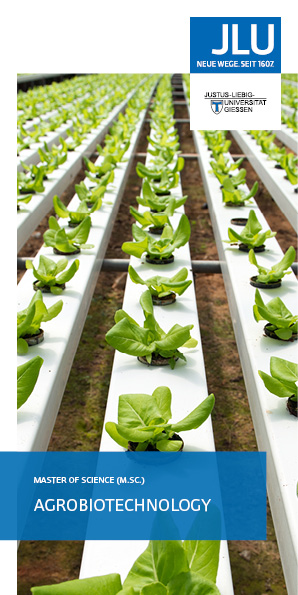
Foto: kenishirotie/123rf.com
- Englischer Studiengang
-
 This course of study is taught in English.
- Overview-rest
-
Biotechnology has produced a new and leading technology that is helping to determine the direction of global economic development and international competitiveness. Since the early 1990s, there has been rapid progress in the biotechnology sector, driven mainly by the results of genomic research and, more recently, by rapid developments in cell biology (cell factories) and technological advances. Growth in these areas is expected to continue to accelerate. It is crucial for our future that the energies resulting from the explosion of knowledge taking place in these fundamental domains are harnessed to the development of technologies that will benefit society as a whole.
Justus Liebig University Giessen (JLU) offers an international Master's degree programme in Agrobiotechnology in order to meet the growing worldwide importance of biotechnology, not least in university education, for plant and animal production as well as for nutritional sciences. Justus Liebig University was the first German university to take up the global challenge of establishing an internationally oriented course of studies that provides the highest level of academic training for entry into the biotechnology and agricultural sectors of the global economy. The overall goal of the Master’s programme in Agrobiotechnology at Giessen University is to prepare scientists in both the traditional “pure” disciplines and in the fields of agriculture and nutrition for leadership roles at the forefront of the agriculture and food sector.
One important educational goal is to provide students with practical methods and expertise based on a broad scientific foundation. In order to achieve this goal, the following factors are crucial:
- research-oriented study,
- solving problems in current farming practice,
- the acquisition of international expertise and the promotion of creativity and innovation,
- attention to the need to identify and assess the impact of technological processes.
The English Master‘s programme Agrobiotechnology is offered by the Faculty 09 Agricultural Sciences, Nutritional Sciences, and Environmental Management.
- StET-Button-Seite
-

Composition of the Study Programme
- Composition of the Study Programme
-
Degree
Master of Science (M.Sc.)
Duration of Studies
4 semesters – 120 credit points (cp)
Composition of the Degree Programme
The study programme is organized in modules (courses). Each module comprises four semester hours per week and is completed with a final examination as given in the module description. The final grade of the study programme is calculated from the achieved module grades.
The course consists of 8 mandatory modules (core modules), 6 optional modules (profile modules), an industrial internship (or 2 more profile modules) and the Master‘s thesis. Having completed the core modules, the students are well equipped with a solid scientific education and ready to deepen their knowledge in specific research areas. By individually choosing their profile modules from a diverse range of study areas, students shape their individual competence profile.
Structure of the Master's Degree Course
The Master’s degree course consists of 16 modules (120 credits):
Modules Core Competence
(mandatory modules)8 modules 48 credits Profile Competence
(optional modules)8 modules or
6 modules + industrial intership
48 credits Master’s thesis 24 credits Total 16 modules 120 credits Core Modules (Mandatory Courses)
- Applied Statistics (6 CP)
- Lab Course Biochemistry (6 CP)
- Plant Protection and Bioengineering (6 CP)
- Principles of Scientific Practice (6 CP)
- Molecular Phytopathology (6 CP)
- Biotechnology and Genomics (6 CP)
- Microbial Food Biotechnology (6 CP)
- Nutritional Physiology of Crop Plants (6 CP)
Profile Modules (6 CP each)
Students tailor their individual profile by selecting 6 modules and the internship or 8 modules from the entire profile module catalogue of the faculty. For example, you can choose profile modules from the following subject areas:
- Plant Breeding
- Phytopathology
- General and Soil Microbiology
- Insect Biotechnology in Plant Protection
- Microbiology of Recycling Processes
- Agricultural and Food Market Analysis
- Insect Biotechnology
- Natural Product Research
- Landscape, Water and Biogeochemical Cycles
- Landscape Ecology and Landscape Planning
- Agricultural, Food and Environmental Policy
- Agronomy and Crop Physiology
- Biometry and Population Genetics
- Crop Biomass and Bioresources
- Bioprocess Engineering and Pharmaceutical Technology
- Political Science
Work Placement (optional) (6 or 12 CP)
The programme offers a voluntary work placement that enables our students to gain an initial insight into the various areas of professional activity in which they hope to pursue in the future. The work placement also enables them to collect hands-on professional experience and establish contacts with potential employers. The variety of contacts that our faculty possesses allows us to provide expert support to students seeking a work placement.
The work placement module replaces one (6 CP) or two (12 CP) profile modules.
Master Thesis (24 CP)
Students dedicate the major part of the 4th semester to writing the Master’s thesis. With the thesis, students prove their capability to independently research a given topic scientifically within a limited period of time.
Application
- Start WS-engl: Commencement of studies
-
Commencement of Studies
Only possible in the winter semester.
- Application: Admission requirements
-
Admission Requirements
In general, students can apply for this Master's programme if they hold a Bachelor's degree with a duration of at least three years (180 Credits) or a comparable degree. The Bachelor's degree must be completed in a closely related scientific field. For example:
- Agrarbiologie (Agricultural Biology)
- Agrarwissenschaften (Agricultural Science)
- Biologie (Biology)
- Biotechnologie (Biotechnology)
- Nachwachsende Rohstoffe und Bioressourcen (Crop Biomass and Bioresources)
Applications with a Bachelor’s degree in another scientific field or with a Bachelor’s degree from abroad will be examined individually as to whether the study requirements are fulfilled. A specialist commission at JLU will then finally decide on the admission. Any information on the status of acceptance without having completed the application process is not possible.
- Application: Language requirements
-
Language Requirements
As the entire degree course is taught in English, applicants must provide proof of sufficient knowledge of written and spoken English at level C1 of the Common European Framework of Reference for Languages (CEFR). Accepted proofs of language proficiency:
- either: TOEFL test, IELTS test, Cambridge English Language Assessment, Pearson PTE Academic, TOEIC, telc, UNIcert, IGSCE;
- or: Proof of having obtained the local higher education entrance qualification in one of the following countries: Australia, Ireland, Canada, New Zealand, USA, United Kingdom, South Africa;
- or: Proof of having completed an English-taught Bachelor’s degree program in one of the following countries: Australia, Ireland, Canada, New Zealand, USA, United Kingdom, South Africa.
- Bewerbergruppen-engl
-
Application Procedure
Depending on where you obtained either your university entrance certificate or your Bachelor degree, we differentiate two application procedures:
Case A
You need to use JLU’s application portal if
- you hold a completed Bachelor’s degree obtained at a German university (the country of origin of your university entrance certificate is of no importance).
- your JLU Bachelor programme is not yet complete. Please provide a preliminary report. The country of origin of your university entrance certificate is of no importance.
- you obtained your university entrance certificate in Germany and attended a Bachelor programme at a German university other than JLU. Please provide a preliminary report if your programme is not yet completed.
- you want to change to another degree programme at JLU. The country of origin of your university entrance certificate is of no importance.
Case B
You need to submit your application to uni-assist if
- you hold a completed Bachelor’s degree obtained at a foreign university (the country of origin of your university entrance certificate is of no importance).
- you obtained your university entrance certificate abroad and attended but not completed yet a Bachelor programme at a German university other than JLU or at any other university within EU. Please provide a preliminary report.
- Application: deadline, intake capacity, fees
-
Intake capacity ("Numerus Clausus")
The intake capacity of this degree programme is not limited internally by the university.
Deadlines
Application for enrolment period winter semester 2027/28
The application deadlines for the winter semester 2027/28 are currently being prepared and are expected to be published here in spring 2027.
Fees
No study fees are charged for this study program. However, students have to pay a semester contribution of approx. 400 EUR for administration and the Germany semester ticket (details).
- Further information-admission international
-
For further information please contact:
Registrar’s Office / Studierendensekretariat
Goethestrasse 58
Postal address: Postfach 11 14 40, 35359 Giessen
Tel.: 0641/99-16400
international.admission@admin.uni-giessen.de / stud-sekretariat@admin.uni-giessen.de
Career Options
Contact
-
Course Director
- Agrobiotechnology (englischsprachiger Studiengang)
-
Prof. Dr. Peter Kämpfer
Department of Applied Microbiology
Research Center for Biosystems, Nutrition and Land Use (IFZ)
Heinrich-Buff-Ring 26-32
35392 Giessen
Phone: +49 (0) 641 99 37352
Office hours: by appointment
Team for Studies and Doctorates of Faculty 09
studies
Further Information
- Further Information: Dokumente
-
Examination regulations
- Examination- and study regulations (in German)
(mit Modulbeschreibungen und Studienverlaufsplänen) - Examination Committee and Regulations (Informationen in English)
- General study regulations for modular and multi-stage study programmes
Courses offered in the course catalogue
- Examination- and study regulations (in German)
- Links Faculty 09
- Master's Degree Programmes of Faculty 09
-
taught in English
- Agrobioinformatics
- Agrobiotechnology
- Insect Biotechnology and Bioresources
- One Health
- Sustainable Transition (digital degree programm)
- Transition Management
taught in German
- Agricultural and Resource Economics
- Bioinformatics and Systems Biology
- Food Economics
- Nutritional Sciences
- Beverage Technology (offered in cooperation with the Geisenheim University)
- Crop Science
- Livestock Sciences
- Nutritional Sciences and Home Economics / Ecotrophology
- Environmental Sciences
- Wine Economics (offered in cooperation with the Geisenheim University)